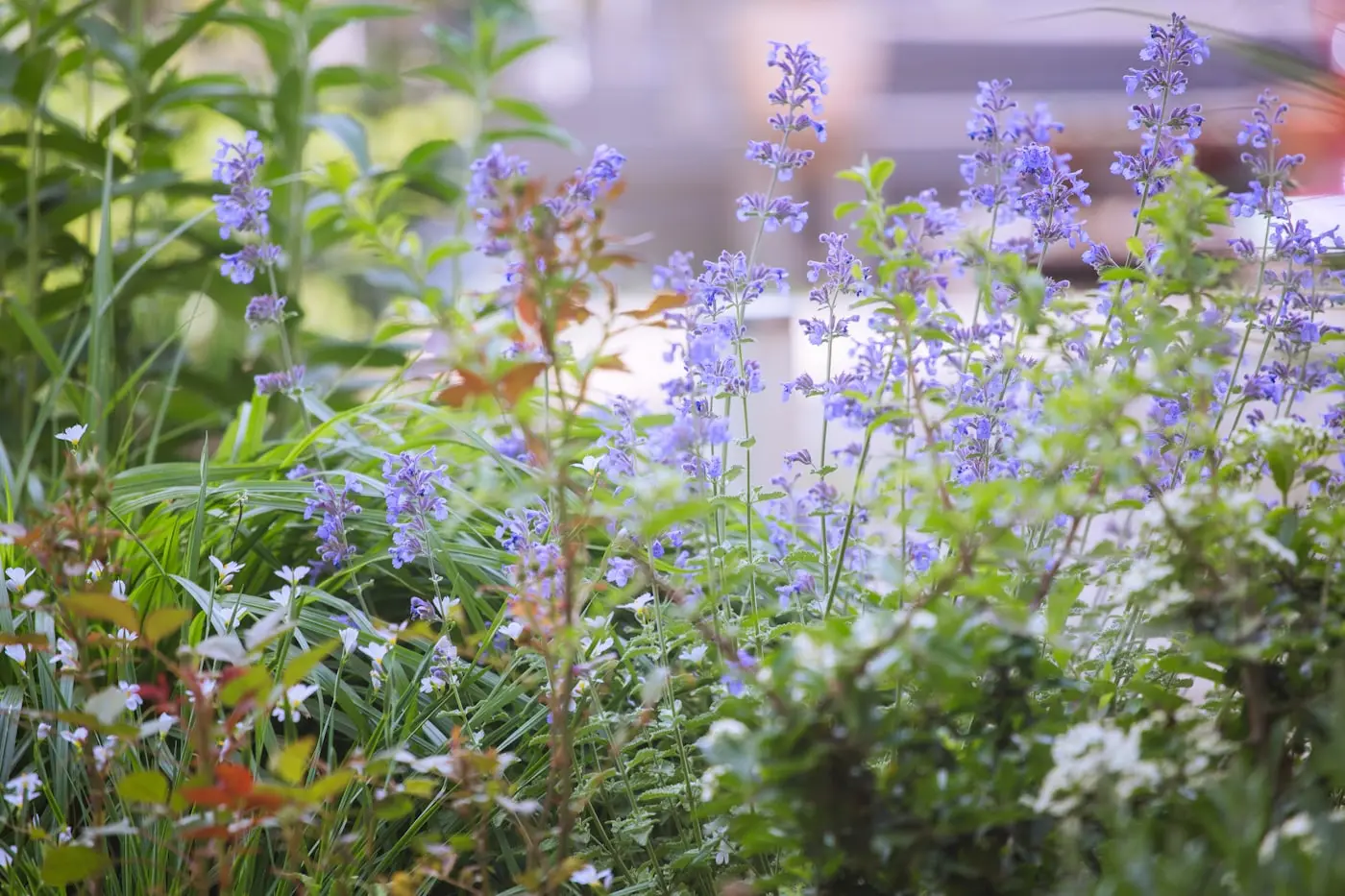
What garden design looks like in Meltham
Meltham is a Holme Valley village sitting at around 250 metres above sea level in the HD9 postcode, between Holmfirth to the east and the open moorland to the west. The village has a traditional mill-village character, with stone-built properties and gardens that reflect the underlying Millstone Grit geology. At this elevation, gardening requires different thinking from lower valley towns: the growing season is shorter, the wind exposure on upper plots is significant, and the acidic soil supports a different set of plants from what works elsewhere in Yorkshire.
The Millstone Grit bedrock produces acidic soils with pH typically between 5 and 6.5. On the upper slopes the soil is thin and the gritstone is often close to the surface. In the valley bottom and sheltered hollows, the soil becomes deeper and more peaty with a higher moisture retention. The acidity is a significant factor: lime-loving plants will not perform in open borders on Meltham's natural soil, but acid-loving species that need ericaceous conditions elsewhere do not need any soil amendment here.
A garden designer who understands the Holme Valley conditions will account for elevation, aspect, and the prevailing westerly wind before selecting any plants or designing any hard landscaping. A south-facing sheltered lower garden in Meltham has more options than a west-facing upper slope. Getting that assessment right in the brief is the difference between a design that works and one that struggles.
Elevation and short growing season
At 250m, Meltham's growing season is noticeably shorter than the lowland West Yorkshire towns. Frost is possible from October through to May in exposed positions. The last frosts in a typical year come in late April or early May on upper ground, and the first autumn frosts can arrive in September. That means the reliable frost-free window for tender plants is sometimes as short as 16 weeks.
That constraint points the design toward genuinely hardy species that establish quickly and do not need a long warm period to perform. Half-hardy plants used as summer bedding or tender perennials left in the ground through winter are high-risk at this elevation. A designer who knows Meltham will choose plants that peak within the compressed season and look reasonable through the rest of the year rather than relying on a long summer.
Wind exposure and shelter design
Properties on the western and upper edges of Meltham catch the prevailing southwesterly and westerly winds. Without shelter, the exposed positions limit what will establish and thrive. The most important design decision on an exposed Meltham plot is the windbreak: a planted hedge or structural planting on the windward boundary that reduces wind speed across the rest of the garden. Native hawthorn, blackthorn, and field maple are the most reliable choices. Holly and yew work well in more sheltered positions. Once a windbreak is established, the microclimate behind it changes significantly and a much wider range of planting becomes possible.
Acidic soil planting choices
Meltham's acidic gritstone soils are an advantage if you choose accordingly. Heathers naturalise across the upper village slopes without any assistance. Rhododendrons, azaleas, and pieris all grow without ericaceous soil amendment. Bilberries do well on thin acidic soil. Hydrangeas respond well to the combination of moisture and acidity and give excellent late-summer colour.
For a more conventional garden plant palette, the key is to avoid strongly lime-preferring species (lavender and rosemary prefer neutral to alkaline soil, and will need some lime addition to do well in open Meltham borders) and focus on the wide range of plants that are neutral to acid tolerant: roses, hardy geraniums, astilbes, hostas, ornamental grasses, and most hardy shrubs perform well on acidic gritstone.
Cost ranges for Meltham garden design
| Service | Cost range |
|---|
| Initial design consultation | £150-400 |
| Planting plan only | £300-800 |
| Full design and project management | £800-3,000+ |
| Windbreak hedge installation | £500-2,000 |
| Full garden makeover (50-100 sqm) | £5,000-15,000+ |
The windbreak hedge element is often the most important single investment on exposed Meltham plots because it unlocks everything else. Designers quote directly based on your site and brief.
Start your free Meltham garden estimate
Tell us what you want from your garden and we put your enquiry in front of a local designer who understands Holme Valley conditions and quotes directly.
Get a design estimate
The full local guide
Common design projects in Meltham
Windbreak planting and shelter design is the first priority on exposed plots. A well-designed hedge on the windward boundary is often more transformative than any amount of planting choice. Native hawthorn or holly hedging at two to three metres height changes the microclimate behind it significantly.
Acidic soil planting schemes that work with the natural soil chemistry are a common request. Rather than fighting the acidity by liming, a good Meltham design embraces the ericaceous range: rhododendrons, azaleas, heathers, pieris, and the wider range of acid-tolerant perennials. This produces a distinctive and locally appropriate planting that is lower maintenance than fighting the soil.
Compact village garden redesigns on the older housing stock often involve making the most of a restricted space. A clear layout, good structural planting, and a simple hard surface for seating creates a usable outdoor space from what can otherwise feel like an awkward leftover.
Frequently asked questions
What soil do Meltham gardens have?
Meltham sits on Millstone Grit bedrock, which produces acidic soils with a typical pH of 5 to 6.5. The soils are often thin on upper slopes, and become deeper and peaty in valley bottoms. The high elevation of around 250m means soils are slow to warm in spring. Acid-loving plants perform naturally well; lime-loving plants need raised beds with amended soil.
How much does garden design cost in Meltham?
An initial design consultation runs £150-400. A planting plan costs £300-800. Full design with project management is typically £800-3,000. A complete garden makeover on a 50-100 sqm plot runs £5,000-15,000. Designers quote directly based on your plot size, aspect, and brief.
How does Meltham's elevation affect the garden design?
At around 250m elevation, Meltham has a noticeably shorter growing season than valley-floor towns. Frost is possible into May and can return in September. Wind exposure on the upper village edges is significant. A designer will choose species that are genuinely hardy at this elevation, specify shelter hedging on the windward side, and time planting programmes to match the shorter season.
What plants work in Meltham's acidic high-elevation gardens?
Acid-loving plants perform naturally in Meltham's gritstone soil: heathers, rhododendrons, azaleas, pieris, and bilberries on upper slopes. Hydrangeas cope well with the moisture and acidity. Hardy ferns suit shaded positions. For the shorter, cooler growing season, focus on hardy geraniums, astilbes, ornamental grasses, and native shrubs including rowan, hawthorn, and hazel.
Do you cover the villages around Meltham?
Yes. We connect homeowners with designers across HD9 including Holmfirth, Honley, Netherthong, Upperthong, Scholes, and the surrounding Holme Valley. Designers quote directly and set their own prices.
Areas around Meltham we also cover
We match homeowners with designers across HD9 including Holmfirth, Honley, Netherthong, Upperthong, Scholes, and the Holme Valley. For general garden maintenance, lawn care, and year-round gardening services in Meltham, visit our local gardeners in Meltham page.