Decking installation costs vary across Yorkshire, with competitive quotes available in Leeds, York and Harrogate.
The quick answer: professionally installed decking in Yorkshire in 2026 costs £100-150 per m2 for pressure-treated softwood, £150-250 per m2 for composite, and £200-350 per m2 for hardwood. A typical 12m2 deck (3m x 4m) - a common size for a rear garden seating area - costs £1,200-1,800 in softwood, £1,800-3,000 in composite, or £2,400-4,200 in hardwood. Those figures are for a flat or gently sloped site with straightforward access. Sloped gardens, which are common across West and North Yorkshire, add to the cost through additional frame work and potentially planning permission if the deck surface exceeds 300mm above ground level.
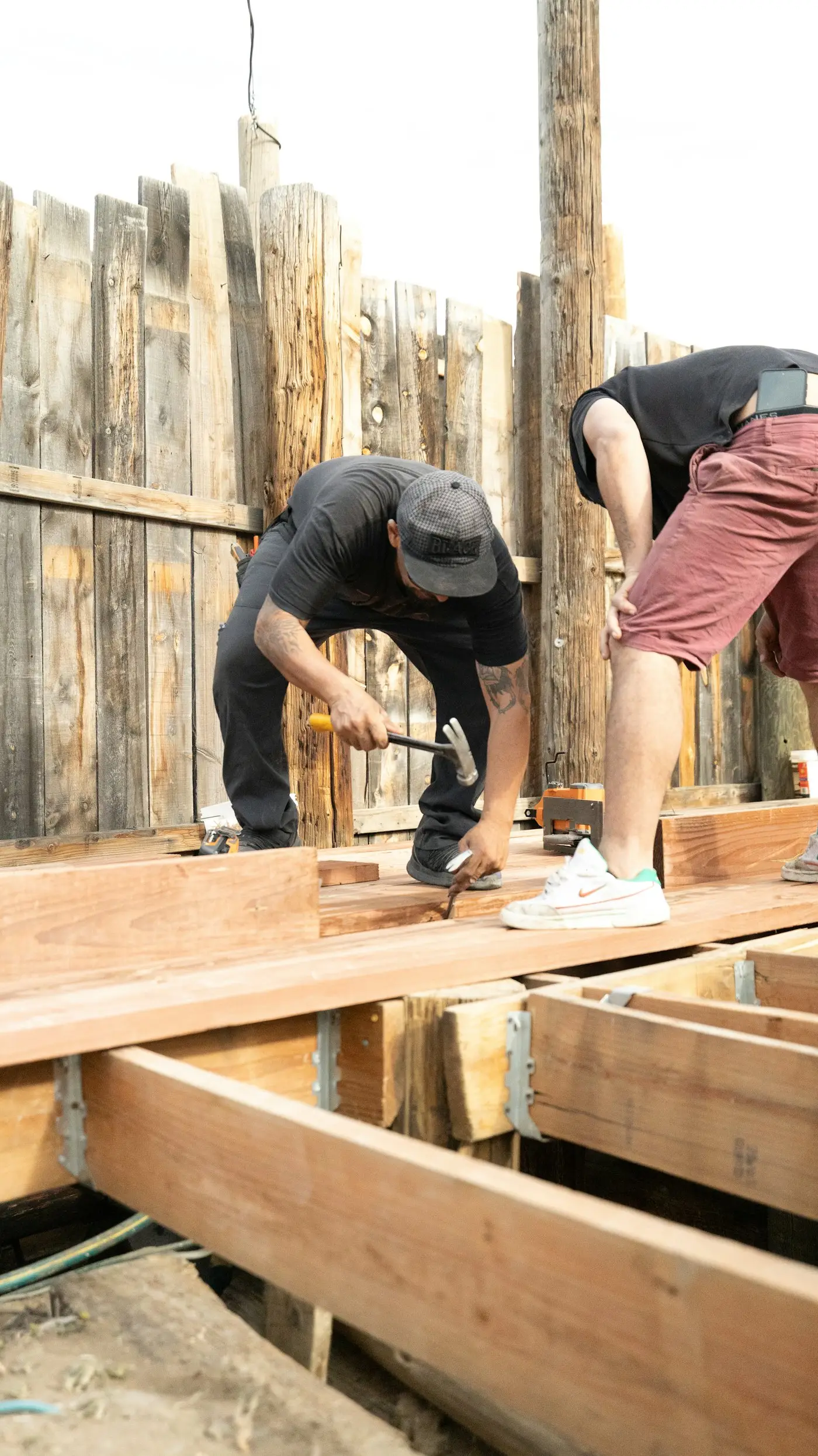
This guide gives you honest numbers for Yorkshire in 2026, covers the Yorkshire-specific considerations around drainage and slope, and explains the long-term cost comparison between materials - because the cheapest upfront option is not always the cheapest over ten years.
Decking Installation Cost Table: Yorkshire 2026
| Material | Cost per m2 (installed) | Typical 12m2 project cost |
|---|---|---|
| Pressure-treated softwood | £100-150/m2 | £1,200-1,800 |
| Composite decking | £150-250/m2 | £1,800-3,000 |
| Hardwood (Ipe, Balau, etc.) | £200-350/m2 | £2,400-4,200 |
These prices include the sub-frame (joists and posts), deck boards, fixings, and a basic neat finish. They do not automatically include steps, balustrades, raised platform work over 300mm height, or removal of an existing deck. Each of those adds to the total - see the cost drivers section below.
What Drives the Cost of a Decking Project
Size
Larger decks are cheaper per m2 than small ones. The fixed costs of setting out, delivering materials, and frame construction are spread over more area. A 20m2 deck will cost proportionally less per m2 than a 6m2 deck. The per-m2 prices above are most accurate for 10-20m2 projects. Very small decks (under 6m2) may come out at the higher end of the per-m2 range because of minimum job costs and fixed overheads.
Ground preparation
On a flat, firm garden with easy access, ground preparation for decking is straightforward: weed membrane, concrete post pads or spiked metal post holders, and the frame goes up. On sloped sites, soft ground, or gardens where the existing surface needs clearing first, preparation adds time and cost. If your garden has a significant slope - which is the case for a large proportion of properties in Bradford, Halifax, Huddersfield, Sheffield, and the dales - the frame needs to account for the level change using longer posts on the low side, which adds material and labour.
Steps
A single flight of steps from the deck down to the garden typically costs £200-400 for softwood steps, £300-600 for composite steps. Wider steps, or steps with a quarter-turn landing, cost more. If the deck height varies because of the slope (one end at ground level, the other end 500mm up), you may need steps at multiple points or a longer flight - this can add £500-800 to the total.
Balustrades and handrails
Balustrades are required by building regulations when the deck surface is more than 600mm above the adjacent ground level. They are also frequently added as a design choice on raised decks at lower heights. Softwood balustrade panelling runs at £80-120 per linear metre. Composite or aluminium balustrade systems are £100-150 per linear metre. Glass panel balustrades cost £150-250 per linear metre. A deck with 6m of balustrade on one side adds £480-900 to the base deck cost.
Subframe specification
The subframe - the joists and posts the boards sit on - is not visible in the finished deck but determines its structural life. On a ground-level softwood deck, 47x100mm joists at 400mm centres on post supports is standard. On a raised deck with significant height, larger section timbers (100x100mm posts, 75x150mm beams) are needed. The subframe cost scales with height and load requirements. A deck at 600mm height uses nearly twice the timber of one at 100mm height.
The Yorkshire slope problem: when does your deck need planning permission?
Decking is permitted development (no planning permission needed) provided the deck surface does not exceed 300mm above natural ground level at any point. On sloped Yorkshire gardens this is frequently breached - a deck built level across a garden falling 400mm from one end to the other will exceed 300mm height at the low end. Before building on a sloped site in Bradford, Harrogate, Holmfirth, or any hilly area, establish the maximum height at the lowest point. If it will exceed 300mm, you need planning permission. Yorkshire councils have had permitted development rights withdrawn on some conservation area properties, so check even for apparently low-level decks.
Material Comparison: Softwood vs Composite vs Hardwood
Pressure-treated softwood: the accessible option
Pressure-treated pine or spruce decking remains the most commonly installed option in Yorkshire gardens. It is widely available, easy to cut and work with, and the cheapest upfront. Modern pressure treatment (UC4 specification for ground-contact use) significantly extends the life of softwood decking compared to untreated timber.
The Yorkshire-specific challenge for softwood is the climate. Yorkshire averages 660-900mm of rainfall annually depending on location (wetter in the Pennines and dales, drier in the Vale of York), and a significant proportion of Yorkshire gardens are north-facing or shaded by buildings and trees. In shaded, north-facing positions, softwood decking goes green with algae faster, stays wet longer after rain, and deteriorates more quickly. Annual cleaning and treatment (decking oil or preservative stain) is essential - allow £50-100 per year in treatment products plus the time to apply it. Without treatment, softwood in a damp Yorkshire position may need board replacement by year 8-10.
In a sunny, south-facing position with good air circulation, well-maintained pressure-treated softwood decking in Yorkshire can last 15-20 years before major work is needed.
Composite decking: the low-maintenance choice
Composite decking - boards made from a mixture of recycled wood fibre and polymer - costs roughly 50-80% more than softwood per m2 installed, but the maintenance comparison changes the picture significantly over a 15-20 year lifespan.
Composite does not rot, does not need annual oiling or staining, and does not go green in the same way as timber - the polymer surface does not provide the nutrient substrate for algae that wood does. An annual wash with warm soapy water and a stiff brush is typically all the maintenance needed. In Yorkshire's wet climate and often-shaded garden positions, this is a significant practical advantage.
The maths: if softwood decking costs £1,400 installed and needs £80 per year in treatments plus board replacement at year 12 (say £400), the 20-year cost is roughly £3,400. Composite at £2,200 installed with £30 per year in cleaning products costs about £2,800 over 20 years - and looks better at year 15 than the softwood does. For Yorkshire gardens that get heavy use in limited dry weather, composite earns back its premium.
Quality varies significantly in the composite market. Cheap composite boards (under £25 per m2 in boards alone) often fade, scratch, and develop surface mould in Yorkshire conditions. Mid-range brands (Trex, Millboard, UPM Profi) carry 15-25 year warranties and perform consistently. Get board samples and check reviews specific to UK outdoor conditions before committing.
Hardwood: the premium choice
Ipe, Balau, Cumaru, and similar tropical hardwoods are genuinely beautiful and extremely durable - Ipe has a natural lifespan of 25-40+ years outdoors without treatment. The wood is extremely dense and hard, resists rot and insect damage, and develops a silver-grey patina if left untreated (which some people prefer) or can be maintained to its original honey colour with regular oiling.
The cost is the highest of the three options, and the working characteristics mean it takes more time to install - hardwood requires pre-drilling for every screw, specialist saw blades, and more precise cutting. Labour costs for hardwood installation are typically 10-20% higher than for softwood.
For Yorkshire gardens, hardwood makes most sense when longevity and appearance are the primary criteria and maintenance commitment is acceptable (oiling once or twice a year). It is also worth checking the sustainability credentials of any hardwood specified - look for FSC or PEFC certification.
Yorkshire-Specific Considerations
Drainage and wet climate
Yorkshire's persistent rainfall makes drainage the single most important design consideration for decking. A well-designed deck should shed water away from the house and away from the structure - boards should be laid slightly off-level (a 1:100 fall is typical) so water runs off rather than pooling. The gap between boards (5-8mm standard) allows rain through to the ground below.
The area beneath a deck can become a drainage problem in wet Yorkshire conditions. If water collects under the deck rather than draining away, it accelerates rot in the subframe and creates habitat for slugs and other pests. For ground-level decks on clay soils, a gravel drainage layer beneath the deck (100mm of pea gravel on a membrane) significantly improves drainage and extends the subframe life. This is rarely mentioned in standard quotes but adds meaningfully to deck longevity.
Sloped gardens in West and North Yorkshire
Bradford, Halifax, Huddersfield, Hebden Bridge, Skipton, Harrogate, and much of the North Yorkshire Moors have significant garden gradients. Decking is one of the most practical ways to create a flat outdoor living area on a slope - it avoids the excavation and retaining wall work that a hard-standing patio would require. The frame is built level on posts of varying heights, the highest point usually nearest the house.
On slopes over 300mm, plan for: longer posts (cost), a need to check planning permission, steps down from the deck to the garden, and potentially a gap between the deck and the house wall for drainage (water should not be trapped against the house). A raised deck on a slope may look and function better than any alternative - but make sure the quote reflects the actual height of posts required, not an average.
North-facing gardens
A large proportion of Yorkshire terraced and semi-detached rear gardens face north or north-east, particularly in the Leeds-Bradford conurbation and the terraced mill towns. North-facing decking stays wet for longer after rain, gets less UV light (which naturally inhibits algae), and is a harder environment for softwood. If your garden faces north, composite or hardwood is a more practical long-term choice than softwood - the annual maintenance burden on softwood in a north-facing Yorkshire position is substantial.
Planning Permission for Decking in Yorkshire
The permitted development rules for decking are straightforward in principle:
- Decking is permitted development (no planning permission required) if it does not exceed 300mm above natural ground level at any point
- It must not cover more than 50% of the total garden area
- It must be within the curtilage of a dwelling house (not applicable to flats)
Yorkshire-specific complications arise because:
- Sloped sites frequently cause decks to exceed 300mm height at the low end, even when modest at the high end
- Properties in Conservation Areas (Harrogate town centre, York city centre, Skipton, many dales villages, Saltaire) have restricted or removed permitted development rights
- Listed buildings require listed building consent for external works including decking
- Some post-war estates have had permitted development rights removed by Article 4 directions
If in any doubt, a pre-application enquiry to your local planning authority (Leeds City Council, Bradford MDC, Kirklees, Calderdale, Harrogate Borough, Sheffield City Council, etc.) takes 1-2 weeks and gives you a definitive answer before you spend money on materials. Most planning portals now have online forms for pre-application queries.
Lifespan and Maintenance Comparison
| Material | Expected lifespan | Annual maintenance | 20-year cost (12m2) |
|---|---|---|---|
| Pressure-treated softwood | 12-18 years | Annual clean and treat (£80-120/yr) | Approx. £3,200-4,200 |
| Composite | 20-30 years | Annual wash (£15-30/yr) | Approx. £2,400-3,600 |
| Hardwood | 25-40 years | Annual oil (£60-100/yr) | Approx. £4,000-6,200 |
The 20-year cost estimate for softwood includes one round of major board replacement at year 12-15 (approximately £600-800 for a 12m2 deck in boards and labour). Composite and hardwood do not typically need this level of intervention within 20 years.
Finding a Reliable Deck Installer in Yorkshire
Decking installation is not a specialist-only trade - many general landscapers, joiners, and garden contractors do this work. The key questions to ask when getting quotes:
- What is the subframe specification? (Ask for the joist size and centres - 47x100mm at 400mm centres is standard for ground-level residential decking)
- What post support system are they using? (Spiked post supports or concrete post pads are both fine; posts set directly in soil are not)
- What is the board gap? (5-8mm is correct for drainage and expansion; tighter than 5mm will cause problems)
- Does the price include a weed membrane beneath the deck?
- Have they checked planning permission requirements for the specific site?
- What warranty do they offer on labour?
As a gardening service we work around decking projects rather than building them ourselves - but we can help with the clearance, border work, and lawn reinstatement that the decking team will need before and after. See also our hard landscaping guide and garden renovation costs in Yorkshire for context on how decking fits into a wider garden improvement budget.
Frequently Asked Questions
How much does decking cost per m2 in Yorkshire?
Pressure-treated softwood: £100-150/m2 installed. Composite: £150-250/m2. Hardwood: £200-350/m2. A typical 12m2 deck costs £1,200-1,800 in softwood, £1,800-3,000 in composite, or £2,400-4,200 in hardwood.
Does decking need planning permission in Yorkshire?
Not in most cases - but decking over 300mm above ground level does need permission, which catches many sloped Yorkshire gardens. Conservation area and listed building properties also need consent. Check with your local council before building on sloped sites or in designated areas.
How do you stop decking going green and slippery in Yorkshire?
Annual cleaning with a decking cleaner or diluted bleach, followed by a decking oil or preservative, keeps softwood in good condition. Ensure 5-8mm gaps between boards for drainage. In shaded north-facing positions, composite decking is significantly more resistant to algae and greening than timber.
Can decking be installed on a sloped garden in Yorkshire?
Yes - decking is one of the best solutions for sloped gardens in West and North Yorkshire. The frame is built level on posts of varying heights. Check that the maximum deck height does not exceed 300mm at any point for permitted development, or apply for planning permission before starting.
Is composite decking worth the extra cost?
In Yorkshire's wet climate, especially for north-facing or shaded gardens, composite has a strong case. The upfront premium over softwood is typically 50-80%, but lower annual maintenance and longer lifespan mean the 20-year total cost is often similar or lower than softwood. The practical difference in maintenance effort is substantial.
How long does composite decking last compared to softwood?
Good-quality composite decking carries manufacturer warranties of 15-25 years and realistically lasts 20-30 years with minimal maintenance. Pressure-treated softwood decking in Yorkshire typically lasts 10-15 years before boards need replacing - the frame may last longer if well-treated. The cost difference over a 20-year period is less dramatic than the upfront price suggests: a softwood deck may need re-staining every 2-3 years and board replacement by year 12-15, while composite needs annual cleaning and little else. For Yorkshire's wet climate, composite is the lower-maintenance long-term choice.
What adds most to the cost of decking installation?
The main cost drivers beyond the board material are: (1) ground preparation - on sloped sites in West and North Yorkshire, significant frame work and levelling is required; (2) steps, which cost £200-500 per flight depending on width and material; (3) balustrades and handrails, typically £80-150 per linear metre; (4) raised platforms over 30cm, which need more substantial joisting and potentially planning permission; and (5) access - restricted garden access means all materials have to be carried through the house, adding time and cost.
Related reading
- Decking installation service - book through Yorkshire Lawn and Garden
- Hard landscaping in Yorkshire - patios, paths, and surfaces compared
- Garden renovation costs in Yorkshire - full project cost guide
Ready to improve your outdoor space?
We handle garden clearance, planting, and maintenance around new decking installations across Yorkshire.
Get a free assessment