Garden decking installation across Yorkshire
The deck you're imagining - whether it's a simple ground-level platform outside the back door or a raised entertaining space with steps and balustrade - starts with the right material choice for Yorkshire's climate. We connect you with experienced decking installers across all 240+ towns in our Yorkshire network, with honest guidance on what will last and what will let you down.
Get a free quote- Free quotes, no obligation
- Local gardeners
- 240+ Yorkshire towns covered
- No call centres
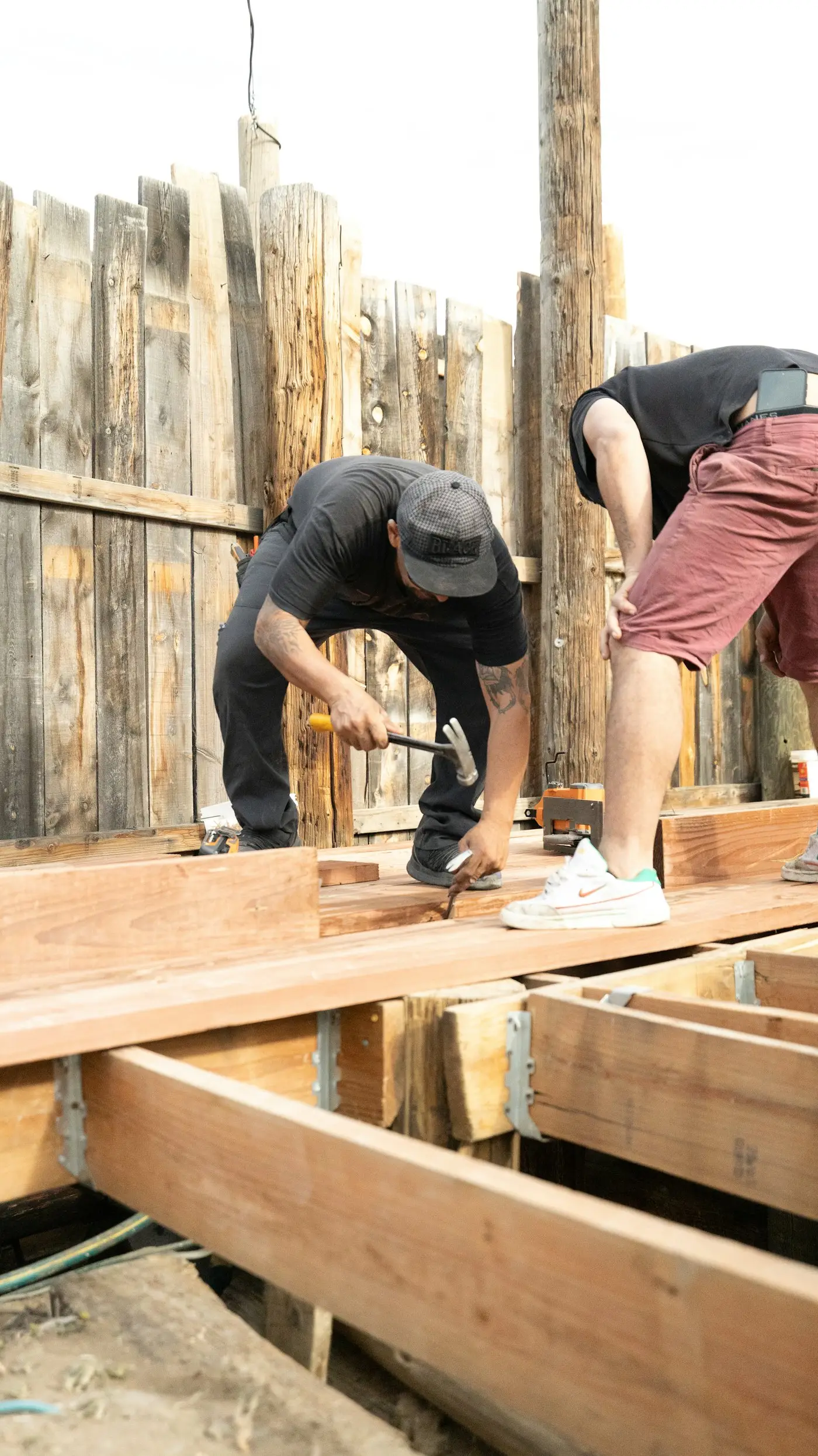
Decking materials for Yorkshire's climate
This is the most important decision you will make about your deck. Yorkshire's climate is wetter and cooler than the national average for much of the year, which makes material choice genuinely critical. A deck that performs well in Surrey can fail in five years in Harrogate or Huddersfield. Here is an honest assessment of each option.
Softwood pressure-treated decking
Softwood decking - typically pine or spruce - is the cheapest option upfront and the most widely available. It is pressure-treated with preservative to resist rot, but in Yorkshire's wet climate, "resist" is not the same as "prevent". Expect a good softwood deck to last 15-20 years if maintained correctly. The problem is that correct maintenance in Yorkshire means cleaning with a deck cleaner every spring to remove the green algae and moss that grows in damp conditions, and restaining every two to three years without fail.
Many Yorkshire homeowners skip the maintenance because it is time-consuming, and a softwood deck that is not maintained in this climate will start to show significant deterioration - greening, softening, checking, and warping - within three to five years. The boards become slippery when wet, which is a safety hazard, and the frame begins to degrade before the boards do if drainage is poor. If you choose softwood, budget for the ongoing maintenance cost and treat it as non-optional in Yorkshire.
Softwood decking is the right choice if you have a tight budget and are committed to the annual maintenance routine, or if you're decking a temporary space and longevity is not the primary concern.
Hardwood decking
Hardwood decking uses tropical or European hardwood species: balau, ipe, oak, and similar dense timbers. These are significantly more expensive than softwood but are inherently more resistant to rot, insect damage, and warping. Hardwood decking in good condition still needs oiling or treating periodically, but the interval is typically every three to five years rather than every two to three, and the risk of deterioration when maintenance is skipped is much lower.
Ipe (Brazilian walnut) is one of the hardest and most durable decking timbers available and is widely considered the premium hardwood option for UK outdoor use. It is very dense, which means it is also very heavy and harder to cut and fix - it requires pre-drilling for fixings, which adds installation time and cost. Balau is a less expensive hardwood alternative with good durability in UK conditions. European oak is popular for its appearance but requires more consistent maintenance than tropical hardwoods to prevent checking and greening.
Hardwood decking is the right choice for homeowners who want natural timber aesthetics with better durability than softwood, who are willing to pay the higher upfront cost, and who will commit to periodic (though less frequent) maintenance.
Composite decking
Composite decking is a board manufactured from a mixture of recycled wood fibre and plastic. It does not rot, does not warp, does not require staining or treatment, and does not need annual cleaning beyond a basic wash-down. In Yorkshire's climate, composite decking is genuinely the best long-term choice for most homeowners who want a low-maintenance outdoor space.
The upfront cost is higher than softwood and broadly comparable to or higher than hardwood, depending on the brand. The major composite brands offer 25-year warranties, which no softwood deck can match in Yorkshire conditions. The range of colours, textures, and finishes has improved dramatically in the last ten years, and quality composite boards now closely replicate the appearance of natural timber.
The main criticism of composite is that cheaper products can fade in UV or develop a slightly plastic sheen over time. Specify a named brand from a reputable manufacturer (Trex, Millboard, and UPM ProFi are well-regarded in the UK) rather than unbranded composite boards, and check whether the product is "full composite" (solid board) or "hollow core" - hollow core is cheaper but less rigid and can flex slightly underfoot.
Composite decking is the right choice for homeowners who want an outdoor space that looks good year after year without ongoing treatment, who are making a long-term investment, or who have found softwood maintenance impractical. Read more on our related hard landscaping guide.
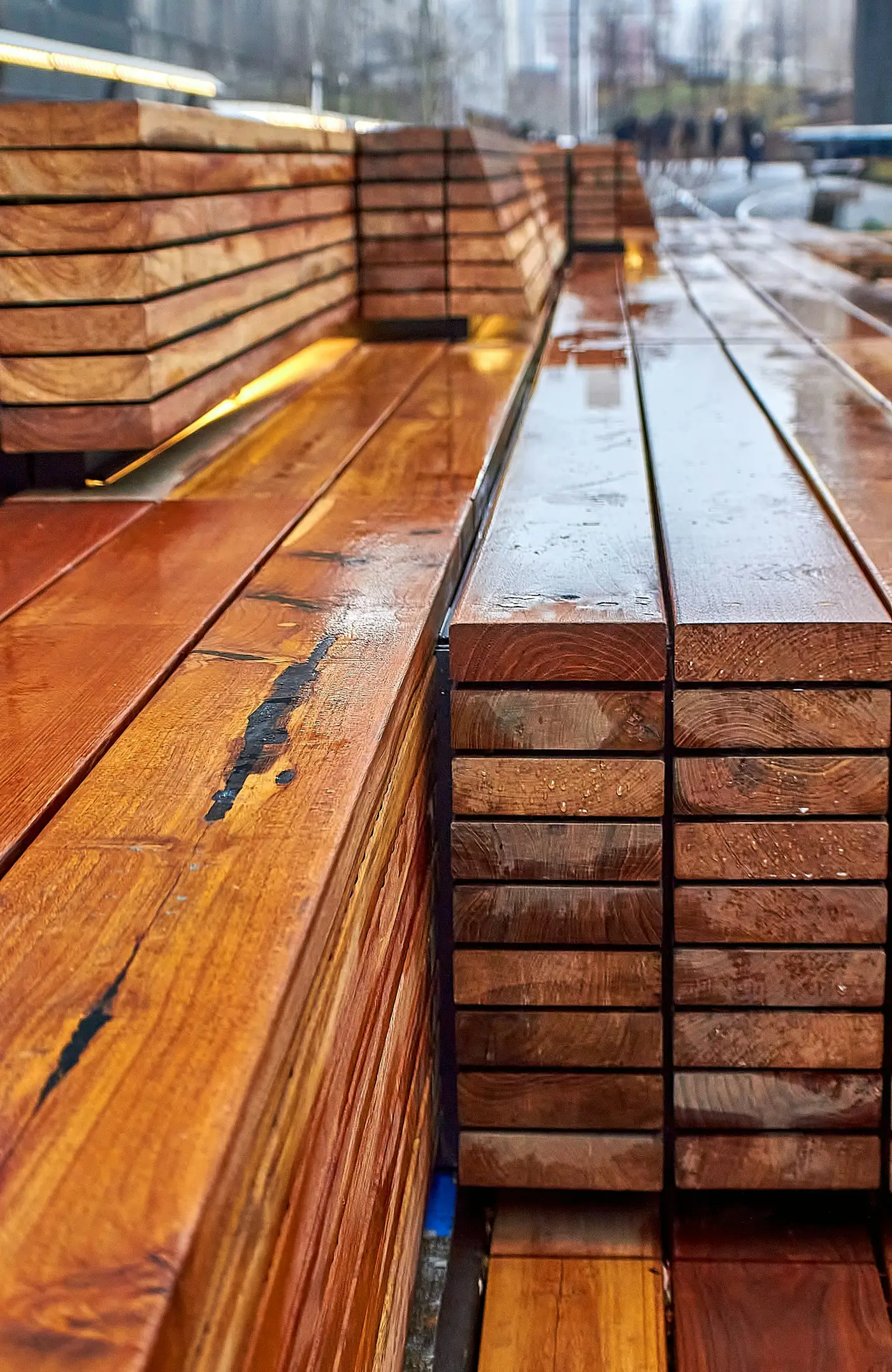
Why Yorkshire's weather makes material choice critical
Yorkshire sits at the northern end of England and is directly exposed to weather systems coming in from the west and northwest. Annual rainfall in West Yorkshire runs at 900-1,100mm; in parts of the Pennines it exceeds 1,500mm. Even the drier East Riding and Vale of York see 600-700mm per year, significantly wetter than London's 600mm average. Yorkshire winters are long, cold, and frequently damp, with ground frost from October through to March in exposed northern positions.
What this means for softwood
Green algae and moss colonise untreated softwood within months of installation in Yorkshire conditions, particularly on north or east-facing decks that receive less sun. This is not purely aesthetic - the biofilm makes the deck surface dangerously slippery in wet weather. Pressure washing alone does not solve the problem without a follow-up treatment; a deck cleaner with algaecide properties is needed before restaining.
The freeze-thaw cycle is also relevant. Yorkshire winters deliver multiple frost and thaw cycles through the season. Any moisture that has penetrated softwood boards expands on freezing, accelerating checking and cracking. Boards that were not fully dried before installation are particularly vulnerable. A reputable installer will specify kiln-dried or suitably seasoned softwood.
What this means for the deck structure
The frame beneath the deck is as important as the boards on top. Even with composite boards, a poorly constructed softwood frame will fail. Specify C24 grade pressure-treated softwood joists on minimum 400mm centres with adequate drainage clearance beneath the deck. Ground-level decks need a minimum clearance of 50mm between the lowest joist and the soil or membrane below to allow airflow. Decks sitting on soft ground with no drainage membrane below them are the most common cause of premature frame failure in Yorkshire gardens. Our local installers understand Yorkshire conditions and can advise on the right base preparation for your specific ground and position.
North-facing and shaded positions
Many Yorkshire gardens, particularly in terraced housing and in gardens surrounded by stone walls, have limited direct sunlight. A north-facing deck in Bradford or Leeds may receive as little as two to three hours of direct sun per day in summer and almost none in winter. These conditions dramatically accelerate algae growth on softwood and are the strongest argument for composite or hardwood in shaded Yorkshire gardens.
Decking installation costs in Yorkshire
These are indicative price ranges per square metre installed, including labour, materials, and basic frame construction. They assume reasonable access and a level or near-level ground. Sloped sites, significant groundwork, and complex shapes will add to the total.
The lifetime cost calculation often favours composite over softwood for Yorkshire homeowners. A softwood deck at £2,000 that requires £200 of stain plus a day of labour every three years costs approximately £3,600 over 15 years. A composite deck at £5,000 with minimal maintenance costs approximately £5,200 over the same period, and is likely still in excellent condition at 25 years where the softwood would need replacement. For homeowners planning to stay in their property long-term, composite usually wins on whole-life cost in Yorkshire conditions.
For broader context on garden investment and value, see our garden renovation guide.
The full guide
Do you need planning permission for decking in Yorkshire?
This is a question that many homeowners skip and then encounter problems with later. The planning rules for decking are specific and worth understanding before you commit to a design.
Permitted development for decking
In England, decking falls under the outbuilding rules for permitted development. The key rule is height: a deck must not be raised more than 30cm above the natural ground level (or more than 30cm above an existing patio surface) to fall within permitted development. Any deck that would be higher than 30cm above the existing ground level at any point requires planning permission before work begins.
This catches a lot of Yorkshire homeowners by surprise because many Yorkshire gardens slope significantly. A deck that is ground level at the house end may be 50cm or higher above the ground at the garden end - and at that point, it legally requires planning permission even if it is not an "elevated" deck in the traditional sense. Your installer should assess this before drawing up plans.
Conservation areas in Yorkshire
Yorkshire has an unusually high concentration of Conservation Areas, reflecting the historic character of its stone-built market towns and village centres. In a Conservation Area, permitted development rights for decking are more restricted. Decking in a Conservation Area that would be visible from a highway requires planning consent regardless of height in some interpretations. Towns with significant Conservation Area coverage include Knaresborough, Skipton, Richmond, Helmsley, Beverley, Whitby, Harrogate town centre, and many village centres across North Yorkshire and the Dales. If you are unsure whether your property is in a Conservation Area, check your local planning authority's online mapping before booking an installer.
Listed buildings
Properties in Conservation Areas are sometimes but not always listed buildings. Listed building consent (separate from planning permission) is needed for any external works to a listed building that would affect its character. If your property is listed, discuss any external works with your local conservation officer before starting.
Flood risk areas
Some Yorkshire riverside and lowland properties are in Flood Risk Zones 2 or 3. If your property is in a flood risk zone, even permitted development works may require a Flood Risk Assessment (FRA) if they involve significant earthworks or permanent structures. The Environment Agency's flood map is publicly available and is worth checking before making significant garden investments in low-lying areas near Yorkshire's river systems.
Our decking installation guide includes a more detailed walkthrough of the planning rules with specific examples from Yorkshire properties.
Ground-level decking vs raised decking in Yorkshire gardens
The decision between ground-level and raised decking is partly aesthetic and partly practical, but Yorkshire's soil conditions and climate make the structural considerations particularly important.
Ground-level decking
A ground-level deck sits on a prepared base at or just above soil level. The preparation is crucial: a proper ground-level deck in Yorkshire should have the topsoil removed (typically 150-200mm), a layer of compacted hardcore (MOT Type 1) laid, a weed membrane placed over the hardcore, and then paving slabs or decking feet on which the frame sits. This creates drainage, prevents the frame from sitting in contact with wet soil, and suppresses weed growth beneath the deck.
Skipping the hardcore and membrane is tempting on cost grounds but is a false economy in Yorkshire. A deck frame sitting directly on compacted earth in a Yorkshire garden will typically start showing rot at the base of the bearers within five to seven years. The additional cost of proper base preparation is modest relative to the total job cost and dramatically extends frame life.
Raised decking
A raised deck sits on posts set into the ground, typically on concrete pad foundations. Posts must be of sufficient size (minimum 100x100mm for most residential raised decks) and must be either set in concrete or fitted to metal post bases bolted to concrete. Posts in contact with the ground should be rated UC4 (highest rot resistance category) or be set on metal bases that keep the timber above soil level.
Raised decks need proper balustrade if they exceed 600mm in height to any accessible edge - this is a safety requirement. Balustrade adds cost but is non-negotiable for any raised deck in Yorkshire where the ground drops away significantly from the house. The balustrade design can be a major aesthetic element of the finished deck: horizontal slat rails, vertical spindle rails, glass panels, and cable systems all give very different looks and price points.
Steps and access
Most decks need at least one set of steps from deck level to the garden. Steps should be constructed from the same material as the deck for visual consistency, with non-slip surfaces - composite decking profiles typically have anti-slip channels built in, while softwood and hardwood steps may need applied grip strips. Plan step dimensions carefully: a comfortable outdoor step has a rise of 150-175mm and a going (tread depth) of 300-350mm. Steps that are too steep are a genuine safety hazard, particularly for older users and on wet mornings.
For inspiration and guidance on complementary garden projects, our garden renovation guide covers decking alongside other landscaping elements.
What a decking installation quote should cover
A complete decking quote should itemise every element of the job. Here is what to expect in a comprehensive quote from a reputable installer, and what to watch for if items are missing.
Frame construction
The structural frame consists of bearers (the main spanning timbers running across the width of the deck) and joists (the secondary timbers running perpendicular to the boards, to which the boards fix). The frame should be specified by timber size, grade, and treatment class. For most ground-level residential decks, 47x150mm C24 pressure-treated softwood on 400mm centres is the standard specification. Larger spans or heavier loads (hot tubs, large planters) need bigger section sizes.
Decking boards
The boards are specified by material, width, and thickness. Standard softwood decking boards run at 125mm or 145mm wide and 32mm thick. Composite boards vary by brand but typically run at 140-150mm wide and 22-25mm thick for hollow core, or 22-25mm thick for solid composite. The quote should specify the brand and product name for composite, or the species and treatment class for timber.
Balustrade and railings
If your deck is raised or the design includes a railing for aesthetic reasons, this should be itemised separately. Balustrade can add significantly to the total cost: a simple softwood post-and-rail system might add £150-250 per linear metre; a glass panel system can add £400-800 per linear metre. Get clarity on what is included before signing off on the quote.
Steps
Steps are typically quoted separately, as the number and configuration varies. A single flight of three steps costs significantly less than a wraparound step arrangement. Include steps explicitly in your scope of works if they are needed.
Treatment and finishing
For softwood decking, the quote should specify whether the first coat of stain or treatment is included in the installation price. Some installers include it; others quote the supply and fit of boards only and leave the finishing to you. For composite decking, no finish is required, but check whether any edge trim, fascia boards, or cap pieces for the frame are included.
Groundwork and clearance
Turf removal, soil excavation, hardcore supply and compaction, membrane supply and laying - these are sometimes included in a full installation quote and sometimes quoted separately. Ask explicitly so you know what the ground will look like when the installer arrives and what you are expected to have done beforehand. Our garden maintenance service can handle any pre-work preparation if needed.
Maintenance schedule for Yorkshire conditions
Softwood decking: clean with a dedicated deck cleaner (bleach-free, algaecide-containing product) each spring; lightly sand any rough or weathered areas; apply a quality decking stain or oil. In Yorkshire conditions, restaining is needed every two to three years at minimum, with some exposed positions needing annual treatment. Composite decking: brush off debris, wash with warm soapy water, and jet-wash annually in spring. No treatment is needed. For both types, keep the deck clear of leaf debris through autumn as wet leaves are the primary cause of surface staining and slip hazard. Our garden maintenance team can schedule seasonal deck cleans as part of a regular garden maintenance visit.
Choosing the look of your deck
The practical material choice done, the aesthetic decisions are the enjoyable part. Yorkshire gardens range enormously in character - from stone-walled cottage gardens in the Dales to urban courtyard spaces in Leeds and Sheffield - and the right deck finish varies accordingly.
Natural timber tones
Freshly installed pressure-treated softwood is typically a pale green-brown from the preservative treatment. Left untreated, it weathers to grey. Stained with a quality decking oil or pigmented stain, softwood can be finished in warm golden tones, rich brown tones, or natural grey tones that sit well with Yorkshire stone. Hardwood starts darker - balau is a warm reddish-brown, ipe a very dark brown - and weathers to silver-grey if left untreated. Many Yorkshire homeowners prefer to let hardwood weather naturally rather than commit to annual oiling, accepting the silver-grey patina as the finish.
Composite colour options
Composite decking is available in a wider range of colours than timber, from light ash tones through warm oak tones to dark charcoal boards. For Yorkshire stone properties, warm mid-brown tones that complement the natural limestone or gritstone of the walls are a popular choice. Lighter tones work well in shaded urban gardens where maximising the sense of light is a priority. Darker charcoal boards can look striking against a white-rendered house or a contemporary garden scheme but absorb heat more, which is rarely a disadvantage in Yorkshire's climate.
Board width and laying pattern
Standard deck boards are typically 125-150mm wide. Narrower boards (90-100mm) give a more detailed, traditional look. Wider boards (150-175mm) have a more contemporary feel. The laying pattern also affects the final appearance: boards running parallel to the house are the simplest and most cost-effective installation. A diagonal or herringbone pattern adds visual interest but increases material waste and installation time. For composite decking, diagonal laying is particularly effective as it follows the direction of typical foot traffic and shows fewer scuff marks from chairs and furniture.
Finishing details
The details that separate a well-finished deck from a basic one include: fascia boards to cover the exposed frame ends; post caps on balustrade posts; integrated LED lighting strips along the frame or steps for evening use; and concealed fixings (hidden fasteners that mean no screw heads are visible on the board surface). These finishing elements add cost but transform the perceived quality of the final result. Discuss them with your installer at the quoting stage rather than adding them as afterthoughts once work has started. Our patio laying service can complement a new deck with matching stone or porcelain paving for the surrounding garden.
Common questions about decking installation in Yorkshire
How much does decking cost in Yorkshire?
Softwood decking installed in Yorkshire typically costs £80-120 per square metre, including frame, boards, and basic fixings. A 20sqm deck costs approximately £1,600-2,400. Hardwood decking costs £150-250 per square metre; composite decking costs £200-350 per square metre. A 20sqm composite deck costs approximately £4,000-7,000. Balustrade, steps, and groundwork preparation are usually quoted separately. Complex shapes, sloped sites, and tight access add to costs. Yorkshire-specific factors - particularly the need for proper base preparation to cope with damp ground conditions - mean a thorough quote will always include base preparation costs. Request an itemised quote that separates frame, boards, finishes, groundwork, and any extras so you can compare accurately.
Do I need planning permission for decking in Yorkshire?
Not usually for a ground-level or near-ground-level deck. Under permitted development rules in England, decking that does not exceed 30cm above natural ground level does not require planning permission for most residential properties. However, if your garden slopes and the deck would be more than 30cm above ground at any point, planning permission is required. Properties in Conservation Areas have more restricted permitted development rights, and Conservation Areas are common across Yorkshire's historic towns and villages. Listed buildings require listed building consent for external works. Always check your specific situation with your local planning authority before starting work. Our installers will flag any potential planning issues during the site survey.
Does composite decking last longer than wood in Yorkshire?
Yes, in Yorkshire conditions composite decking significantly outlasts softwood and generally matches or exceeds hardwood in durability. Quality composite decking brands (Trex, Millboard, UPM ProFi) carry 25-year warranties and require no treatment. Softwood decking in Yorkshire that is maintained correctly lasts 15-20 years, but maintenance is not optional in this climate and many homeowners find the annual cleaning and periodic restaining difficult to sustain. Composite eliminates that requirement entirely. The difference in longevity is most pronounced in shaded, north-facing gardens common in Yorkshire's terraced housing, where algae growth on untreated softwood is rapid and persistent.
What decking material is best for Yorkshire's climate?
For most Yorkshire homeowners who want a low-maintenance deck that performs well long-term, composite decking is the best choice. Yorkshire's wet climate and frequent freeze-thaw cycles are hard on untreated and inadequately maintained softwood. Composite does not rot, does not warp, does not require annual treatment, and does not become slippery in wet weather when a grooved anti-slip profile is specified. If you prefer natural timber and are committed to regular maintenance, hardwood (particularly balau or ipe) is a better choice than softwood in Yorkshire. Softwood is viable on a tight budget with strict maintenance discipline, but is the least forgiving option in this climate if maintenance is skipped.
Frequently asked questions
How much does decking installation cost in Yorkshire?
Decking installation in Yorkshire typically costs £100-150 per m2 for pressure-treated softwood, £150-250/m2 for composite, and £200-350/m2 for hardwood. A standard 12m2 project runs £1,200-4,200 depending on material. Ground prep, steps and balustrades add to the total.
How long does decking take to install?
A standard 12-15m2 deck takes one to two days for an experienced installer. Larger or more complex projects with multiple levels, steps and built-in seating take two to four days.
What wood is best for decking in Yorkshire's wet climate?
Pressure-treated softwood (Scandinavian redwood or pine, tanalised) is the most popular choice - it handles Yorkshire's wet winters well and lasts 15-20 years with minimal maintenance. Composite decking suits homeowners who want to eliminate annual oiling. Hardwood (such as bangkirai or ipe) is the premium option and the longest-lasting.
How do I maintain decking in Yorkshire?
Softwood decking needs cleaning annually and re-oiling or re-staining every two to three years. Composite decking needs only an annual clean. Yorkshire's wet climate and moss growth mean an annual pressure wash in spring is worthwhile for any decking material. Anti-slip strips help in shaded or north-facing positions.
Is composite or timber decking better for Yorkshire gardens?
Both work well. Timber is cheaper upfront and repairable. Composite costs more initially but saves the annual oiling task - a meaningful benefit in Yorkshire where summers are short and you want to spend them in the garden, not maintaining it.
Decking installation covering 240+ towns across Yorkshire
Our decking installers cover the full county from the Yorkshire Dales to the Humber. Find your local installer below, or find your nearest gardener in Yorkshire to explore all services in your area.
- York
- Harrogate
- Beverley
- Hull
- Cottingham
- Scarborough
- Wetherby
- Boston Spa
- Driffield
- Malton
- Norton
- Helmsley
- Pickering
- Kirkbymoorside
- Easingwold
- Thirsk
- Ripon
- Knaresborough
- Tadcaster
- Selby
- Pocklington
- Northallerton
- Leeds
- Bradford
- Sheffield
- Halifax
- Wakefield
- Huddersfield
- Doncaster
- Rotherham
- Barnsley
- Haxby
- Strensall
- Huntington
- Copmanthorpe
- Bishopthorpe
- Stamford Bridge
- Filey
- Bridlington
- Goole
- Ilkley
- Dunnington
- Boroughbridge
- Skipton
- Whitby
- Stokesley
- Market Weighton
- Stockton-on-the-Forest
- Keighley
- Otley
- Bedale
- Hornsea
- Castleford
- Dewsbury
- Garforth
- Guiseley
- Horsforth
- Morley
- Pontefract
- Ackworth
- Batley
- Bingley
- Cleckheaton
- Holmfirth
- Horbury
- Ossett
- Pudsey
- Hebden Bridge
- Mirfield
- Sowerby Bridge
- Brighouse
- Elland
- Featherstone
- Normanton
- Hemsworth
- Maltby
- Mexborough
- Wath-upon-Dearne
- Rawmarsh
- Swinton
- Royston
- Darton
- Hoyland
- Wombwell
- Penistone
- Thorne
- Bawtry
- Kippax
- Rothwell
- Knottingley
- Richmond
- Leyburn
- Masham
- Settle
- Guisborough
- Loftus
- Saltburn-by-the-Sea
- Pateley Bridge
- Grassington
- Long Preston
- Hebden
- Shipley
- Hessle
- Brough
- Swanland
- Withernsea
- Heckmondwike
- Birstall
- Liversedge
- Yeadon
- Catterick Garrison
- Acomb
- Poppleton
- Rawcliffe
- Sherburn-in-Elmet
- Howden
- Mytholmroyd
- Marsden
- Meltham
- Conisbrough
- Tickhill
- Adwick-le-Street
- Thurnscoe
- South Elmsall
- Denby Dale
- Farsley
- Crofton
- Armthorpe
- Sprotbrough
- Todmorden
- Willerby
- Hedon
- Hawes
- Addingham
- Burley-in-Wharfedale
- North Cave
- Barlby
- Haworth
- Baildon
- Bolton-upon-Dearne
- Goldthorpe
- Cudworth
- Honley
- Queensbury
- Upton
- Kirkburton
- Skelmanthorpe
Get a decking installation quote today
Tell us your approximate deck size, preferred material, and whether you need steps or balustrade. We'll connect you with a local installer and get you a price.
Get a free quote