Patio laying and installation across Yorkshire
Patio Laying in Yorkshire | Supply and Lay From £30 per m2
Yorkshire's freeze-thaw winters destroy cheap paving inside five years. The right material and a proper sub-base on clay ground makes the difference between a patio that lasts 20 years and one that is cracking by year three.
- Free quotes, no obligation
- Local gardeners
- 240+ Yorkshire towns covered
- No call centres
How much does patio laying cost in Yorkshire?
Patio laying in Yorkshire typically costs £30-£50 per m2 for concrete slab, £50-£80 for natural sandstone, and £70-£100 for porcelain, all-in with supply and labour included.
Concrete slab patios in Yorkshire cost £30–£50 per m2 all-in. Natural sandstone costs £50–£80 per m2. Porcelain costs £70–£100 per m2. For a 20m2 patio, that is £600–£1,000 for concrete, £1,000–£1,600 for sandstone, and £1,400–£2,000 for porcelain. The full breakdown by material and size is in the price table further down.
These prices include sub-base preparation on reasonably level ground with standard clay soil conditions. Additional excavation on sloping gardens or particularly heavy clay requiring deeper drainage work adds to the base price.
Does patio laying in Yorkshire need planning permission?
Most rear garden patios in Yorkshire are permitted development and do not need planning permission, but any impermeable surface over 5m2 in a front garden requires permission or must use a permeable material such as gravel or permeable block paving.
Planning note: patios in rear gardens are normally permitted development. However, any hard surface over 5m2 in a front garden using an impermeable material requires planning permission. If your property is in a conservation area, additional restrictions may apply. Check before you start.
What patio material works best in Yorkshire's climate?
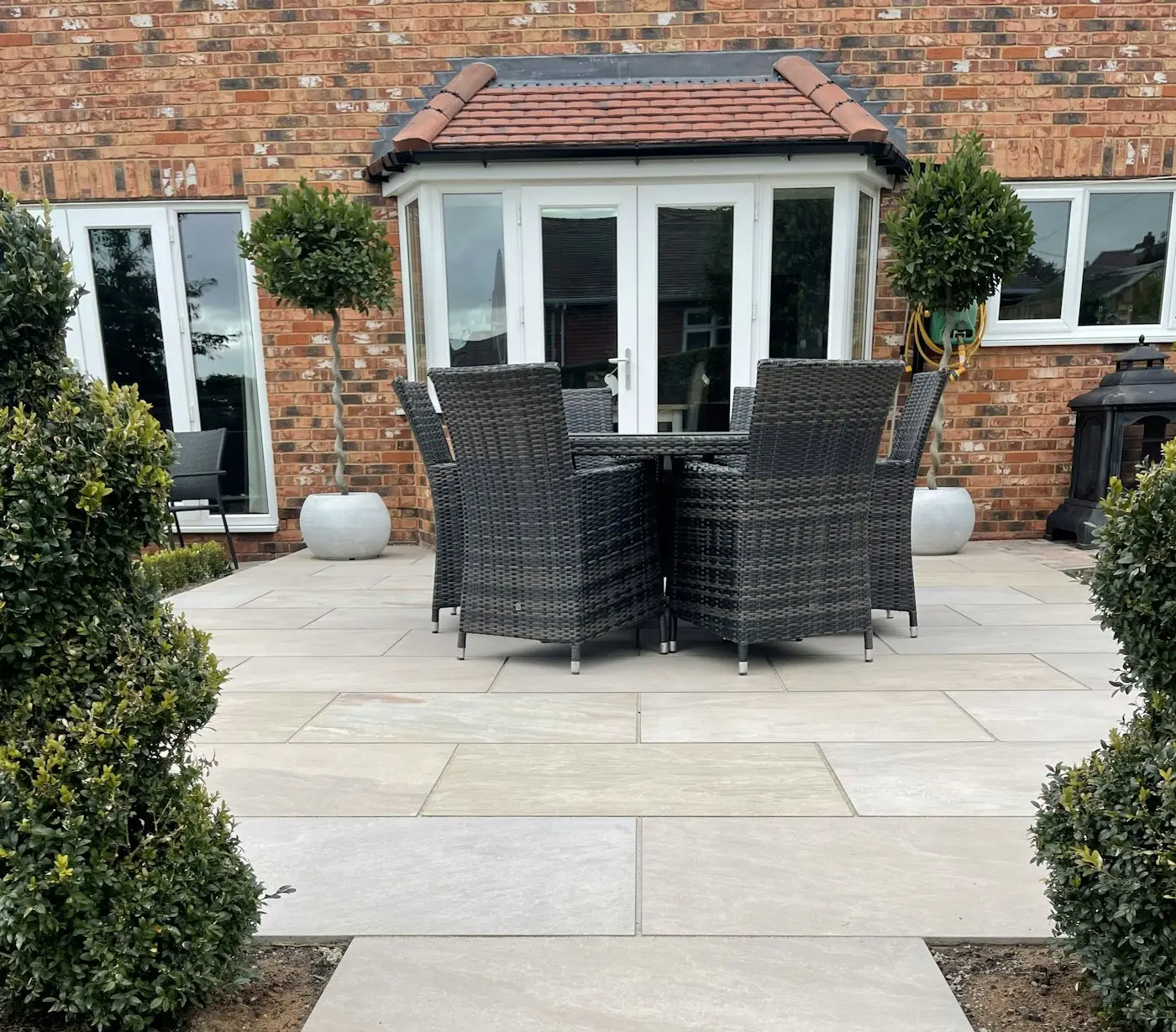
Porcelain is the most frost-resistant choice for Yorkshire gardens, followed by quality natural sandstone with a frost-resistance specification; avoid cheap unbranded concrete slabs that absorb water and spall in freeze-thaw conditions.
The single most important factor in choosing patio material for a Yorkshire garden is frost resistance. Yorkshire winters regularly bring temperatures of -5C to -10C, with freeze-thaw cycling through January and February that is more damaging to paving than sustained cold. Water in the pores of a stone or concrete slab expands as it freezes, and if the material absorbs too much water, the surface spalls (flakes off) or cracks from the inside.
Porcelain paving
Porcelain is the most frost-resistant paving option available for Yorkshire gardens. It is fired at temperatures above 1,200C, which vitrifies (fuses) the material into an almost completely non-porous surface. Water absorption is below 0.5%, meaning there is virtually nothing to freeze and expand. A quality porcelain patio will look the same after 20 Yorkshire winters as it did when it was laid. It is also easy to clean. The smooth, non-porous surface does not hold staining or moss as readily as natural stone.
The downsides of porcelain are cost (the highest of the three main options) and installation requirements. Porcelain must be laid on a full mortar bed: the spot-and-dab method used for cheaper slabs does not provide adequate support for the large-format slabs typically used in porcelain paving, and slabs can crack under point loads. This adds to installation time and cost. Large-format porcelain slabs (600x600mm and larger) are now the standard in premium Yorkshire garden installations.
Yorkshire sandstone and natural stone
Yorkshire sandstone has been used as a building and paving material in the county for centuries, and it looks at home in Yorkshire gardens in a way that no imported material quite replicates. The warm buff and grey tones of Yorkshire stone complement both modern and traditional garden styles. Good quality Yorkshire sandstone with a natural split or riven finish is frost-resistant when properly specified: look for a water absorption rate below 3% and a freeze-thaw resistance certification (EN 12371). Indian sandstone is widely used as a lower-cost alternative and performs well when properly sealed and maintained; quality varies significantly between suppliers so the stone specification matters more than the origin.
Natural sandstone is laid on a full mortar bed for Yorkshire conditions. The traditional practice of spot-and-dab bedding leaves hollow points beneath the slab that become unstable in frost. Full bed mortar eliminates this and is now the standard recommended practice.
Concrete slab paving
Concrete slab paving covers a huge range of quality. At the budget end, basic grey concrete slabs from DIY stores are the worst performers in Yorkshire conditions. They have high water absorption, poor freeze-thaw resistance, and will show surface spalling and flaking within three to five winters. At the upper end, named concrete slabs from manufacturers such as Marshalls, Brett or Bradstone include air-entrained concrete with proper freeze-thaw resistance ratings and are a reliable choice at lower cost than natural stone or porcelain. If choosing concrete slab for a Yorkshire patio, always ask for the manufacturer's name and the freeze-thaw resistance specification. The £8–£12 per m2 slab from a builders' merchant will not survive Yorkshire winters.
Block paving
Concrete block paving is more commonly used for driveways than patios in Yorkshire, but it is used in some garden settings, particularly for contemporary designs or where a permeable surface is needed (permeable block paving uses jointing sand rather than mortar and allows water through the joints). Quality concrete block paving from named manufacturers is frost-resistant. The main maintenance consideration is weed growth in the sand joints, which requires periodic re-sanding and moss treatment.
What sub-base depth does a patio need on Yorkshire clay?
A patio on Yorkshire clay needs at least 100mm of compacted MOT Type 1 hardcore plus a 50mm mortar bed, requiring excavation to 200mm below the finished patio surface to allow for the slab thickness.
Yorkshire's clay ground requires a more substantial sub-base than the guidance from national paving manufacturers typically assumes. The standard residential specification for a patio on clay in Yorkshire is as follows.
Excavation depth
Excavate to a depth of at least 200mm below the finished patio surface: this provides room for 100mm of compacted hardcore (MOT Type 1), 50mm of sharp sand or concrete mortar bed, and 40-60mm of slab thickness. On particularly wet or soft clay, increase the hardcore to 150mm. Any peat, soft spots or disturbed fill should be removed and replaced with compacted Type 1 during excavation.
Hardcore layer
100mm minimum of MOT Type 1 crushed stone, compacted in layers with a plate compactor. The Type 1 layer is what gives the patio its structural integrity: it distributes the load of the slabs, foot traffic and any furniture weight across a wide area of clay rather than concentrating it at points. Without an adequate Type 1 base on clay, slabs settle unevenly over the first two to three years as the clay below consolidates under load.
Mortar bed
For all natural stone and porcelain, lay on a full 50mm mortar bed (1:4 cement:sharp sand ratio for most applications). For economy concrete slabs, a 40mm full mortar bed or a 50mm sharp sand bed with full mortar joints. Do not spot-and-dab on Yorkshire clay: it creates hollow points that fail in frost and produce rocking slabs.
Drainage fall
The finished patio surface must fall away from the house at a minimum gradient of 1:60 (roughly 17mm per metre). This is the minimum required to ensure water drains off the patio surface without pooling. On Yorkshire clay, which drains poorly, this fall specification is not optional. A flat patio on clay will hold standing water after heavy rain, which accelerates pointing deterioration and creates ice hazards in winter. The fall direction should drain to a lawn, border or patio drain, not towards a neighbour's boundary.
What are typical patio laying prices across Yorkshire?
Patio laying in Yorkshire runs from £600 to £1,000 for a 20m2 concrete slab patio up to £1,400-£2,000 for the same size in porcelain, all-in with sub-base preparation on standard clay ground.
| Material and size | Typical Yorkshire price | Notes |
|---|---|---|
| Concrete slab, 20m2 | £600–£1,000 | Named manufacturer slab. Budget DIY-store slabs not recommended for Yorkshire conditions. |
| Concrete slab, 40m2 | £1,100–£1,800 | Includes full sub-base and pointing. |
| Natural sandstone, 20m2 | £1,000–£1,600 | Full mortar bed. Yorkshire or Indian sandstone with frost-resistance spec. |
| Natural sandstone, 40m2 | £1,800–£3,000 | Larger area, slightly better per-m2 rate. |
| Porcelain, 20m2 | £1,400–£2,000 | Full mortar bed required. Best frost resistance. |
| Porcelain, 40m2 | £2,600–£3,800 | Premium option. Least maintenance long-term. |
| Additional excavation (per m2) | £5–£15/m2 | Sloping ground or deep clay requiring extra excavation depth. |
| Step construction | £150–£400 per step | Depends on material and construction method. |
Prices are for Yorkshire urban and suburban areas (York, Harrogate, Leeds, Bradford, Sheffield, Hull and surrounding towns). Remote rural locations may attract a travel or access premium.
The full guide
Pointing types and mortar mixes for Yorkshire winters
The pointing between slabs is one of the most critical details for Yorkshire patio longevity. The wrong pointing will crack and open up in the first hard winter, allowing water in behind the slabs and accelerating both frost damage to the slabs and weed establishment in the joints.
Brush-in polymeric jointing compound
Polymeric jointing compounds (sold under various brand names as pointing mortar, joint stabiliser or similar) are the current best practice for domestic patio pointing. They are applied dry, brushed into the joints, and then activated with water. Once cured, they are flexible: they accommodate the slight thermal movement that all paving experiences through Yorkshire's temperature range without cracking. They also resist weed growth better than loose sand and are more consistent to apply than hand-mixed mortar. Suitable for joints 3-20mm wide. Not suitable for very narrow joints in porcelain paving (under 3mm), where specialist resin grout is used instead.
Sand and cement mortar pointing
Traditional mortar pointing (3:1 or 4:1 sand:cement ratio) is still widely used and performs well when done correctly. The risk is cracking in Yorkshire's freeze-thaw conditions if the mix is too rich (too much cement) or if there is moisture in the joints when the mortar is applied. A slightly weaker mix (4:1 or 5:1) is more appropriate for Yorkshire conditions than the standard 3:1, as it is more flexible and slightly less rigid. Mortar pointing requires skill to apply neatly and consistently and is harder to patch if individual joint sections fail.
Pattern options
For natural stone and concrete slabs, the most common laying patterns in Yorkshire gardens are: straight coursed (all horizontal joints align, giving a structured formal look), stretcher bond (slabs offset by half a length, like brickwork, more informal and slightly stronger than straight coursed), and random/natural (varied slab sizes and lengths, particularly suited to natural sandstone and giving a traditional English garden appearance). Porcelain is almost always laid in a grid pattern or offset grid. More complex patterns such as herringbone or fan are used in block paving and add to laying time and cost.
Planning rules for patios in Yorkshire
Most rear garden patios in Yorkshire are permitted development. The rules that catch homeowners out are as follows.
- Front garden impermeable surfaces over 5m2: any impermeable hard surface larger than 5m2 in a front garden (or side garden facing a highway) requires planning permission or must use a permeable material. Yorkshire councils apply this rule actively: if you are paving a front garden area, choose permeable block paving, gravel, or pattern-imprinted permeable resin, or apply for permission.
- Conservation areas: many Yorkshire town centres, historic villages and Georgian/Victorian residential areas are conservation areas. Hard landscaping in conservation areas is sometimes subject to Article 4 directions that remove permitted development rights. Check with your local council planning department before starting work in areas such as Harrogate town centre, Richmond, Beverley, Knaresborough or the historic villages of North Yorkshire.
- Listed buildings: if your property is listed, any hard landscaping work within the curtilage of the listed building requires listed building consent, even in the garden. Most domestic properties are not listed, but check if you are unsure.
- Building over drains: if the patio area is over or close to a public sewer, you may need approval from Yorkshire Water or a build-over agreement before laying impermeable surfaces.
Frequently asked questions about patio laying in Yorkshire
Do I need planning permission to lay a patio in Yorkshire?
Most rear garden patios are permitted development without planning permission. The exception is any impermeable hard surface over 5m2 in a front garden: this needs planning permission or must use a permeable material. Conservation area properties have additional restrictions. Always check with your local planning authority if you are in a designated area or if the patio is at the front of the property.
What is the best patio material for Yorkshire winters?
Porcelain is the most frost-resistant option: near-zero water absorption means nothing to freeze and expand. Quality natural sandstone with a frost-resistance specification performs well and looks at home in Yorkshire gardens. Named concrete slabs from Marshalls, Brett or Bradstone are a solid budget option. Avoid cheap unbranded concrete slabs from DIY stores: they spall and crack within a few Yorkshire winters.
How do I stop a new patio getting weeds between the joints?
Use brush-in polymeric jointing compound rather than loose kiln-dried sand. Polymeric pointing sets firm, resists weed establishment and accommodates Yorkshire's freeze-thaw movement without cracking. Lay a weed-suppressing membrane under the sub-base as an additional defence. No pointing method prevents weeds permanently. Check and treat annually. Resin-based grout is used for narrow porcelain joints (under 3mm).
Further reading
How long does patio laying take in Yorkshire?
A 20m2 patio typically takes 2-3 days to complete, including excavation, sub-base compaction, mortar bed and slab laying. Larger patios of 40m2 take 4-5 days. Sloping sites or heavy clay requiring extra excavation add a day or more. Allow 48 hours after completion before the patio takes foot traffic or furniture.
What is the difference between supply and lay and labour only for patio installation in Yorkshire?
Supply and lay means the patio layer sources and supplies the slabs, sub-base materials and mortar as well as carrying out the work. Labour only means you buy the materials yourself and pay for time only. Supply and lay usually works out cheaper overall, as patio layers buy at trade rates. Labour only makes sense if you have specific slabs already purchased or want a material the layer does not usually stock.
How do I find a reliable patio layer in Yorkshire?
Look for a patio layer who specifies the sub-base depth, drainage fall and mortar mix upfront rather than after the quote. A reliable layer will ask about ground conditions, existing drainage and what the patio will be used for. Ask to see examples of completed work in similar Yorkshire soil conditions. Avoid anyone who quotes without asking about site conditions, as the sub-base is where corners tend to get cut.
When is the best time to have a patio laid in Yorkshire?
Late spring to early autumn is best for patio laying in Yorkshire: dry conditions allow mortar to cure without frost interference. Avoid laying in temperatures below 5 degrees Celsius as frost damages freshly laid mortar before it sets. Book in winter for a spring start to secure your preferred slot before peak-season demand fills up.
A patio built to last in Yorkshire's climate
Tell us your postcode, rough size and preferred material. A local patio layer can take it on and come back with a proper quote including sub-base specification and material recommendation for your site.
Request a gardenerPatio laying across all of Yorkshire.
Local patio installers covering 240+ towns across Yorkshire. Find your nearest specialist for postcode-specific pricing and knowledge of local ground conditions.
- Patio laying in York
- Patio laying in Harrogate
- Patio laying in Beverley
- Patio laying in Hull
- Patio laying in Cottingham
- Patio laying in Scarborough
- Patio laying in Wetherby
- Patio laying in Boston Spa
- Patio laying in Driffield
- Patio laying in Malton
- Patio laying in Norton
- Patio laying in Helmsley
- Patio laying in Pickering
- Patio laying in Kirkbymoorside
- Patio laying in Easingwold
- Patio laying in Thirsk
- Patio laying in Ripon
- Patio laying in Knaresborough
- Patio laying in Tadcaster
- Patio laying in Selby
- Patio laying in Pocklington
- Patio laying in Northallerton
- Patio laying in Leeds
- Patio laying in Bradford
- Patio laying in Sheffield
- Patio laying in Halifax
- Patio laying in Wakefield
- Patio laying in Huddersfield
- Patio laying in Doncaster
- Patio laying in Rotherham
- Patio laying in Barnsley
- Patio laying in Haxby
- Patio laying in Strensall
- Patio laying in Huntington
- Patio laying in Copmanthorpe
- Patio laying in Bishopthorpe
- Patio laying in Stamford Bridge
- Patio laying in Filey
- Patio laying in Bridlington
- Patio laying in Goole
- Patio laying in Ilkley
- Patio laying in Dunnington
- Patio laying in Boroughbridge
- Patio laying in Skipton
- Patio laying in Whitby
- Patio laying in Stokesley
- Patio laying in Market Weighton
- Patio laying in Stockton-on-the-Forest
- Patio laying in Keighley
- Patio laying in Otley
- Patio laying in Bedale
- Patio laying in Hornsea
- Patio laying in Castleford
- Patio laying in Dewsbury
- Patio laying in Garforth
- Patio laying in Guiseley
- Patio laying in Horsforth
- Patio laying in Morley
- Patio laying in Pontefract
- Patio laying in Ackworth
- Patio laying in Batley
- Patio laying in Bingley
- Patio laying in Cleckheaton
- Patio laying in Holmfirth
- Patio laying in Horbury
- Patio laying in Ossett
- Patio laying in Pudsey
- Patio laying in Hebden Bridge
- Patio laying in Mirfield
- Patio laying in Sowerby Bridge
- Patio laying in Brighouse
- Patio laying in Elland
- Patio laying in Featherstone
- Patio laying in Normanton
- Patio laying in Hemsworth
- Patio laying in Maltby
- Patio laying in Mexborough
- Patio laying in Wath-upon-Dearne
- Patio laying in Rawmarsh
- Patio laying in Swinton
- Patio laying in Royston
- Patio laying in Darton
- Patio laying in Hoyland
- Patio laying in Wombwell
- Patio laying in Penistone
- Patio laying in Thorne
- Patio laying in Bawtry
- Patio laying in Kippax
- Patio laying in Rothwell
- Patio laying in Knottingley
- Patio laying in Richmond
- Patio laying in Leyburn
- Patio laying in Masham
- Patio laying in Settle
- Patio laying in Guisborough
- Patio laying in Loftus
- Patio laying in Saltburn-by-the-Sea
- Patio laying in Pateley Bridge
- Patio laying in Grassington
- Patio laying in Long Preston
- Patio laying in Hebden
- Patio laying in Shipley
- Patio laying in Hessle
- Patio laying in Brough
- Patio laying in Swanland
- Patio laying in Withernsea
- Patio laying in Heckmondwike
- Patio laying in Birstall
- Patio laying in Liversedge
- Patio laying in Yeadon
- Patio laying in Catterick Garrison
- Patio laying in Acomb
- Patio laying in Poppleton
- Patio laying in Rawcliffe
- Patio laying in Sherburn-in-Elmet
- Patio laying in Howden
- Patio laying in Mytholmroyd
- Patio laying in Marsden
- Patio laying in Meltham
- Patio laying in Conisbrough
- Patio laying in Tickhill
- Patio laying in Adwick-le-Street
- Patio laying in Thurnscoe
- Patio laying in South Elmsall
- Patio laying in Denby Dale
- Patio laying in Farsley
- Patio laying in Crofton
- Patio laying in Armthorpe
- Patio laying in Sprotbrough
- Patio laying in Todmorden
- Patio laying in Willerby
- Patio laying in Hedon
- Patio laying in Hawes
- Patio laying in Addingham
- Patio laying in Burley-in-Wharfedale
- Patio laying in North Cave
- Patio laying in Barlby
- Patio laying in Haworth
- Patio laying in Baildon
- Patio laying in Bolton-upon-Dearne
- Patio laying in Goldthorpe
- Patio laying in Cudworth
- Patio laying in Honley
- Patio laying in Queensbury
- Patio laying in Upton
- Patio laying in Kirkburton
- Patio laying in Skelmanthorpe