Tree surgery across Yorkshire
Qualified local tree surgeons. Pruning, felling and stump removal.
From crown reduction on an overgrown sycamore to felling a storm-damaged ash, Yorkshire's trees need people who know what they are doing. Get your enquiry in front of a qualified local arborist who covers your postcode.
- Free quotes, no obligation
- Local gardeners
- 240+ Yorkshire towns covered
- No call centres
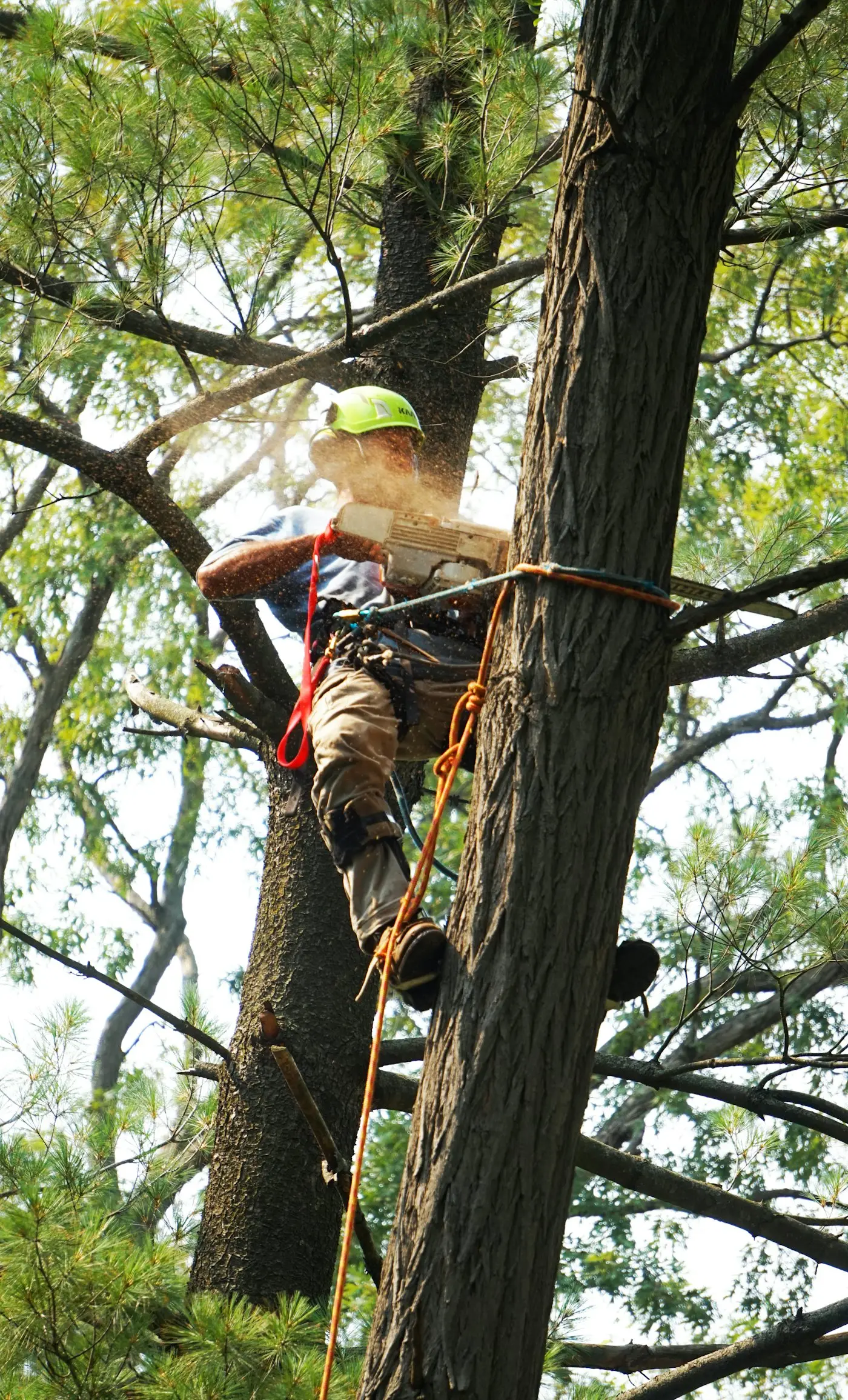
The quick answer on price and scope
Tree surveys and smaller pruning jobs typically start at £150–£400 per tree. Felling a small to medium tree runs £300–£800, with larger trees requiring aerial work or a crane coming in at £800–£1,500 or more depending on access and complexity. Stump grinding is usually a separate job at £75–£200 per stump. Emergency call-outs for storm damage carry a premium - typically £60–£80 per hour versus the standard £40–£60/hr for planned work.
Prices vary across Yorkshire. More remote locations in the Dales, the North York Moors and the higher Pennine areas attract an access premium, as equipment travel time and difficult site conditions affect the cost. For a full breakdown, the tree surgery cost guide for Yorkshire covers typical rates by job type and area.
Before any tree work: check whether the tree has a Tree Preservation Order (TPO) or whether it is in a conservation area. Getting this wrong can result in a fine of up to £20,000. See the permissions section below for exactly what to check.
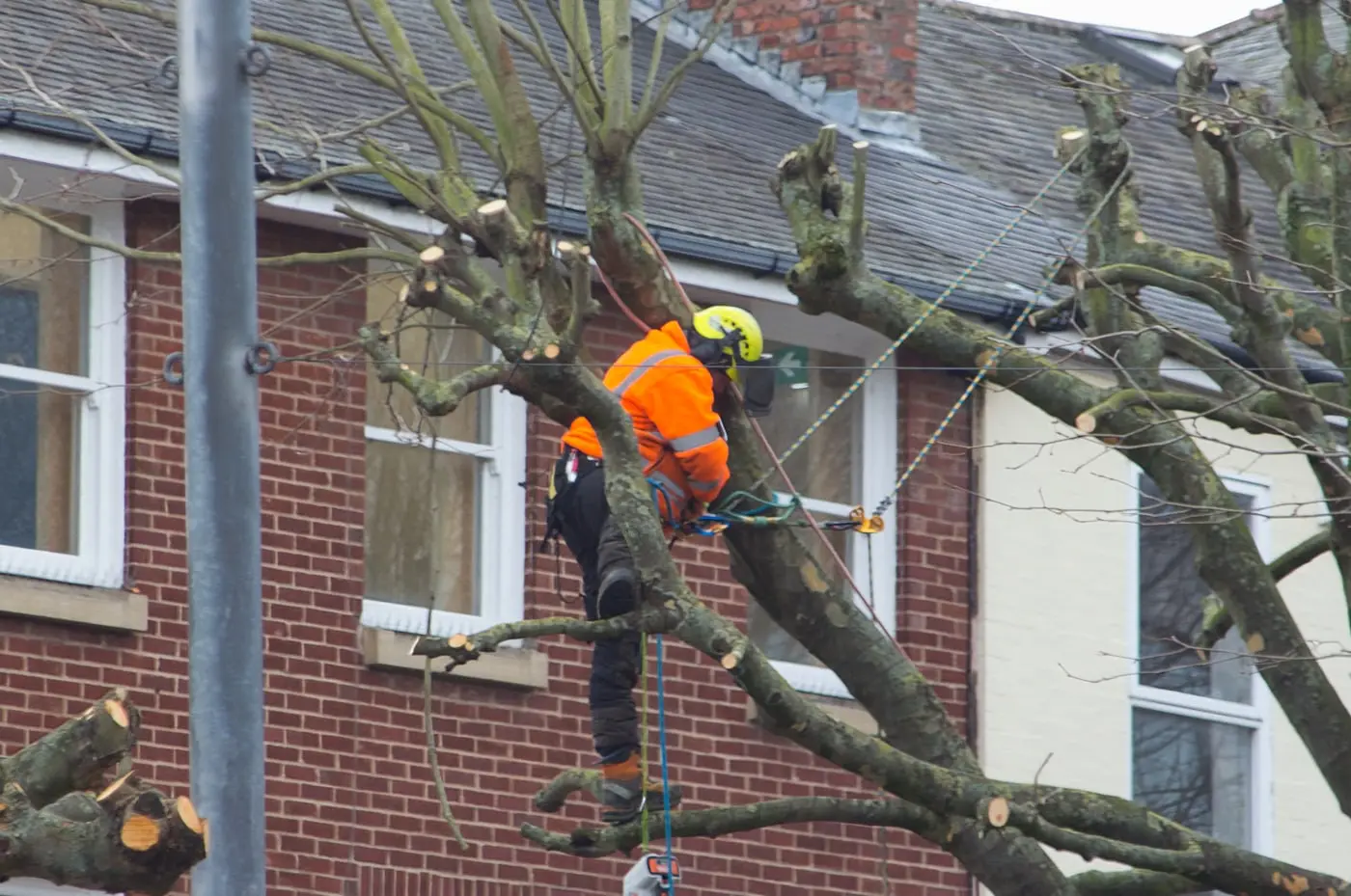
Types of tree work
Tree surgery is not one job - it covers a range of distinct operations, each requiring different skills, equipment and sometimes qualifications. Understanding what you need helps you brief the arborist accurately and compare quotes like for like.
Crown pruning
Crown pruning covers three main operations that are often confused with each other. Crown thinning removes selected branches throughout the crown to increase light and air movement without changing the overall shape or size - it is the least dramatic option and the one most commonly recommended for oaks and mature specimen trees. Crown reduction reduces the overall height and spread by cutting branches back to suitable growth points, making the tree smaller while retaining a natural shape. Formative pruning shapes young trees early to encourage a strong, well-spaced structure that reduces the need for heavy intervention later. All three should be carried out to BS3998, the British Standard for tree work, which specifies how cuts should be made to minimise harm and promote healing.
Deadwooding
Deadwooding removes dead, dying or broken branches from the crown. Dead wood poses a hazard - branches can fall without warning, particularly in high winds - and it can harbour disease that spreads to living tissue. Deadwooding is often a routine maintenance operation on mature trees and can be done at any time of year without harming the tree.
Tree felling
Felling removes the whole tree. On a small tree in an open garden, felling is straightforward: the arborist cuts it down in one piece and sections it on the ground. On larger trees, particularly those close to buildings, fences or other garden features, sectional felling is required - the tree is dismantled from the top down, with branches and sections lowered by rope to avoid damage below. This takes significantly longer and requires proper aerial qualifications and rigging kit.
Stump grinding
Felling leaves a stump. Stump grinding uses a specialised rotary cutter to grind the stump down to roughly 200mm below soil level, eliminating the trip hazard and allowing the area to be used again. The grinding produces a pile of wood chips, which can be used as mulch in borders. Stump grinding is almost always a separate quotation from the felling job - the equipment is different and some arborists subcontract it. See the stump grinding guide for Yorkshire for typical costs and what to expect.
Root management
Tree roots near buildings, drains or hard surfaces can cause damage over time. Root management involves either severing roots at a safe distance (root pruning) or installing a physical root barrier to redirect growth. This is specialist work requiring an understanding of how the intervention will affect the tree's stability - always ask for professional advice before cutting major roots.
Emergency storm damage
Storm-damaged trees and fallen limbs need prompt attention, particularly if they are blocking access, resting on a structure, or creating a safety risk. Most arborists will respond to genuine emergencies quickly, but expect to pay a premium for out-of-hours or emergency call-out. If a tree has fallen on a building or vehicle, your home insurance policy may cover the cost of removal - check before committing to a quote.
When to prune different tree types
Timing matters for tree work. Getting it right reduces stress on the tree, improves wound healing and, in some cases, helps avoid the spread of disease.
Deciduous trees
November through to late February is the recommended window for most deciduous pruning. The tree is dormant, sap movement is minimal, and wounds seal more readily without the competition from actively growing tissue. Winter pruning also has a practical advantage: with the leaves off, you can see the structure clearly and make better decisions about what to remove.
Fruit trees
Apple, pear, plum and cherry trees are best pruned in winter - December to February for apples and pears, late summer for plums and cherries (stone fruits are vulnerable to silver leaf disease if pruned in winter, so the guidance differs from other deciduous trees). If your orchard or garden fruit trees need attention, the fruit tree pruning guide for Yorkshire covers species-specific timing and technique.
Evergreen trees
Evergreens are best pruned in late summer - August into early September - when growth has slowed for the year but the tree still has time to settle before the first frosts. Major work on large conifers should be avoided in spring, when they are producing new growth, and in the depths of winter, when they are at their most vulnerable to cold damage.
What to avoid: spring pruning
Spring is generally the worst time to prune. Sap is rising, wounds bleed heavily and heal slowly, and the tree is under stress from the energy expenditure of producing new leaves and growth. There is also the nesting season consideration: from March through to August, active nests in trees are legally protected under the Wildlife and Countryside Act 1981. Always check for nests before any crown work during this period. If you find an active nest, work in that section must wait until the birds have left.
Tree surgery prices across Yorkshire
These ranges cover the majority of domestic jobs. For the full breakdown by area, see the tree surgery cost guide for Yorkshire.
| Job type | Typical price | Notes |
|---|---|---|
| Tree survey / assessment | £100–£200 | Written report on tree health, risk and recommended work. Worth having before agreeing major work. |
| Crown reduction (small tree) | £150–£300 | Garden trees up to approximately 6m. Includes cleanup and chip removal. |
| Crown reduction (medium tree) | £250–£500 | 6–12m trees. Price varies with access and whether aerial work is needed. |
| Deadwooding | £100–£350 | Depends on tree size and amount of dead wood. Can be combined with crown thinning. |
| Felling (small tree) | £150–£400 | Straight-forward felling in open gardens with easy access. |
| Felling (medium tree) | £300–£800 | Sectional felling near structures or in confined spaces. |
| Felling (large tree) | £800–£1,500+ | Large or complex trees requiring aerial work or crane. Quote individually. |
| Stump grinding (small) | £75–£150 | Under 300mm diameter. Machine access required. |
| Stump grinding (medium) | £100–£200 | 300–600mm diameter. |
| Emergency call-out | £60–£80/hr | Premium rate for same-day or out-of-hours response. |
Yorkshire prices sit broadly in line with the national average for tree surgery. The exception is in remote rural areas - the Dales, the Moors, high Pennine - where travel time, access difficulty and longer job setup can push prices higher than in urban centres.
The full guide
Yorkshire's trees: what you are likely to be dealing with
Yorkshire's landscape supports a wide variety of tree species, and each comes with its own considerations for timing, permissions and approach.
Ash (Fraxinus excelsior)
Ash was for decades one of Yorkshire's most common hedgerow and garden trees. Ash dieback (Hymenoscyphus fraxineus), a fungal disease, has now spread across the county and the vast majority of Yorkshire ashes will eventually die or need removal. If your garden has an ash tree showing signs of dieback - die-back from the tips, diamond-shaped lesions on the bark, epicormic shoots at the base - it is worth getting an assessment. A tree in decline loses structural integrity faster than a healthy one and can become a safety risk without obvious external signs. Felling a large, partially-dead ash requires specific expertise, as the wood can behave unpredictably. See the tree surgeon Yorkshire guide for what an ash assessment typically involves.
Oak (Quercus robur and Q. petraea)
Oaks are frequently covered by Tree Preservation Orders, particularly mature specimens in urban and suburban gardens in towns like Harrogate, Ripon and the York suburbs. Never assume work on a mature oak is straightforward - check for a TPO before engaging anyone. Oaks benefit from minimal intervention; crown thinning to improve light and remove deadwood is far preferable to heavy reduction, which oaks respond to poorly. Sessile oak (Q. petraea) is more common in the Pennine west and Dales areas; pedunculate oak (Q. robur) is typical in the lowland vales and East Yorkshire.
Horse chestnut (Aesculus hippocastanum)
Horse chestnuts have faced a difficult few decades - bleeding canker (Pseudomonas syringae pv. aesculi) is widespread, causing oozing bark lesions and die-back. It is not curable but does not automatically mean the tree needs to come down. A qualified arborist can assess the extent of the infection and advise on management. The disease does not spread to other species, so neighbouring trees are not at risk.
Sycamore (Acer pseudoplatanus)
Sycamore is naturalised and prolific across Yorkshire. In a garden context it grows fast, seeds prolifically and can quickly shade out other planting. However, if a sycamore is established and has a trunk diameter over 75mm at 1.5m height in a conservation area, you need to notify the council before doing any work on it, even if it has no TPO. This catches many homeowners off guard, particularly in older conservation areas around Harrogate, Richmond and the historic village centres of North Yorkshire.
Hawthorn (Crataegus monogyna)
Hawthorn is a native species and a common boundary and hedgerow tree across rural Yorkshire. It is excellent habitat - do not cut it between March and August when nesting is underway. Hawthorn responds well to hard pruning and can be taken down and coppiced if needed without killing it, which gives useful flexibility for boundary management.
Silver birch (Betula pendula)
Common in the wetter gardens of the Pennine fringe and on the edges of the moorland. Birch is a pioneer species, seeding freely into lawns and borders. In a garden setting it grows fast and can become too large for the space within ten years. It also bleeds heavily if pruned in spring - winter is essential for birch work. Mature birch can be reduced but responds better to overall size management than to repeated heavy reduction.
Tree Preservation Orders and conservation areas
This is the section most people skip and then regret. The penalties for carrying out unlawful tree work are substantial.
Tree Preservation Orders (TPOs)
A TPO is a formal protection placed on an individual tree, a group of trees or an area of woodland by the local planning authority. It is a criminal offence to cut down, uproot, top, lop, willfully damage or willfully destroy a protected tree without the council's consent. The maximum fine in a magistrates' court is £20,000, and in some cases the council can require you to replant.
You can check for TPOs on your local council's planning portal. Most Yorkshire councils now have an online mapping tool where you can search by postcode. If you are not sure, call the tree officer at your local authority - they are required to tell you, and the call is free. Your arborist should also check before starting work.
Conservation areas
Even without a TPO, if your tree is in a conservation area and has a trunk diameter greater than 75mm at 1.5m from the ground, you must give at least six weeks' written notice to the council before carrying out any work on it. The council can respond by making the tree the subject of a TPO within that six-week period, effectively blocking the work. Conservation areas are common across Yorkshire - they cover large parts of Harrogate, Knaresborough, Richmond, Skipton, Beverley, Wetherby and numerous smaller historic town and village centres. Check on the Historic England register or your council's local plan documentation if you are unsure whether your property falls within a conservation area.
BS3998: what it means and why to ask
BS3998 is the British Standard for tree work. It specifies how pruning cuts should be made to maximise wound-closure response, where branches should be cut to avoid leaving stubs, and what constitutes acceptable practice for different types of tree operation. Asking any arborist whether they work to BS3998 is a quick filter for quality. A good arborist will mention it unprompted.
Qualifications to check before hiring a tree surgeon
Tree surgery is physically hazardous and involves working at height with powered equipment. The competence and insurance of the person doing the work matters enormously. Here is what to ask for before you agree a price.
- City and Guilds Level 3 in arboriculture (or equivalent): the main vocational qualification for practising arborists. Some experienced surgeons hold older-format qualifications - ask how long they have been practising if you want to probe further.
- NPTC CS30: safe use of a chainsaw. The basic chainsaw competency unit. Anyone using a chainsaw for paid work should hold this.
- NPTC CS31: felling and processing trees up to 380mm diameter. Required for any felling work.
- NPTC CS38: use of a chainsaw from a rope and harness. Required if the arborist is working at height in the tree using climbing techniques rather than a platform.
- PA1 and PA6A: pesticide application certificates. Only required if the arborist is applying herbicide to stumps (to prevent regrowth), but worth asking about if stump treatment is discussed.
- Public liability insurance: the absolute minimum is £5 million. Ask to see the certificate, not just a verbal assurance. An uninsured tree surgeon working on your property is a significant risk - if anything goes wrong, you could be liable.
- Professional body membership: the Arboricultural Association (AA) or International Society of Arboriculture (ISA) membership indicates ongoing professional development and adherence to a code of conduct.
Stump grinding in detail
Stump grinding deserves its own section because it is frequently misunderstood - particularly around what is and is not included in a felling quote.
A stump grinder uses a rotating disc with carbide teeth to chip the stump into wood chips from the top down, typically to around 200mm (8 inches) below the surrounding soil level. It does not remove roots - it grinds the stump to a depth where the surface can be levelled and planted or turfed over. Major lateral roots remain in the soil and will decay naturally over several years.
The process leaves behind a pile of wood chips mixed with soil. These can be used as border mulch or removed. If you want to lay turf over the area, the chips and loose soil should be cleared and replaced with topsoil before seeding or turfing - discuss this with the arborist when agreeing the job scope.
Typical Yorkshire prices for stump grinding are £75–£150 for a small stump (under 300mm diameter), £100–£200 for a medium stump (300–600mm), and higher for very large stumps with significant root flare. Access to get the grinding machine to the stump affects the price - machines range from walk-behind units that can get through a standard gate to larger tracked machines for serious stumps that need a wider access route. The stump grinding cost guide has a full breakdown.
Emergency call-outs and storm damage
Yorkshire gets its share of serious weather. Storm Arwen (2021), the frequent autumn gales that push through the Pennines, and the occasional heavy snow event all cause tree damage. If you have a fallen tree or a dangerous branch, here is what to do.
- If the tree or branch has landed on a structure (house, greenhouse, fence), photograph the damage for your insurance claim before anything is moved.
- If the tree is on a power line, call your local distribution network operator - do not attempt to deal with it yourself and do not let an arborist approach the line without the power being isolated first.
- If the tree is blocking a public road or pavement, contact your local council or highway authority - they have responsibilities for clearing highway obstructions and may also contribute to costs.
- For dangerous trees on your own property, call a local arborist for an emergency assessment. Most arborists will prioritise genuine safety situations. Expect higher rates for same-day or out-of-hours response - typically £60–£80/hr versus the standard £40–£60/hr for planned work.
Frequently asked questions about tree surgery
Do I need permission to cut down a tree?
If the tree has a Tree Preservation Order, you need written consent from the council before any work. If the tree is in a conservation area with a stem diameter over 75mm at 1.5m height, you must give six weeks' written notice even without a TPO. Outside these two situations, you can generally carry out work on trees on your own property. Always check before starting: the fines for unlawful work on a protected tree are up to £20,000. Your local council's planning portal will show any TPOs; your council's planning department can tell you if your property is in a conservation area.
When is the best time to prune trees in Yorkshire?
November to February for most deciduous trees. December to February for apple and pear. August to early September for evergreens. Avoid spring (sap rising, wounds bleed) and March to August for active nest protection. Stone fruit trees (plum, cherry) should be pruned in late summer, not winter. The tree pruning guide for Yorkshire covers timing for all common species.
How much does tree surgery cost in Yorkshire?
Small pruning jobs start at £150–£300. Medium crown reductions run £250–£500. Felling a small to medium tree costs £300–£800. Large trees requiring aerial work start at £800 and can exceed £1,500. Stump grinding is separate at £75–£200 per stump. Remote Dales and Moors locations attract a premium over these figures. Always get two or three quotes for anything over £500.
How do I find a qualified tree surgeon in Yorkshire?
Ask for: City and Guilds Level 3 arboriculture, NPTC CS30/CS31 (chainsaw units), CS38 (aerial work), and a current public liability insurance certificate for a minimum of £5 million. Ask whether they work to BS3998. Check for Arboricultural Association membership. Get everything in writing before the job starts - the scope of work, the price, what is included in cleanup and chip removal, and how stump treatment is handled. The tree surgeon Yorkshire guide has a full checklist.
Further reading
Tree work that needs doing properly
Tell us your postcode and what the tree situation is. A qualified local arborist can take it on and come back with a proper quote.
Request a gardenerTree surgery across all of Yorkshire.
Qualified local arborists covering 240+ towns and surrounding villages. Find your nearest tree surgeon in Yorkshire - pick your town for postcode-specific pricing and local knowledge.
- Ackworth
- Acomb
- Addingham
- Adwick-le-Street
- Armthorpe
- Baildon
- Barlby
- Barnsley
- Batley
- Bawtry
- Bedale
- Beverley
- Bingley
- Birstall
- Bishopthorpe
- Bolton-upon-Dearne
- Boroughbridge
- Boston Spa
- Bradford
- Bridlington
- Brighouse
- Brough
- Burley-in-Wharfedale
- Castleford
- Catterick Garrison
- Cleckheaton
- Conisbrough
- Copmanthorpe
- Cottingham
- Crofton
- Cudworth
- Darton
- Denby Dale
- Dewsbury
- Doncaster
- Driffield
- Dunnington
- Easingwold
- Elland
- Emley
- Farsley
- Featherstone
- Filey
- Flockton
- Garforth
- Golcar
- Goldthorpe
- Goole
- Grassington
- Greetland
- Guisborough
- Guiseley
- Halifax
- Harrogate
- Hawes
- Haworth
- Haxby
- Hebden
- Hebden Bridge
- Heckmondwike
- Hedon
- Helmsley
- Hemsworth
- Hessle
- Holmfirth
- Honley
- Horbury
- Hornsea
- Horsforth
- Howden
- Hoyland
- Huddersfield
- Hull
- Huntington
- Ilkley
- Keighley
- Kippax
- Kirkburton
- Kirkbymoorside
- Knaresborough
- Knottingley
- Leeds
- Leyburn
- Linthwaite
- Liversedge
- Loftus
- Long Preston
- Maltby
- Malton
- Market Weighton
- Marsden
- Masham
- Meltham
- Mexborough
- Middleham
- Mirfield
- Morley
- Mytholmroyd
- Normanton
- North Cave
- Northallerton
- Norton
- Ossett
- Otley
- Pateley Bridge
- Penistone
- Pickering
- Pocklington
- Pontefract
- Poppleton
- Pudsey
- Queensbury
- Rawcliffe
- Rawmarsh
- Reeth
- Richmond
- Ripon
- Rotherham
- Rothwell
- Royston
- Saltburn-by-the-Sea
- Scarborough
- Selby
- Settle
- Sheffield
- Sherburn-in-Elmet
- Shipley
- Silsden
- Skelmanthorpe
- Skipton
- Slaithwaite
- South Elmsall
- Sowerby Bridge
- Spofforth
- Sprotbrough
- Stamford Bridge
- Stocksbridge
- Stockton-on-the-Forest
- Stokesley
- Strensall
- Swanland
- Swinton
- Tadcaster
- Thirsk
- Thorne
- Thornton
- Thurnscoe
- Tickhill
- Todmorden
- Upton
- Wakefield
- Wath-upon-Dearne
- Wetherby
- Whitby
- Willerby
- Withernsea
- Wombwell
- Yeadon
- York