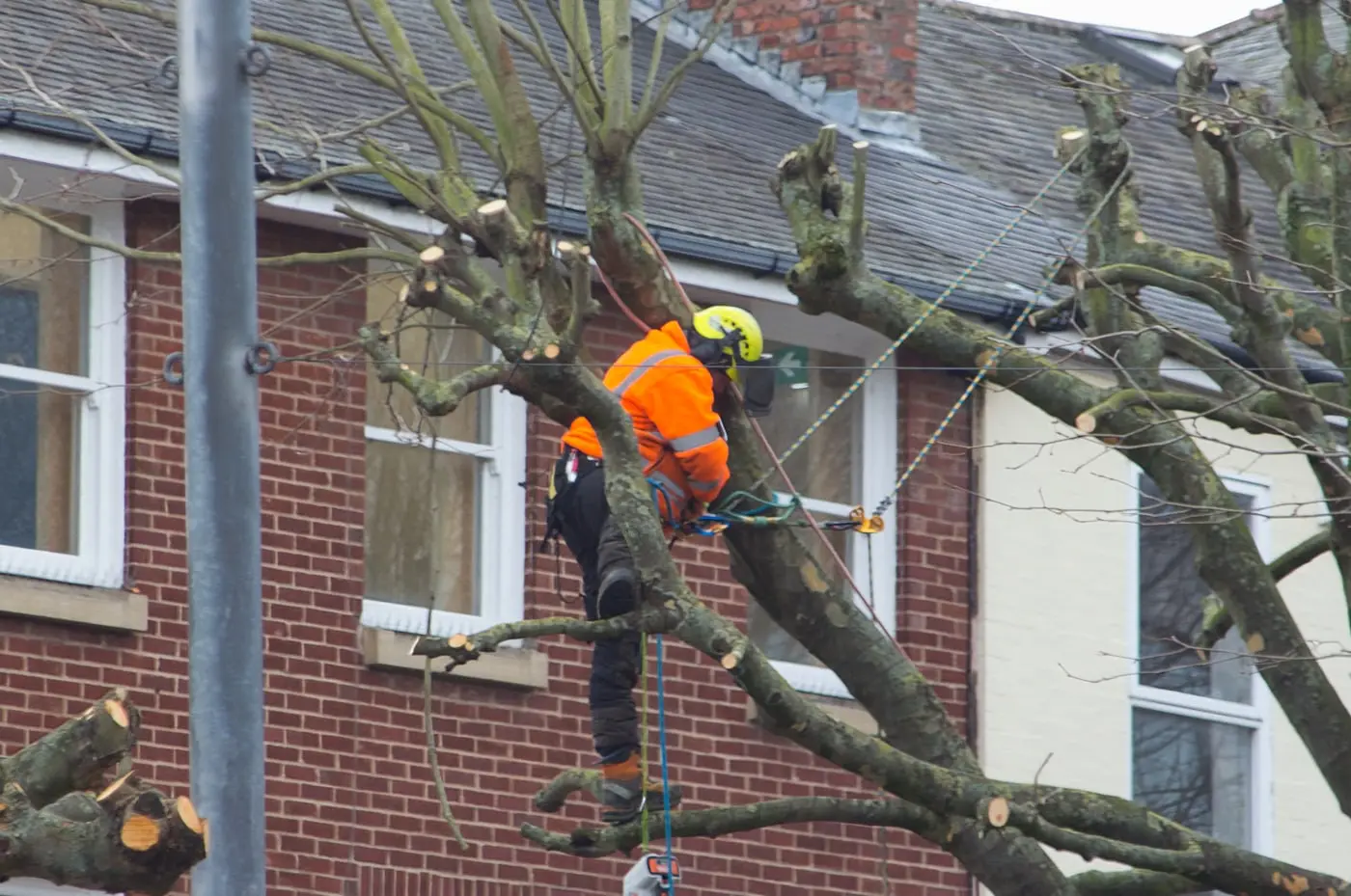
Fruit tree pruning services are available throughout Yorkshire, with specialists serving gardens in Harrogate, Ripon and Knaresborough.
Most fruit trees in Yorkshire domestic gardens are not being pruned correctly - or at all. The two most common mistakes are pruning plum trees in winter (which opens them to silver leaf fungal disease), and leaving apple trees completely alone for five or more years until the canopy is a tangled mess of crossing branches that produces small, poor-quality fruit in the outer third only. Both are easy to avoid once you understand the basic rules, and those rules are different for each species.
This guide covers apple, pear, plum, and cherry pruning: the right season for each, the Yorkshire-specific timing considerations that national guides do not mention, what it costs to have a gardener do it, and when DIY crosses the line into professional territory.
The Short Answer: When to Prune Each Fruit Tree
Before the detail, the quick reference. Different species have genuinely different requirements and mixing them up is how damage happens.
| Tree | When to prune | Yorkshire timing note |
|---|---|---|
| Apple | November to late February (dormant) | Wait for bud swell in North Yorkshire - late February is safer than December |
| Pear | November to late February (dormant) | Same as apple; slightly more vigorous so tolerates harder cut |
| Plum | June to August (summer only) | Never prune in winter - silver leaf disease risk. Dales frosts extend the no-prune window further |
| Cherry | June to August (summer only) | Same rule as plum - all Prunus species summer only |
| Trained forms (espalier, cordon) | Late July to August (summer) | Light winter tidy possible; main formative work in summer |
Apple Trees: The Main Event
Apple trees are by far the most common fruit tree in Yorkshire domestic gardens, and they need annual pruning to stay productive. A tree that gets left for even three or four years starts to build up a thicket of crossing, competing branches and produces progressively smaller fruit as light and air are excluded from the canopy.
The goal: an open goblet
The target shape for a free-standing apple tree is an open goblet or open vase. Imagine a wine glass: four to six main scaffold branches radiating outward and upward from a short central trunk, with the centre of the canopy kept open so that light can reach the fruit and air can move through to reduce disease pressure. When you stand underneath and look up through a well-pruned apple tree, you should be able to see sky through the canopy.
The practical sequence for winter pruning an established apple tree is:
- Remove all dead, diseased, or damaged wood first. This is non-negotiable and has no upper limit - take it all out regardless of how much it is.
- Remove branches that are crossing and rubbing against each other. Where two branches rub, they create wounds that let in disease. Take out the weaker of the two.
- Remove any branches growing vertically up through the centre (water shoots from the previous season's over-vigorous growth) or growing straight down.
- Shorten lateral shoots (sideshoots off the main scaffold branches) by about one third to encourage fruiting spur development.
- Step back frequently and look at the overall shape. The aim is an open, balanced canopy, not a symmetrical one. Work with the natural structure.
The critical rule is the one-third limit: never remove more than a third of the total canopy volume in a single pruning. Taking too much in one go triggers a stress response - the tree produces a flush of vigorous, upright water shoots from below the cuts, which are unproductive and have to be removed the following year. If a neglected tree needs significant reduction, spread it across two or three consecutive winters.
Yorkshire-specific timing for apple pruning
National guides say "prune in winter." In practice, the best time depends on where in Yorkshire you are. There are two competing considerations: you want the tree fully dormant (which means after leaf fall and before bud break), but you also want to be able to read the buds - to see which are plump and alive and which are dead, so you know what to cut and what to leave. And in Yorkshire, particularly in the north of the county, you also want the worst of the frost to be behind you before you make cuts.
In South Yorkshire - Sheffield, Rotherham, Doncaster - the milder urban climate means you can read buds clearly from late January and the risk of severe post-pruning frost is lower. Pruning from late January to the end of February works well.
In North Yorkshire - the Vale of York, the Howardian Hills, the Wolds - late February is the better target. The county warms more slowly and the risk of a sharp frost damaging freshly cut wood is real into March.
In the Dales and on the North York Moors, frosts can continue into May. This does not mean you cannot prune until May - apple trees are dormant through February and into March and are reasonably tolerant of some post-pruning cold. But it does mean that in exposed positions at altitude, the later end of the winter pruning window is safer. Wait until you can see the buds beginning to swell - not open, just swell - and prune then. You will be able to see clearly what is alive and the tree will seal its wounds quickly as growth begins.
Yorkshire rootstock reality
The vast majority of apple trees in domestic Yorkshire gardens are grafted onto semi-dwarfing rootstocks (typically M26 or MM106). These rootstocks keep the tree to a manageable size - roughly 2.5 to 4 metres - but they require annual pruning to stay productive. A tree on a semi-dwarfing rootstock that is never pruned gradually fills its canopy with unproductive old wood and produces less fruit each year. Annual pruning is not optional maintenance on these trees - it is what keeps them functioning.
Pear Trees
Pear pruning follows the same winter dormant-season timing as apples, with the same Yorkshire latitude adjustments. The main practical difference is that pears tend to be more vigorous than apples on comparable rootstocks - they push harder in response to pruning and can tolerate a somewhat harder cut without producing the excessive water-shoot regrowth that apples do.
The target shape is the same open goblet. Pears fruit on both spurs on older wood and on the tips of the previous year's growth (tip-bearing), which means you need to be slightly more careful about removing all of the previous season's shoots. Shorten laterals by about one third but do not remove them all - leave some tip-bearing growth if the tree is tip-bearing rather than spur-bearing. Your gardener will know which type you have by looking at the fruiting pattern.
One issue specific to pears in Yorkshire is fireblight - a bacterial disease that spreads through blossoms in spring and causes branches to look as though they have been scorched. If you see this, prune out affected branches immediately (not during the winter dormant pruning window - as soon as you spot it, in season), cutting at least 30cm below the visible infection and sterilising your pruning tools between cuts with a bleach solution or methylated spirits. Fireblight cannot be treated chemically and spreads quickly in warm, wet spring conditions - the kind that Yorkshire regularly provides.
Plum Trees: The Rule That Must Not Be Broken
Plum trees are not apples. The single most important thing to know about plum pruning is this: do not prune plums in winter. Full stop. This applies to all Prunus species - plums, damsons, greengages, bullaces, cherries, and ornamental cherry trees. If someone tells you to prune your plum tree in February, they are giving you advice that could kill the tree.
Why summer pruning is mandatory for plums
Silver leaf disease is caused by the fungus Chondrostereum purpureum. The fungal spores are airborne and are most prevalent in autumn and winter - exactly the period when plum trees are dormant and when you might be tempted to prune them. When the spores land on a fresh pruning wound on a Prunus tree in cold, damp conditions, they infect the wood. The disease spreads through the branch system, producing a silvery sheen on the leaves of affected branches (the visible symptom that gives it its name), and eventually kills branches and can kill the whole tree if the infection progresses far enough.
Summer pruning - June through August - avoids this entirely. During summer, the fungal spore count is much lower, the tree is actively growing and can produce wound-sealing callus tissue quickly, and the warm, dry conditions are inhospitable to the fungus. Prune your plum tree in summer, keep cuts clean and at a slight angle to shed water, and if you make any large cuts (over 2cm diameter), apply a wound sealant.
Yorkshire and silver leaf: extra caution in the Dales
Yorkshire's climate makes this rule more important, not less. The county's wet, cool conditions - particularly in the Dales, on the Moors, and in the Pennine valleys - are exactly what Chondrostereum purpureum thrives in. A gardener who knows the county will treat the summer-only rule for plums as absolute. The risk is not theoretical: silver leaf infection is genuinely common in Yorkshire plum trees, and a significant proportion of the cases are traceable to winter pruning.
How much to remove in a summer prune? Keep it light - one quarter of the canopy at most in a single season. Remove dead, diseased, or crossing branches first. Shorten laterals to keep the tree's shape manageable. For a plum that has not been touched for years, spread the work across two or three summers rather than attempting a major renovation in one go.
Cherry Trees
Cherries follow the same rule as plums: summer pruning only, June to August, for the same silver leaf reasons. Cherries are also sensitive to bacterial canker - another disease that enters through pruning wounds and is more of a problem in cool, wet conditions - which reinforces the summer timing.
Sweet cherry trees in particular can grow very large if left unpruned, which makes them difficult to harvest and increasingly hard to prune safely. If you have a sweet cherry that has been allowed to grow tall, the question is whether to attempt significant reduction (which requires spreading over multiple summers and is best done by a professional who can work safely at height) or to simply live with the height and accept that birds will get most of the fruit from the upper canopy.
Fan-trained cherries against a warm south or south-west facing wall are manageable and productive in Yorkshire. Summer pruning to keep the fan framework in shape, removing shoots growing directly into or away from the wall, and tying in replacement laterals is a satisfying and achievable garden task.
What Does Fruit Tree Pruning Cost?
Cost depends on tree size, access, the number of trees, and how much work is needed. A tree that has been pruned annually is a quick job. A tree that has not been touched in eight years requires considerably more thought and time.
| Job | Typical cost (2026) | Notes |
|---|---|---|
| Single small apple tree (semi-dwarfing, maintained) | £30-£50 | Annual maintenance prune, good access |
| Single larger apple or pear (standard, neglected) | £60-£100 | More time, may need ladder work |
| Plum or cherry (summer prune) | £35-£70 | Depends on size; light prune only |
| Small orchard (6-10 trees) | £175-£220 per day | Day rate; most small orchards need 1-2 days |
| Espalier or cordon maintenance | £40-£80 per session | Trained forms need summer tie-in and winter tidy |
| Waste removal | £20-£40 additional | Or leave for you to compost - agree upfront |
These are realistic Yorkshire prices for 2026. Be cautious of any quote that is significantly below this range without a clear explanation - fruit tree pruning done incorrectly (particularly plum pruning at the wrong time) can cost you the tree. The slightly higher investment in a knowledgeable gardener is worth it.
For general gardener pricing context, see the how much does a gardener cost guide and the gardener hourly rate guide.
DIY vs Hiring: Where the Line Is
Fruit tree pruning is one of those gardening tasks where the gap between competent DIY and professional work is meaningful. For a single small apple tree that has been reasonably maintained, a confident homeowner with good quality secateurs and a pruning saw, and who has read the basic principles carefully, can do a decent job. The tree is forgiving of moderate mistakes in winter pruning - it will regrow.
There are situations where hiring is clearly the right call:
- Any work that involves a ladder. Ladder safety requires two people minimum and the right equipment. Do not prune large upper canopy branches alone on a ladder.
- Plum or cherry trees that have not been pruned for several years. Getting the summer-only rule right and spreading renovation correctly over multiple seasons requires judgment.
- Trees that show signs of disease - silver leaf sheen on leaves, canker on bark, dieback in sections of canopy. A qualified horticulturist can diagnose the problem and recommend whether to prune, treat, or remove.
- Any significant renovation of a neglected tree - deciding what to take in year one vs years two and three requires understanding of how the tree is likely to respond.
- Trained forms (espaliers, fans, cordons) where the framework needs to be maintained precisely to keep the form productive.
The good news is that annual pruning of a small to medium apple or pear tree is a genuinely learnable skill. Attend an RHS fruit pruning workshop if you want to build confidence. Or have a gardener do it for two or three years while you watch and ask questions - most good gardeners are happy to explain what they are doing.
Common Mistakes and How to Avoid Them
Pruning plums in winter
Already covered, but worth repeating: this is the mistake that causes the most lasting damage in Yorkshire fruit gardens. Silver leaf infection from a winter prune can kill a branch or the whole tree. Summer only for all Prunus species.
Taking too much in one year
The one-third rule exists for a reason. A stressed tree responds with excessive vegetative growth - water shoots that are straight, vigorous, and produce no fruit - at the expense of fruiting spurs. If you need to do major renovation, plan it over two to three years.
Leaving large wounds unprotected
Cuts under about 2cm diameter will seal themselves in normal conditions. Larger cuts - particularly on plums and cherries in summer - benefit from a wound sealant applied immediately after cutting. This is especially relevant on trees in exposed positions or in the damper parts of Yorkshire where fungal pressure is higher.
Not cleaning tools between trees
Fireblight on pears and bacterial canker on cherries spread on contaminated cutting tools. Wipe blades with a diluted bleach solution or methylated spirits between trees, and certainly between any tree showing disease symptoms and a healthy one.
Ignoring trained forms through the summer
Espaliers and cordons need attention in late July and August as well as a light winter tidy. Homeowners who prune their trained forms only in winter wonder why the forms get increasingly tangled - it is because the formative summer pruning that keeps the framework in shape has been skipped. Both seasons matter for trained forms.
Yorkshire note on late frosts and blossom damage
Pruning timing affects frost risk in a secondary way that is worth understanding. Pruning in late January or early February can slightly advance bud break on apple and pear trees - the pruning stimulates growth. In areas with late frosts (the Dales, the Moors, exposed North Yorkshire positions), this matters because an early blossom caught by a May frost will fail to set fruit. In frost-prone positions, this is another reason to prune at the later end of the winter window, in late February, rather than rushing in January.
Related reading
- Garden maintenance across Yorkshire
- Garden clearance across Yorkshire
- How much does a gardener cost in the UK?
- Gardener hourly rates in the UK
- Autumn garden care in Yorkshire
- Yorkshire garden jobs by season
- Planting Trees in Yorkshire - choosing and establishing a new fruit tree
- Tree pruning in Yorkshire: ornamental and structural tree work
- Tree surgeons in Yorkshire: when to call an arborist
Frequently Asked Questions
When should I prune apple trees in the UK?
November through to late February, when the tree is fully dormant. In Yorkshire, particularly in the north of the county and at altitude in the Dales, late February is the better target - wait until you can see the buds beginning to swell and you will make more accurate decisions about what to cut.
Can I prune my plum tree in winter?
No. Prune plums (and all Prunus species including cherries) in summer only - June to August. Winter pruning on plums risks silver leaf fungal infection entering through the wound. In Yorkshire's cool, wet climate the risk is real rather than theoretical.
How much does it cost to have fruit trees pruned in the UK?
£30 to £80 per tree for standard domestic sizes. Day rates for larger orchard work run £175-£220. See the full cost guide for broader pricing context across different types of garden work.
How do I know if my apple tree needs pruning?
Crossing or rubbing branches, dead wood visible in the canopy, branches growing inward or downward, or two or more seasons of declining fruit quality are all indicators. Any apple on a semi-dwarfing rootstock (the vast majority in domestic gardens) needs annual pruning to stay productive.
What is the best shape for apple trees?
An open goblet: four to six main scaffold branches radiating outward and upward from a short trunk, with the centre kept open to light and air. When you look up through the canopy you should see sky. A closed, congested canopy means less light to the fruit and higher disease pressure.
How much can I take off a fruit tree in one pruning?
No more than a third of the total canopy in a single pruning. Taking more triggers excessive water-shoot growth at the expense of fruiting. For a seriously neglected tree, spread the renovation over two or three winters.
Does Yorkshire's climate affect when I prune fruit trees?
Yes. Late frosts in North Yorkshire and the Dales (sometimes into May) mean pruning at the later end of the winter window - late February - is safer than pruning in December or January. In South Yorkshire the milder urban climate allows pruning from late January. The key in all cases is to prune when you can read the buds clearly, so you know what to cut.
When do I prune pear trees?
Same dormant-season window as apples: November to late February. Pears are slightly more vigorous than apples and tolerate a harder prune without the same excessive regrowth response. The same Yorkshire timing caveats apply.
Should I hire a gardener to prune my fruit trees or do it myself?
DIY is reasonable for a small, maintained apple tree with good ground-level access. Hire a professional for: any work requiring a ladder, plum or cherry renovation (summer timing and judgment required), diseased trees, or any trained form (espalier, cordon, fan) that needs its framework maintained precisely. The cost of an experienced gardener getting it right is much lower than the cost of a mistake that sets the tree back three years.
Need help in your Yorkshire garden?
Whether it is fruit tree pruning, knotweed assessment, or installing raised beds - tell us what you need and we put your enquiry in front of a local Yorkshire gardener.
Get a free assessmentWhat is the best shape to prune an apple tree into?
An open goblet or open vase shape is the standard aim for a free-standing apple tree. The idea is to remove the central leader (or keep it short) and develop four to six main scaffold branches radiating outward and upward. This opens the centre to light and air, which improves fruit quality and reduces disease. A dense, closed canopy means the inner fruit gets no sun and disease pressure increases. When you look up through the canopy, you should be able to see sky.