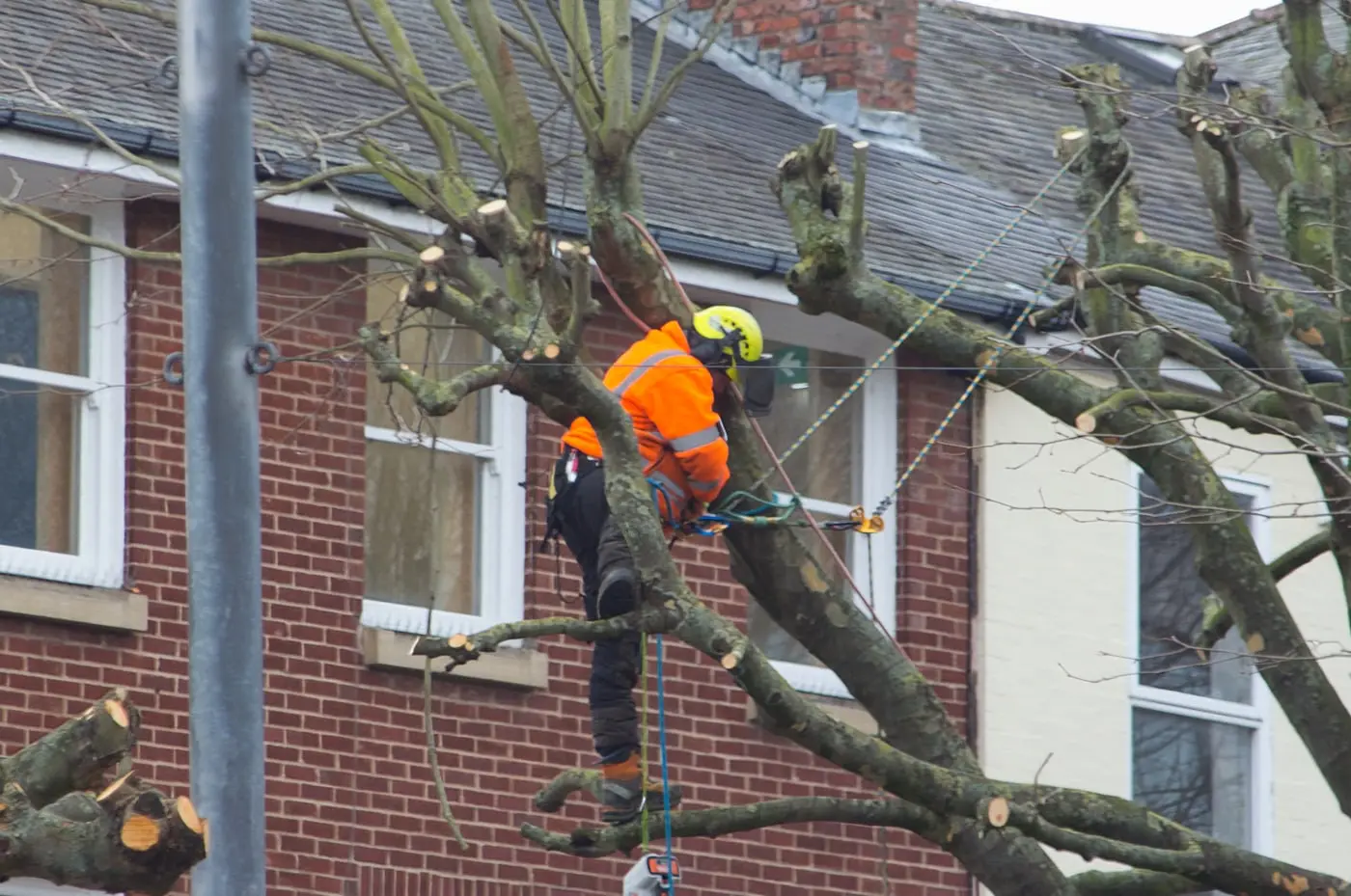
Tree pruning covers a huge range of activities, from cutting a few crossing branches off a young ornamental cherry with a hand saw to dismantling the crown of a 15-metre oak. The first is a routine gardening job. The second is specialist arboricultural work. Most of what happens in Yorkshire domestic gardens sits somewhere between the two, and the question worth asking at the start is always: what does this job actually require?
This guide focuses on the pruning that is within gardener scope - the light work, the fruit trees, the ornamental shrubs, the seasonal shaping that makes up the practical majority of tree-related calls a Yorkshire gardener receives. Where the work crosses into arborist territory, that is made clear. For the full breakdown of when a tree surgeon is needed rather than a gardener, see the tree surgeon guide for Yorkshire. For pricing on larger tree work, see the tree surgery cost guide.
When to prune trees in Yorkshire: seasonal timing
The right time to prune depends almost entirely on the species. Yorkshire's climate adds one practical constraint: the county's winters can be wet and cold, which affects when work can be done comfortably and how quickly wounds recover. Here is the seasonal framework:
| Season | Conditions in Yorkshire | Best for |
|---|---|---|
| November to February (dormant season) | Cold, often wet. Frosts possible. Some days too frozen to work effectively. | Most deciduous trees and shrubs: apple, pear, oak, ash (if needed), hawthorn, ornamentals. Best visibility of structure with no leaves. |
| March to April (early spring) | Variable. New growth beginning. Sap rising. | Avoid pruning most trees. New growth is vulnerable; removing it wastes the energy the tree has put into it. Exceptions: dead branch removal is safe any time. |
| May to August (growing season) | Warmer, longer days. Active growth. | Cherries, plums, and related Prunus species. Silver birch. Overgrown ornamental shrubs that need taming. Ornamental cherries. |
| September to October (late season) | Growth slowing. Yorkshire often wet by October. | Light tidying of ornamentals. Hedge work. Avoid heavy pruning of trees as wound-closing capacity is reducing for the year. |
The key principle: prune deciduous trees when they are dormant, with the exception of species susceptible to fungal disease that enter through pruning wounds (cherry, plum, birch) where summer pruning is safer. Dead branch removal can be done any time of year, as the branch is already dead.
What a gardener can safely prune
A qualified gardener with good horticultural knowledge can safely handle a significant amount of tree and shrub pruning work. This includes:
- Light pruning of ornamental trees and shrubs up to about 4-5 metres, working from the ground or a standard ladder
- Apple, pear, and plum tree pruning - formative, renovation, and annual maintenance (full detail below)
- Dead branch removal on accessible trees using loppers, hand saw, or pruning saw
- Crown lifting on smaller ornamental trees, removing the lowest branches to increase clearance from ground level
- Formative pruning of young trees to establish good structure in the first 3-5 years
- Ornamental cherry and ornamental plum pruning (in summer, see below)
- Shrub pruning of any kind: roses, buddleia, cotoneaster, viburnum, and similar
The test is whether the work can be done safely from the ground or a standard domestic stepladder using hand pruning tools. Once the job requires a chainsaw, climbing equipment, or aerial access, it crosses into arborist territory.
When you need a certified arborist
Gardeners and arborists work in overlapping but distinct areas. The following jobs require a qualified arborist with relevant NPTC chainsaw certificates:
- Any tree felling, regardless of size
- Crown reduction and crown thinning on large trees (over 4-5 metres)
- Any work requiring a chainsaw above ground level
- Work requiring climbing equipment or an aerial work platform
- Emergency removal of storm-damaged trees or large branches
- Any work on trees near power lines, structures, or public access areas
- Work on trees showing structural instability or disease-related weakness
- Any work on a TPO (Tree Preservation Order) tree
The honest scope test
If you would feel confident doing the job yourself from a ladder with a hand saw, a gardener can do it better and faster. If you would be nervous doing it yourself and find yourself thinking about what happens if it goes wrong, you need an arborist. Risk awareness is the most reliable guide.
Pruning by species: the trees most common in Yorkshire gardens
Apple and pear trees
Apple and pear are by far the most common fruit trees in Yorkshire domestic gardens. Both are pruned in the dormant season, November to February, when the tree is not actively growing and the structure is clearly visible. Pear trees are slightly more resistant to cold than apples but otherwise follow the same principles.
What to remove first: Always start with the three Ds - dead, diseased, and damaged branches. Cut back to healthy wood or to the branch collar (the raised ring of tissue where the branch joins the trunk or parent branch). Do not cut flush with the trunk; leave the collar intact as it contains the cells that will seal the wound.
Opening the centre: The classic approach for established apple trees is to aim for an open goblet shape - a central area relatively clear of crossing or congested branches, with an open centre that allows light and air into the canopy. Remove crossing branches (branches that rub against each other), and branches growing straight down or straight into the centre. The goal is a tree where you could throw a hat through the canopy at most points.
Spur-bearing vs tip-bearing varieties: This is the most common source of confusion with apple pruning. Most apple varieties are spur-bearing - they produce fruit on short stubby growth called spurs that develop along the older branches. For these, you can cut back side shoots to 3-5 buds from their base to encourage spur development. Tip-bearing varieties (Bramley's Seedling is the most common tip-bearer in Yorkshire gardens) produce fruit at the tips of new growth, so cutting back all the tips removes next year's fruit. Identify your variety if possible, or prune lightly until you understand how it fruits.
Renovation pruning: Yorkshire fruit trees, particularly in older gardens, are frequently under-pruned and have developed into congested, crossing messes. Renovation works over 2-3 years: do not try to fix years of neglect in one session, as removing too much growth in one go stresses the tree and stimulates excessive regrowth. Take out the worst crossing branches in year one, open the centre in year two, then maintain the improved structure going forward. For detailed seasonal timings, see the fruit tree pruning guide for Yorkshire.
Cherry and plum trees
The critical rule for all Prunus species (cherries, plums, damsons, gages, ornamental cherries) is to prune in summer, not winter. The reason is silver leaf disease (Chondrostereum purpureum), a fungal pathogen that enters pruning wounds most readily in autumn and winter when the spores are most active and the tree's wound-closing capacity is lowest. Infection causes a characteristic silvery sheen on the leaves of affected branches, progressing to branch death and eventually the death of the whole tree. The disease is serious and there is no cure once the wood is infected.
Prune cherries and plums between May and August, ideally June or July. At this time of year the tree is in active growth, wound-closing is at its fastest, and silver leaf spore levels are at their lowest. Keep cuts clean, use sharp tools, and avoid leaving stubs.
Morello cherry: A particularly common variety in Yorkshire gardens because it tolerates shadier positions better than sweet cherries. Morello is a sour cherry that produces fruit on one-year-old wood. Pruning should remove a proportion of the old fruited wood each year to encourage new growth, done in summer after fruiting. Renovation of a congested Morello can be quite hard: cut old woody stems back to strong young growth in June, and the tree will typically respond well.
Ornamental cherries: The pruning rules are the same as fruiting cherries: summer only, May to August. Most ornamental cherries only need pruning to remove dead, crossing, or awkward branches rather than for fruiting management. They resent heavy pruning and do best with light, infrequent cuts rather than regular hard reduction.
Oak
Oak should be pruned as little as possible. It is a long-lived tree that resents unnecessary cutting, and wounds on oak are slow to seal. The only reasons to prune an oak are safety (removing a genuinely dangerous or structurally compromised branch), crown lifting (removing the lowest branches to increase ground clearance), or removing dead wood. Never top an oak - cutting the main leader or removing large sections of the canopy to reduce height is deeply damaging and not a legitimate pruning technique for any tree, but particularly for oak.
Many oaks in Yorkshire gardens - particularly older specimens - will have Tree Preservation Orders. Before any work on an oak, check with your local council planning department. Unauthorised work on a TPO oak can result in unlimited fines. For significant pruning of a mature oak, you need a qualified arborist with the appropriate experience, not a gardener.
If you need crown lifting on a smaller oak (removing the lowest branches from a young tree to increase clearance), this can be done by a gardener from ground level in the dormant season. Cuts should be made to the branch collar and not left as stubs.
Ash
Ash dieback (Hymenoscyphus fraxineus) has spread extensively across Yorkshire and has changed how ash trees should be managed in domestic gardens. Many Yorkshire gardens have ash trees now showing characteristic symptoms: wilting and blackened leaves in summer, diamond-shaped lesions on the bark where the bark has died back, epicormic growth (small shoots sprouting directly from the trunk in response to crown stress), and progressive dieback working down through the crown.
For mildly affected ash trees showing some dead branches but otherwise structurally sound, a gardener can remove accessible dead branches in summer using hand tools, following good hygiene: clean and disinfect tools between cuts, and dispose of infected material properly rather than leaving it on site. Do not compost infected ash material.
For ash trees with significant dieback, or ash trees anywhere near a building, path, wall, or public area, get an arborist assessment before doing any work. Ash with advanced dieback develops brittle, unpredictable dead wood that can detach without warning, particularly in wind. A tree that looks manageable in leaf can be dropping large sections by the time the dead wood has dried out in autumn. Arborist assessment should address whether the tree is safe to retain with managed dead branch removal, or whether the extent of infection and structural compromise makes it a hazard that needs removal.
Silver birch
Silver birch is a fast-growing, relatively short-lived tree (typical lifespan 60-90 years) that is common in Yorkshire gardens as an ornamental specimen. It requires minimal pruning. The main thing to know is that birch bleeds heavily from pruning wounds if cut in winter or early spring, when the sap is rising. This will not kill the tree but it is wasteful of the tree's resources and looks alarming. Prune silver birch in summer, between May and July, when the sap flow has stabilised.
Silver birch often needs crown lifting as it matures, removing the lower branches to increase clearance and light beneath the canopy. This is straightforward gardener work when the lower branches are accessible. Dead branch removal can be done at any time. Birch does not respond well to hard pruning: it is better to remove a branch entirely than to cut it back to a stub, which tends to die back and create entry points for disease.
Yorkshire-specific considerations
Pennine weather and wind exposure
The western parts of Yorkshire, from the South Pennines through Calderdale and into North Yorkshire, are genuinely wind-exposed. Gardens in these areas accumulate storm damage more frequently than sheltered lowland sites. Trees that have been weakened by pruning cuts, disease, or root issues are more vulnerable to wind throw. After significant storms, check trees for cracked branch unions, leaning, or sudden crown dieback, which can indicate root damage that is not immediately visible. Ash trees with dieback are particularly vulnerable to wind damage because the dead wood becomes brittle and the reduced leaf canopy creates increased wind resistance in unexpected ways as the structure changes.
Ash dieback across the county
Yorkshire has a large ash population, both in gardens and in the wider landscape. The disease is now present across the county and the question for most ash tree owners is not whether the tree will be affected, but when and how severely. Some trees show remarkable resilience and hold on for many years with limited canopy loss. Others decline rapidly. The rate of progression is affected by the tree's overall health, its soil conditions, and the severity of secondary infections (particularly honey fungus, which can exploit the root system of a weakened ash).
Do not ignore an ash that is showing symptoms near your house. Have it assessed. The assessment cost is low relative to the cost of emergency removal after a branch failure, or the liability if a weakened tree damages a neighbour's property.
TPO trees and conservation area requirements
Yorkshire has a large number of TPO trees and extensive conservation areas. Before any significant pruning on a tree that might be protected, check with your local planning authority. The 12 Yorkshire councils all maintain TPO registers. In a conservation area, any tree with a trunk diameter over 75mm requires 6 weeks' notice to the council before work, even without a specific TPO. The council then has the opportunity to make a TPO. When in doubt, check first - the administrative burden of checking is minimal; the consequences of proceeding without checking can be significant.
Seasonal quick reference for Yorkshire trees
| Species | When to prune | Key notes |
|---|---|---|
| Apple / pear | November to February (dormant) | Open goblet shape, remove crossing/dead branches, tip-bearers need different approach |
| Cherry / plum / Prunus | May to August (summer only) | Silver leaf disease risk if pruned in autumn/winter. Never prune November-March. |
| Silver birch | May to July (summer) | Bleeds heavily if cut in winter/spring. Dead branches can be removed any time. |
| Oak | Dormant (November-February) if pruning must happen | Prune as little as possible. Check for TPO first. Major work requires arborist. |
| Ash | Summer preferred for dead branch removal | Check for dieback symptoms. Significant dieback = arborist assessment required. |
| Rowan / mountain ash | November to February (dormant) | Light pruning only. Good natural form; usually needs minimal intervention. |
| Ornamental crab apple | November to February (dormant) | Remove crossing, dead branches. Can thin for better fruiting display. |
| Hawthorn (garden tree) | November to February, or July-August | Flexible. Hard renovation can be done in dormancy. Check for nesting birds before any work. |
How much does tree pruning cost?
For gardener-scope pruning in Yorkshire - small trees, fruit trees, ornamentals, accessible light pruning - costs in 2026 run approximately:
- Single apple or pear tree (standard garden size): £50-150 depending on condition and amount of work needed
- Fruit tree renovation (neglected tree needing substantial work): £100-250
- Ornamental tree light pruning and deadwood removal: £50-120
- Crown lifting on a small ornamental tree from ground level: £60-150
- Ornamental cherry pruning (summer visit): £50-120
For arborist-scope work on larger trees, see the full tree surgery cost guide for Yorkshire. The key message is: for jobs within gardener scope, gardener rates apply, which are considerably below arborist rates for the same scale of work.
Garden maintenance services that include regular pruning and tree care are often the most cost-effective approach for a garden with several trees and shrubs to manage. An annual or biannual maintenance visit that covers all the pruning at once is more efficient than booking individual visits for each tree. See the garden maintenance service page for how that works across Yorkshire. For more on planting and border management, the borders and planting service covers the complementary work around trees and shrubs.
Frequently asked questions
When is the best time to prune trees in Yorkshire?
For most deciduous trees, the dormant season (November to February) is the primary window. The tree is not growing, wounds close efficiently, and the structure is visible without leaves. Important exceptions: cherries and plums in the Prunus family must be pruned in summer (May to August) to avoid silver leaf disease. Silver birch should also be pruned in summer to avoid heavy bleeding from wounds. Dead branches can be removed safely at any time of year. Yorkshire's wet winters mean some jobs are weather-dependent - avoid pruning in hard frosts or saturated conditions.
Can my gardener prune my apple tree?
Yes, for the vast majority of domestic apple trees. Apple and pear pruning in the dormant season is standard gardening work and does not require arborist qualifications. A knowledgeable gardener can handle formative pruning on young trees, renovation of neglected older trees, and routine annual maintenance. The work becomes more complex if the tree is very large with major structural problems, or if machinery is needed to access it. For most Yorkshire garden apple trees, a qualified gardener with horticultural knowledge is the right person. See our fruit tree pruning guide for the full seasonal detail.
How do I know if my tree needs an arborist or a gardener?
Height, equipment, and risk. If the tree is under 4-5 metres and the work can be done safely from ground level or a standard ladder with hand tools, and the tree is not near a building or structure, a gardener can handle it. If the tree is over 5 metres, requires a chainsaw above ground level, is close to a building, power line, or boundary, or shows structural problems that raise safety concerns, you need a qualified arborist with NPTC chainsaw certificates and appropriate tree surgery insurance. Our tree surgeon guide for Yorkshire explains the qualification requirements in full.
Should I prune my ash tree if it has ash dieback?
It depends on severity. Mildly affected trees with dead branches in accessible positions can have those branches removed by a gardener using hand tools, with good hygiene practice (disinfect tools between cuts). A significantly diseased ash near a building, path, or wall needs an arborist assessment before any work. Ash dieback weakens the wood, making branches brittle and unpredictable. An arborist will assess whether the tree is safe to retain or poses a genuine structural hazard. Do not carry out major work on a heavily infected ash without professional input.
Related articles
- Planting Trees in Yorkshire - the companion guide for adding new trees
- How to Find a Tree Surgeon in Yorkshire
- Tree Surgery Costs in Yorkshire (2026 Prices)
- Stump Grinding in Yorkshire: for full tree removal, what happens next
- Fruit Tree Pruning in Yorkshire
- How Much Does Hedge Trimming Cost?
- Yorkshire Lawn Care Calendar
- Autumn Garden Care in Yorkshire
- Garden Maintenance Across Yorkshire
- Borders and Planting Across Yorkshire
Tree and shrub pruning across Yorkshire.
A local Yorkshire gardener for fruit trees, ornamentals, and accessible pruning work. 60-second form, free to you.
Start the assessmentGardeners in your area
We cover the whole of Yorkshire. Click through to your town for local pricing and availability: