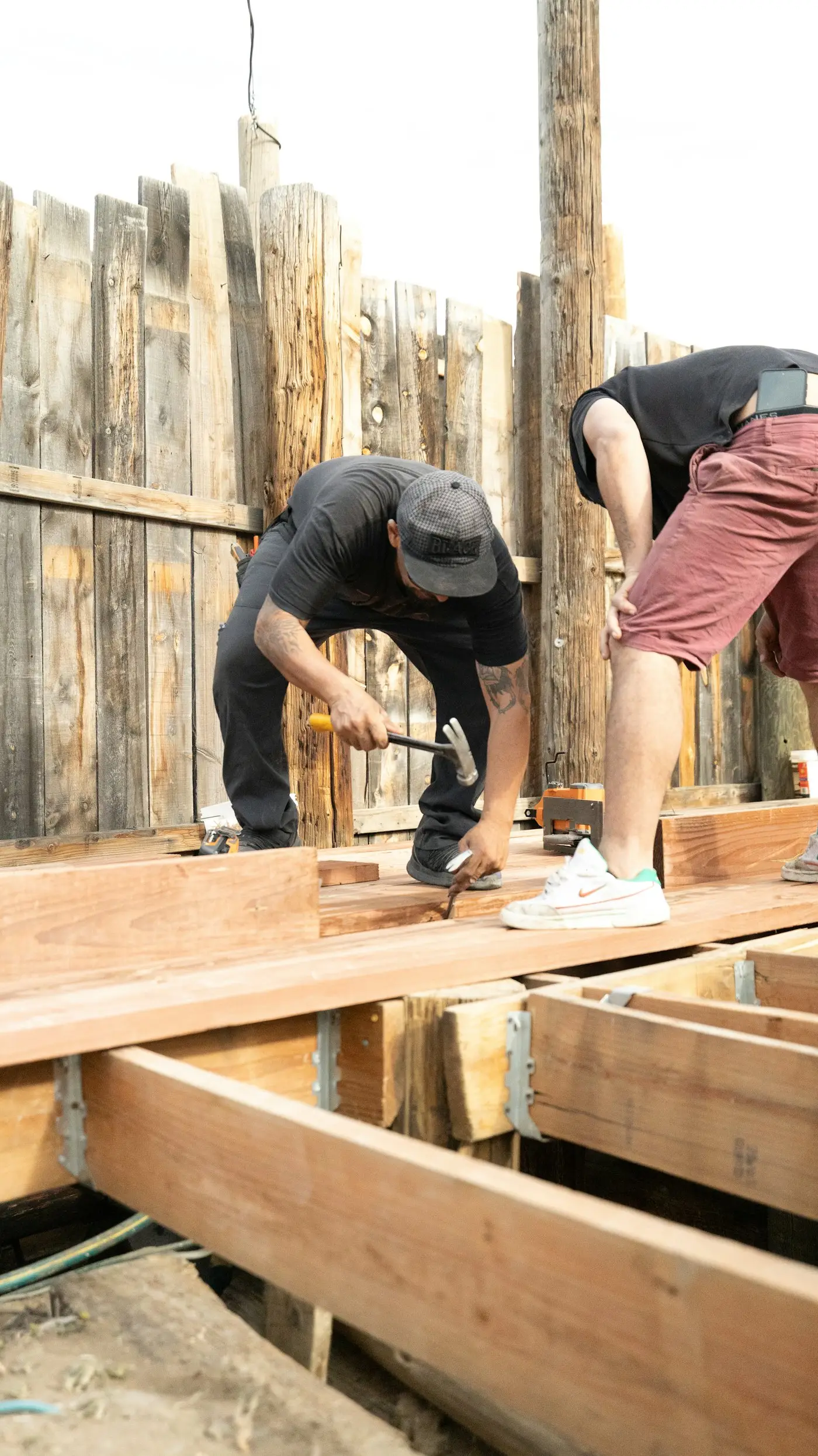
Decking installers are active across Yorkshire, with strong demand from homeowners in Sheffield, Wakefield and Bradford.
Decking is one of the most popular garden improvements across Yorkshire, and it is easy to understand why. A significant proportion of Yorkshire gardens sit on sloping ground - the hills of Sheffield, Bradford, Halifax, Hebden Bridge, and the valleys around Harrogate and Ilkley produce garden topographies where laying a level patio is either impossible or prohibitively expensive. Decking, built on a frame that follows the slope, solves this problem elegantly and creates genuinely usable outdoor living space where there would otherwise be a difficult slope or an awkward drop. For gardens with reasonably level ground, our patio laying service is worth comparing before committing to a deck - material costs, drainage requirements, and long-term maintenance are quite different between the two options.
But Yorkshire's climate adds complexity that guides written for a national audience often skip past. The county's persistent damp, the relatively high annual rainfall across the West Riding, and the damp-laden air that settles into valleys like those around Hebden Bridge and Holmfirth mean that softwood decking behaves differently here than it does in Surrey. Yorkshire homeowners who installed cheap pressure-treated softwood decks in the early 2010s are, in many cases, now replacing them. That experience has driven a significant shift towards composite decking in the region over the last five years - and the shift makes sense.
This guide gives you the real costs for decking installation in Yorkshire in 2026, works through the material options honestly, and covers what to ask any installer before they start work. We are a gardening service, not a specialist decking firm - but we work alongside decking teams regularly, and we handle the lawn restoration, border planting, and ongoing garden maintenance that makes the space around a new deck look as good as the deck itself.
The Quick Answer: Decking Costs in Yorkshire 2026
Installed decking in Yorkshire costs roughly £125-500 per square metre depending on material and complexity. A small deck of 15-20m2 costs £2,500-10,000 installed. A medium deck of 25-35m2 costs £4,000-16,000. Here is how those numbers break down by material:
| Material | Small deck (15-20m2) | Medium deck (25-35m2) | Typical lifespan (Yorkshire) |
|---|---|---|---|
| Pressure-treated softwood | £2,500-5,000 | £4,000-8,000 | 12-18 years with maintenance |
| Hardwood (oak, iroko) | £4,000-8,000 | £6,500-14,000 | 25-30 years |
| Composite | £5,000-10,000+ | £8,000-16,000+ | 20-25+ years (often warranted) |
Labour rates for decking in Yorkshire run at £150-200 per person per day. A typical two-man crew takes 4-5 days for a medium deck, including frame construction, board laying, and finishing. That puts labour at roughly £1,500-2,000 for the crew across the job. The significant variation in total cost is driven by materials, any structural challenges (steep slopes, difficult access, elevated decks requiring deeper posts), and add-ons like balustrades, steps, and integrated lighting.
Material Options: What Works in Yorkshire
Pressure-treated softwood: the budget choice with caveats
Pressure-treated softwood - typically pine or spruce impregnated with preservative under pressure to resist rot and insect attack - is the most common choice for garden decking across the UK. It is widely available, easy to work with, and significantly cheaper than the alternatives. The boards are light, cut easily, and the green-tinted treatment weathers to a pleasant silver-grey over time without intervention.
The caveats for Yorkshire are significant. Pressure-treated softwood needs annual treatment with a good-quality decking oil or stain to maintain its resistance to moisture. In Yorkshire's climate, skipping this treatment for even one or two seasons accelerates decay at the board ends, around fixings, and anywhere water sits after rain. On a south-facing deck in Harrogate with good airflow, annual treatment may be enough. On a north-facing deck in Hebden Bridge that barely dries out between October and March, the same boards will show signs of serious deterioration within a decade.
Boards should be the C24 grade minimum for decking applications, not the cheap construction timber that some less reputable installers substitute to hit a low quote price. Ask specifically for decking-grade pressure-treated boards and check the specification before work begins. The frame underneath matters too: the joists and bearers that support the boards should also be pressure-treated to UC4 standard (ground contact grade) if any part of the frame is near or in contact with soil.
Hardwood decking: the long-life middle ground
Hardwood decking - typically iroko, ipe (Brazilian walnut), or European oak - is substantially denser and more durable than softwood. The cellular structure of hardwood is less permeable to moisture, which means it resists decay far more effectively without the chemical treatment that softwood relies on. Good hardwood decking installed correctly should last 25-30 years in Yorkshire with basic oiling every 2-3 years to maintain its appearance and protect the surface.
The trade-off is cost. Hardwood decking boards cost roughly three to four times as much as softwood boards at the timber merchant, and the denser material is harder to cut and fix - which adds to labour time. Expect to pay £4,000-8,000 for a small hardwood deck in Yorkshire in 2026, rising to £6,500-14,000 for a medium-sized project. Iroko is currently better value than ipe and performs comparably in Yorkshire's climate. European oak looks beautiful but is on the more expensive end and does require oiling to prevent it checking (cracking on the surface) as it dries.
One practical note: hardwood is significantly heavier than softwood. Delivery and handling of hardwood boards requires more labour and sometimes a different logistics approach, particularly on sites with difficult access. This is worth discussing with your installer before quoting.
Composite decking: the Yorkshire-smart choice for most homeowners
Composite decking - boards made from a mixture of wood fibre and plastic, often with a protective polymer cap layer - has become the material of choice for a growing proportion of Yorkshire homeowners, and the case for it in Yorkshire's specific climate is strong. The capped composite boards that now dominate the better end of the market are essentially impervious to Yorkshire's damp. They do not absorb moisture, they do not rot, they do not need annual treatment, and they do not warp or split as softwood does when exposed to repeated wet-dry cycles.
The practical maintenance requirement for a good composite deck is sweeping and occasional washing with a domestic pressure washer - perhaps two hours once a year. Compare that to the annual treatment required for softwood (a full day's work for a typical deck, plus the cost of decking oil or stain each year) and the lifecycle cost case for composite becomes clear. Over a 20-year period, the maintenance cost difference largely offsets the higher upfront installation cost.
The quality range in composite is significant. Budget composite boards (available from DIY sheds) use a lower density wood fibre mix and no protective cap layer, and they can discolour, fade, and develop a slimy algae surface in Yorkshire's conditions. The better composite manufacturers - Trex, Millboard, Cladco, and others - use dense boards with a textured, capped surface that resists algae and UV fading. Specify a capped composite board from a recognised manufacturer and ask to see the manufacturer warranty (typically 20-25 years on the better products). Do not accept uncapped composite as a like-for-like substitution for capped.
The Yorkshire damp test for decking materials
A useful mental check when choosing decking material: imagine the board sitting wet for four months straight, as many Yorkshire decks effectively do from November to February. Softwood in that condition is fighting against its own decay; the treatment slows it down but does not stop it. Hardwood handles it well. Capped composite barely registers it. For a north-facing garden in Bradford or a shaded valley garden in Holmfirth, composite is not a luxury choice - it is the practical one.
What Drives the Cost of a Yorkshire Deck
Ground preparation and frame depth
The deck frame - the joists, bearers, and posts that support the boards above ground - is where most of the structural cost sits. The posts that support the frame need to be sunk into the ground to a depth that provides stability, typically 600mm or more depending on deck height. Each post usually sits in a concrete footing. On a slope, different posts will be at different heights, which requires more precise work and more materials.
For decks built at height - say, a deck off a back door on a sloped garden where the deck surface is 800mm or more above ground level at the low end - the structural requirements increase significantly. Deeper posts, more substantial bearers, and potentially the addition of diagonal bracing all add cost. Any deck over 600mm high is essentially a raised structure and needs to be engineered accordingly.
Access and material delivery
The same access constraints that affect patio projects - narrow side passages, restricted rear access - affect decking installations. Decking boards are long (typically 3.6m or 4.8m) and need to be manhandled through side passages that were not designed for them. A difficult access site adds at least a day to any decking job. Scaffolding or elevated work platforms are occasionally needed on raised deck projects, which adds hire cost and time.
Steps and balustrades
Steps connecting the deck to the garden below, and balustrades required for safety on raised decks, are significant additions to the base cost. A set of simple timber steps from deck level to garden might add £400-800 to the project. A full balustrade around a medium deck in metal and glass (a popular choice currently) can add £2,000-5,000 depending on specification and run length. Frame balustrades in softwood or composite are cheaper at £800-2,000 for a medium deck, and match the decking material aesthetically.
Balustrades are not optional on decks over 600mm above ground level - Building Regulations require them at that height for safety. Your installer should be specifying them as a matter of course on any raised deck; if they are not, ask why.
Lighting
Integrated deck lighting - LED strips under the handrails, post-top lights, or recessed spots in the deck boards - transforms an outdoor space and is easiest to install during the original build rather than retrofitted later. A basic LED system with a transformer, cable, and six to eight fixtures costs roughly £300-600 installed during the deck build. More elaborate systems with smart controls and multiple zones can run to £1,000-2,000.
Pattern and board layout
Standard boards laid parallel to each other in a single direction is the simplest and cheapest layout. Diagonal board runs look striking but waste more material at the edges and take longer to cut and fix, adding to both material cost and labour time. Herringbone or picture-frame borders are increasingly popular with composite and add further to the complexity. Expect a 15-25% increase in board material cost for diagonal or pattern laying compared to straight runs.
Building Regulations and Planning Permission
Most garden decking in Yorkshire falls under permitted development and does not require planning permission. The key conditions are: the deck surface must be no higher than 30cm above the natural ground level, and the deck together with any outbuildings must not cover more than 50% of the garden area. A deck at the front of the house (including to the side if it faces a highway) generally requires planning permission.
There is a common misconception that all decking requires Building Regulations approval. This is not correct for most domestic garden decks. Building Regulations do apply if the deck structure is over 600mm above ground level (in which case structural adequacy and balustrade safety requirements apply) or if the deck is attached to the house in a way that could affect the structural integrity of the building. A deck on freestanding posts that does not connect to the house structure generally does not require Building Regulations approval even if it is elevated, though your installer should be able to confirm for your specific project.
If your property is in a conservation area - which applies to significant parts of Harrogate, York, Skipton, and many villages in the Yorkshire Dales and North York Moors - permitted development rights may be restricted and a prior approval check with the local authority is advisable before starting work. Listed buildings require consent for any external alterations regardless of scale.
Maintaining Your Yorkshire Deck
Softwood maintenance
Pressure-treated softwood decking needs a good-quality decking oil or stain applied at least once a year to maintain its rot resistance and appearance. The best time to apply is late spring or early autumn when temperatures are moderate and dry weather can be expected for 24-48 hours after application. Clean the deck thoroughly first - pressure washing works well - allow it to dry completely, and apply two coats of decking oil working along the board grain.
Yorkshire's winters are hard on untreated softwood. Boards that go through winter without fresh treatment often show splitting, checking, and the beginnings of surface greying and rot at joints and board ends by spring. Boards that are allowed to deteriorate to this stage need sanding back before treatment can be applied effectively, which adds time to the job. Annual treatment before winter is strongly recommended for softwood decks anywhere in Yorkshire.
Composite and hardwood maintenance
Composite decking needs only brushing to remove leaf debris and an occasional wash down with a domestic pressure washer or deck cleaner. Proprietary composite deck cleaners address any surface algae growth that can develop in shaded, damp positions - typically a wash in early spring does the job. Do not use solvent-based cleaners on composite boards, as these can damage the polymer cap layer.
Hardwood decking should be oiled every 2-3 years to maintain its colour and surface integrity, though in Yorkshire's climate oiling every other year is sensible. Allow the boards to dry thoroughly in spring before oiling. Hardwood does not require the full sanding-back that neglected softwood needs, but a light sand before oiling helps the product penetrate evenly.
Finding a Reliable Decking Installer in Yorkshire
Decking installation sits across the boundary between general building work and specialist carpentry. Some landscaping companies install decking; dedicated decking specialists also operate across Yorkshire. Here is what to look for and what to ask.
- Get at least three quotes and ask each installer to specify the board grade, frame specification, and post footing depth in writing. The cheapest quote is frequently the one that substitutes lower-grade timber or skips on footing depth - you will not discover this until the deck starts to flex or the boards show premature decay.
- Ask to see a completed project from the previous year, in Yorkshire if possible. You want to see how the deck looks after one winter's exposure, not how it looks on installation day.
- Ask whether they carry public liability insurance and what their workmanship guarantee covers and for how long. A reputable installer should offer at least a two-year workmanship guarantee.
- For composite decking, ask which manufacturer's boards they are specifying and check the manufacturer's warranty terms yourself. Some warranties are conditional on registered professional installation - your installer should be able to register the warranty on your behalf.
- If your deck requires Building Regulations compliance (elevated deck over 600mm), ask how they are managing that process. Self-certification or a completion certificate from the local authority are both valid routes; what is not acceptable is no documentation at all.
Once the decking team has finished, the surrounding garden often needs attention. Decking installation disturbs lawns, compacts soil around post positions, and leaves the area around the deck in need of work. See our turfing cost guide for what lawn restoration around a new deck costs in Yorkshire in 2026, and our borders and planting service if you want to landscape the garden edges around the new deck. For a view of the whole garden project, from design through to finished planting, our garden design timeline guide covers typical timeframes and sequencing.
Decking and the Wider Garden
A new deck rarely stands alone as a garden project. In our experience working across Yorkshire gardens, decking installations are most satisfying when they are designed as part of the whole garden space rather than dropped in as a standalone feature. A deck that leads nowhere, has no planting around it, and sits in a garden that otherwise has not been thought through looks exactly as unfinished as it is.
The best Yorkshire decks connect the house to the garden in a way that makes the whole space feel designed. Steps from the deck lead down to a lawn or gravel area. The deck edges are softened with planted borders - clipped evergreens for structure, perennials for seasonal colour. Lighting on the deck connects to lighting in the garden beyond. The planting palette on the deck (pots, planters) connects to the planting in the borders.
This is where a garden design consultation before the decking work begins pays dividends. Understanding the whole space - where the sun is at different times of day, how you want to move between house and garden, what the view from the deck looks out onto - shapes the deck design from the start. See our garden design service if you want to think through the whole project, or our garden makeover cost guide for a sense of what a complete garden transformation including decking, planting, and hard landscaping costs in Yorkshire.
For complete garden transformation projects that include decking as one element, our garden makeover service covers the full scope from design to installation. We also recommend reading our patio cost guide if you are weighing up decking versus a patio - both are viable solutions to Yorkshire's sloped gardens, but they suit different budgets, maintenance preferences, and garden styles.
Frequently Asked Questions
Do I need planning permission for decking in Yorkshire?
Most rear garden decking in Yorkshire does not require planning permission under permitted development, provided the surface is no more than 30cm above ground level and the deck covers no more than 50% of the garden. Front-of-house positions require permission. Properties in conservation areas (including parts of Harrogate, York, and Skipton) may have restricted permitted development rights - check with your local authority before starting work.
How long does decking last in Yorkshire?
Pressure-treated softwood: 12-18 years with annual maintenance (shorter on damp, north-facing sites). Hardwood: 25-30 years with oiling every 2-3 years. Capped composite from a reputable manufacturer: 20-25+ years with minimal maintenance. Yorkshire's persistent damp shortens softwood life compared to the national average; composite and hardwood are relatively unaffected by the climate.
Is composite decking worth the extra cost in Yorkshire?
For most Yorkshire gardens, yes. The higher upfront cost is offset by near-zero maintenance spend, a longer lifespan, and no annual treatment time. The case is strongest on north-facing or shaded sites and in damper parts of Yorkshire (West Riding valleys, coastal areas near Scarborough and Whitby) where softwood decay rates are highest.
Does decking add value to a Yorkshire home?
A well-installed deck in good condition improves garden appeal and can support the sale price, particularly on sloped gardens where it creates usable outdoor space that would otherwise not exist. Estate agents suggest quality garden improvements add 5-10% to garden appeal. A rotting or poorly maintained softwood deck is actively negative - buyers price in a replacement cost.
How long does decking installation take in Yorkshire?
A small deck (15-20m2) takes a two-man crew 2-3 days. A medium deck (25-35m2) takes 4-5 days. Complex projects with steps, balustrades, and lighting can run to 7-10 days. Spring and early summer bookings fill up fast across Yorkshire - contact installers in February or March for a summer deck.
Related reading
- Garden design - planning your deck and outdoor space from the start
- Full garden makeover service - decking, planting, and landscaping
- Borders and planting - softening the garden around a new deck
- Patio laying costs in Yorkshire - decking vs patio compared
- Turfing costs in Yorkshire - restoring the lawn around a new deck
- Garden design timeline - sequencing a garden transformation project
- Garden makeover costs - what a full garden transformation costs in Yorkshire
Ready to improve your Yorkshire garden?
We handle the garden work around your new deck - turfing, planting, and maintenance. Tell us what you need.
Get a free assessment