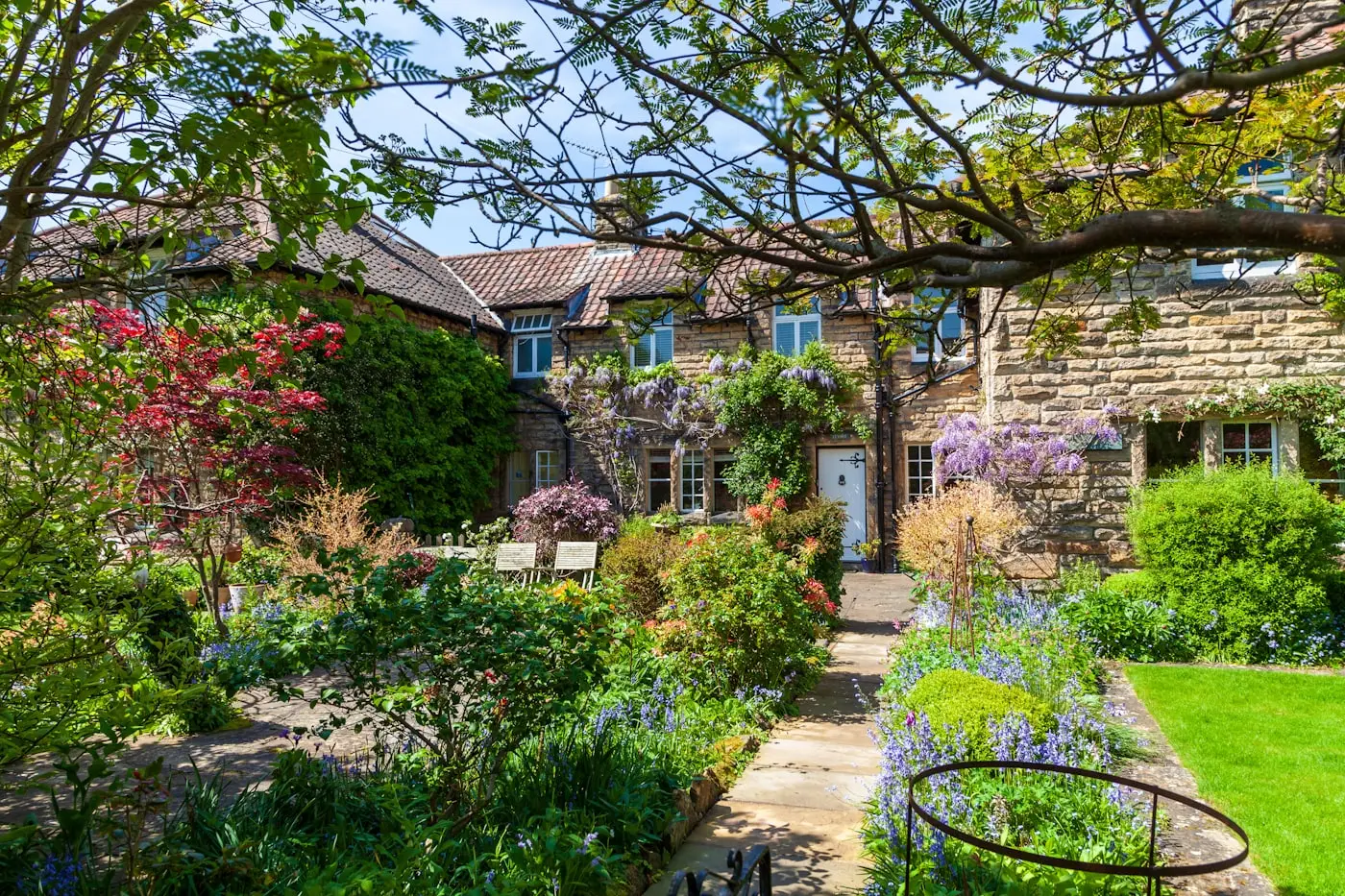
Huddersfield sits at the confluence of the Colne and Holme valleys, with the town centre in the valley bottom and residential areas spreading up the valley sides in every direction. The result is a town where almost every garden has a gradient, where the view from an upstairs window often looks out over the rooftops of the houses below, and where the moorland skyline - Marsden Moor, Meltham Moor, the hills above Holmfirth - is visible from most of the town on a clear day. This landscape character profoundly shapes what Huddersfield residents want from their gardens and what is physically possible to achieve.
Kirklees Metropolitan Borough is a large and diverse authority. It includes Huddersfield and its suburbs but also extends to Holmfirth and the Holme Valley to the south, Slaithwaite and Marsden and the Colne Valley to the west, and Batley, Dewsbury, and Mirfield to the east. Garden design conditions vary significantly across this area, from the steep gritstone valleys of the west to the flatter, more clayey ground toward Dewsbury and Batley in the east. This guide focuses primarily on the Huddersfield area and the western valleys, where the design challenges are most distinctive.
Huddersfield's Topography: The Challenge and the Opportunity
Huddersfield's valley-side topography is the defining factor for most garden design projects in the area. In Lindley, Almondbury, Slaithwaite, Honley, and Linthwaite, gradients of 15 to 30 degrees are common in domestic gardens. In the steeper parts of the Colne Valley - Milnsbridge, Golcar, Linthwaite - some plots fall or rise by 5 to 8 metres from top to bottom. This is challenging territory for any design, but it is also rich with opportunity: the views from hillside Huddersfield gardens can be spectacular, and a well-designed terraced garden on a valley side is a more interesting space than a flat suburban plot could ever be.
The key design decision on a sloped Huddersfield plot is the same as for Sheffield or any hilly West Yorkshire garden: how much to terrace and how much to work with the natural slope. Full terracing creates level, usable spaces with clear functions and defined character. Partial terracing - a level entertaining area near the house, then a more naturalistic slope below - can be more cost-effective and often produces gardens that feel more connected to the surrounding landscape. Decking integrated into the upper terrace is increasingly popular in Huddersfield, as it creates a level platform without the extensive excavation and wall-building that a paved terrace on a steep slope requires.
Gritstone: the natural building material for Huddersfield gardens
Millstone grit - the dark, coarse-grained sandstone that built Huddersfield's mill buildings and characterises the local landscape - is the natural retaining wall material for valley-side gardens in the area. Locally sourced gritstone for dry-stone or mortared walling connects the garden to the local geology, looks appropriate in the landscape, and is often more cost-effective than imported alternatives. A gritstone wall in a Huddersfield garden has the same rightness about it that a York stone patio has in a York garden. Ask your designer and contractor to specify locally sourced gritstone where possible.
Huddersfield's Soils: Acid Gritstone on the Slopes, Wetter in the Valleys
Millstone Grit dominates the geology of Huddersfield and the surrounding valleys. The soils this produces are acid, typically pH 4.5 to 6.0, and free-draining on the slopes where the rock is close to the surface. In the valley bottoms, soils are often heavier and wetter - alluvial deposits mixed with slope-washed material. The distinction matters for plant selection, and a good designer will assess which condition your plot faces before drawing up a planting plan.
On the acid gritstone slopes, the plant palette is genuinely distinctive. Rhododendrons and Azaleas are not struggling plants that have been coaxed into an alien soil chemistry - they are growing in conditions that closely mirror their natural Himalayan and Chinese habitat. They will grow larger, flower more reliably, and live longer in Huddersfield's acid soil than they would in a garden on alkaline ground. The same applies to Pieris, Kalmia, and most heathers. A designer who works in Huddersfield regularly and understands this soil chemistry will write a planting plan that exploits it rather than fighting it.
What Garden Design Costs in Huddersfield
| Scope | Typical Cost | What's Included |
|---|---|---|
| Concept drawings only | £400-£900 | Site visit, measured survey, initial concept sketches. Good starting point before committing to a full design. |
| Full design (plan only, no build) | £700-£2,200 | Measured survey, scaled planting plan, hard landscaping layout, materials specification, plant list. |
| Small mill-cottage garden (Slaithwaite, Marsden, Milnsbridge) | £3,500-£8,000 | Design and build. Typically 25-60 sqm. Often on a slope. Paving or decking, raised planters, fencing, simple planting. |
| Medium suburban garden (Lindley, Honley, Golcar) | £9,000-£18,000 | Design and build. Typically 70-180 sqm. May include terracing, gritstone retaining walls, patio, planted borders, structural planting. |
| Larger hillside garden (Almondbury, Holmfirth, upper valley properties) | £18,000-£30,000+ | Significant terracing, multiple levels, extensive gritstone or block retaining walls, comprehensive planting, possibly drainage work and decking. |
| Planting refresh (existing structure retained) | £2,000-£6,000 | New planting scheme for existing beds. Particularly effective in Huddersfield where switching to acid-suited plants can transform a struggling garden. |
Terracing costs are the major variable in Huddersfield design budgets. Gritstone retaining walls run from £200 to £420 per linear metre installed (dry-stone toward the lower end; mortared with gritstone facing toward the upper end). A garden that needs 20 linear metres of retaining wall has £4,000 to £8,000 of wall cost before any other design elements. See our sloping garden design guide for Yorkshire for a fuller breakdown of terracing approaches and costs.
The Design Process for a Huddersfield Garden
Stage 1: Site visit, survey, and slope assessment
On a Huddersfield slope, the site visit is where the structural decisions begin. A designer will assess the gradient, check which direction the slope faces (south-facing slopes are warm and dry; north-facing slopes are cooler and often damp), look at existing drainage patterns, and identify any structural problems with existing walls or boundaries. They will also think about the view: where do the best views from the plot lie, and how can the design frame or enhance them? In Huddersfield's valleys, a hillside garden with a view over the valley toward the opposite side and the moorland skyline above is a significant asset that a good design will deliberately engage with.
Stage 2: Concept and layout
The concept stage for a sloped Huddersfield garden is where terracing decisions get made. How many levels, where walls sit, how levels connect via steps, where the main sitting area is positioned - these are the structural choices that define the character of the finished garden. A designer should show you at least two layout options for a complex sloped site, with clear diagrams showing how the levels and transitions work. The choice of local gritstone for retaining walls should be discussed at this stage - it affects both cost and the visual character of the finished garden significantly.
Stage 3: Planting design
A Huddersfield planting plan should start from the site's soil pH and work outward. On acid gritstone: exploit what thrives naturally - ericaceous shrubs for structure and spring colour, ornamental grasses for summer movement, native and naturalistic planting for the wilder lower areas of a large plot. On the heavier valley-bottom soils: select for moisture tolerance in lower areas, with better-drained raised beds for anything that needs sharp drainage. Planting that references the surrounding moorland landscape - heathers, bilberry, moor-edge scrub species - can create a beautiful continuity between garden and hillside on appropriate plots.
Stage 4: Implementation
Hard landscaping and wall-building on sloped sites should happen first; planting follows once the structural framework is in place. Autumn is the best planting time for trees, shrubs, and perennials. Huddersfield's Pennine climate means frost risk can extend into late April or early May at higher valley positions - Holmfirth and Marsden are higher and cooler than the valley floor and see later last frosts. Tender plants should wait until the risk has clearly passed, typically from mid-May onward in most Huddersfield positions.
Garden Styles in Huddersfield and the Colne and Holme Valleys
Terraced hillside gardens
The archetypal Huddersfield garden design challenge. A well-executed terracing scheme on a Colne Valley slope, using local gritstone for retaining walls, creates a garden that feels connected to the landscape it sits in while providing genuinely functional, level spaces for entertaining and planting. The best terraced Huddersfield gardens use the level changes to create distinct outdoor rooms - a main terrace close to the house for everyday use, a second level for planting, a lower garden for productive growing or wilder planting - each with its own character but connected by a clear design language of materials and planting.
Acid-soil ericaceous gardens
In Lindley, Almondbury, Honley, and the upper Colne Valley, some Huddersfield gardens make a feature of the naturally acid soil rather than treating it as a constraint. A garden planned around Rhododendrons, Azaleas, Pieris, and heathers, set against a backdrop of native Scots pine or silver birch, can be spectacular in spring and maintain strong year-round structure through the deep-evergreen foliage of the Rhododendron canopy. This style is not for everyone - it has a distinctly woodland feel and requires commitment to the planting philosophy - but on the right hillside plot in Huddersfield, it is one of the most naturally beautiful approaches available.
Low-maintenance gardens with decking and hard landscaping
The most common Huddersfield brief across all property types. Decking, in particular, has become a major element of sloped garden design in the area: a raised timber deck on a steep plot provides a level entertaining platform without the excavation and wall-building cost of a paved terrace. Combined with a low-intervention planting palette of structural evergreens and ground-cover plants, a well-designed decked garden in Slaithwaite or Milnsbridge can look excellent year-round with minimal maintenance. Composite decking products designed for wet northern climates have improved significantly in quality and are now a strong choice for Huddersfield's high-rainfall environment.
Rural outdoor gardens (Holmfirth and the Holme Valley)
Holmfirth and the surrounding Holme Valley villages have a strong walking and cycling culture - the Pennine Way, the Kirklees Way, and a dense network of moorland paths pass through or near the town. Many Holmfirth gardens are designed with an eye on the surrounding landscape: naturalistic planting that transitions toward meadow or moorland at its outer edges, kitchen gardens that take advantage of the Holme Valley's relatively sheltered aspect, and outdoor seating areas positioned to look up toward the moorland skyline. In this context, a garden that fights the natural landscape rather than connecting with it always looks slightly wrong.
Ready to design your Huddersfield garden?
Tell us about your plot and we put your enquiry in front of local designers who cover Huddersfield and the wider Kirklees area.
Start the assessmentFrequently Asked Questions
How much does garden design cost in Huddersfield?
For a typical Huddersfield garden design and build, expect to pay £5,000 to £14,000 for a medium-sized garden. Larger hillside properties in Lindley, Almondbury, or Honley with significant terracing requirements run from £14,000 to £28,000 or more. Small mill-cottage gardens in Slaithwaite or Marsden typically cost £3,500 to £8,000 for a full design and build. Design-only fees are usually £600 to £2,200. Terracing on a steep slope adds cost: gritstone retaining walls run from £200 to £420 per linear metre installed.
What garden design works on a slope in Huddersfield?
Terraced levels with gritstone retaining walls are the most practical solution for steep Huddersfield plots. Local gritstone is both cost-effective and visually appropriate. Each terrace can serve a distinct function - entertaining terrace near the house, planted borders on the middle level, productive garden lower down. Decking integrated into the upper terrace creates a level platform without the full excavation cost of a paved terrace. On very steep plots, a combination of terracing and structural decking is often the most effective approach.
What plants thrive in Huddersfield's acid soils?
Huddersfield's millstone grit produces naturally acid soils (pH 4.5 to 6.0) that suit ericaceous plants extremely well. Rhododendron, Azalea, Pieris, Calluna (heather), Erica, Kalmia, and blueberries all thrive without any soil amendment. Hardy Geraniums, Astilbe, Hostas, Persicaria, and most ornamental grasses also perform well. Mediterranean herbs and chalk-loving plants require raised beds with imported compost to succeed.
How much does garden design cost in Kirklees?
Design costs across Kirklees borough are broadly similar to Huddersfield: medium gardens £5,000 to £14,000 for design and build; larger hillside properties £14,000 to £28,000 or more. Holmfirth and the Holme Valley tend toward the higher end given the steep topography and rural character. Batley and Dewsbury tend toward the lower end with more urban and inter-war suburban garden types. Design-only fees are £600 to £2,200 across the borough.
Do I need planning permission for garden changes in Huddersfield?
Most domestic garden landscaping does not require planning permission. Standard permitted development limits apply: walls over 1 metre adjacent to a highway, hard surfaces on front gardens over 5 sqm using non-permeable materials, and works on listed buildings require consent. Conservation areas exist in parts of the Huddersfield town centre, Lindley, Marsden, and Holmfirth. Retaining walls over 1 metre on or near boundaries may need structural engineer sign-off. Check with Kirklees Metropolitan Borough Council before proceeding on any borderline cases.
How long does a garden design project take in Huddersfield?
From initial site visit to completed garden, allow 3 to 9 months. The design phase typically takes 4 to 10 weeks. For Huddersfield hillside projects with terracing, the build phase can extend to 4 to 8 weeks. Planting is best done in autumn or spring. Frost risk can extend into late April or early May at higher Holme and Colne Valley positions, so tender plants should wait until the risk has clearly passed.
What is the best low-maintenance garden design for Huddersfield?
More hard landscaping relative to planted borders, with decking or paving replacing lawn on sloped sites where mowing is difficult. When planting is included, structural evergreens (Taxus, Ilex), ornamental grasses, and spreading ground-cover plants reduce ongoing maintenance. Acid-soil ericaceous shrubs like heathers, Pieris, and Rhododendron are excellent low-maintenance choices for Huddersfield - they suit the natural soil and once established require minimal intervention. See our small garden design ideas for Yorkshire for compact plot solutions.
Can I grow a kitchen garden in Huddersfield?
Yes, with some climate adaptation. Raised beds are essential for drainage on gritstone soils and earlier spring warm-up. A polytunnel or cold frame extends the season in Huddersfield's Pennine climate. Brassicas, leeks, root vegetables, and salad crops perform very well. Tender crops need a sheltered south-facing position. Holmfirth and Marsden at higher elevation have a shorter growing season than lower valley positions - check local frost dates before planning tender crops outdoors without protection.
What makes Huddersfield's garden design market distinctive?
Huddersfield sits at the intersection of Pennine mill-town culture and the walking and cycling landscape of the Holme and Colne valleys. Many residents have a strong connection to the outdoor landscape - using the Pennine Bridleway, cycling the Transpennine Trail, or walking the Holme Valley - and their gardens often reflect a desire to connect with that rural outdoor aesthetic even within an urban setting. Native planting, naturalistic schemes, and gardens that transition toward wildness at their outer edges are popular. At the same time, the strong mill-town community character values practical, well-made outdoor spaces over purely aesthetic ones. The most successful Huddersfield designs tend to be both beautiful and visibly competent.