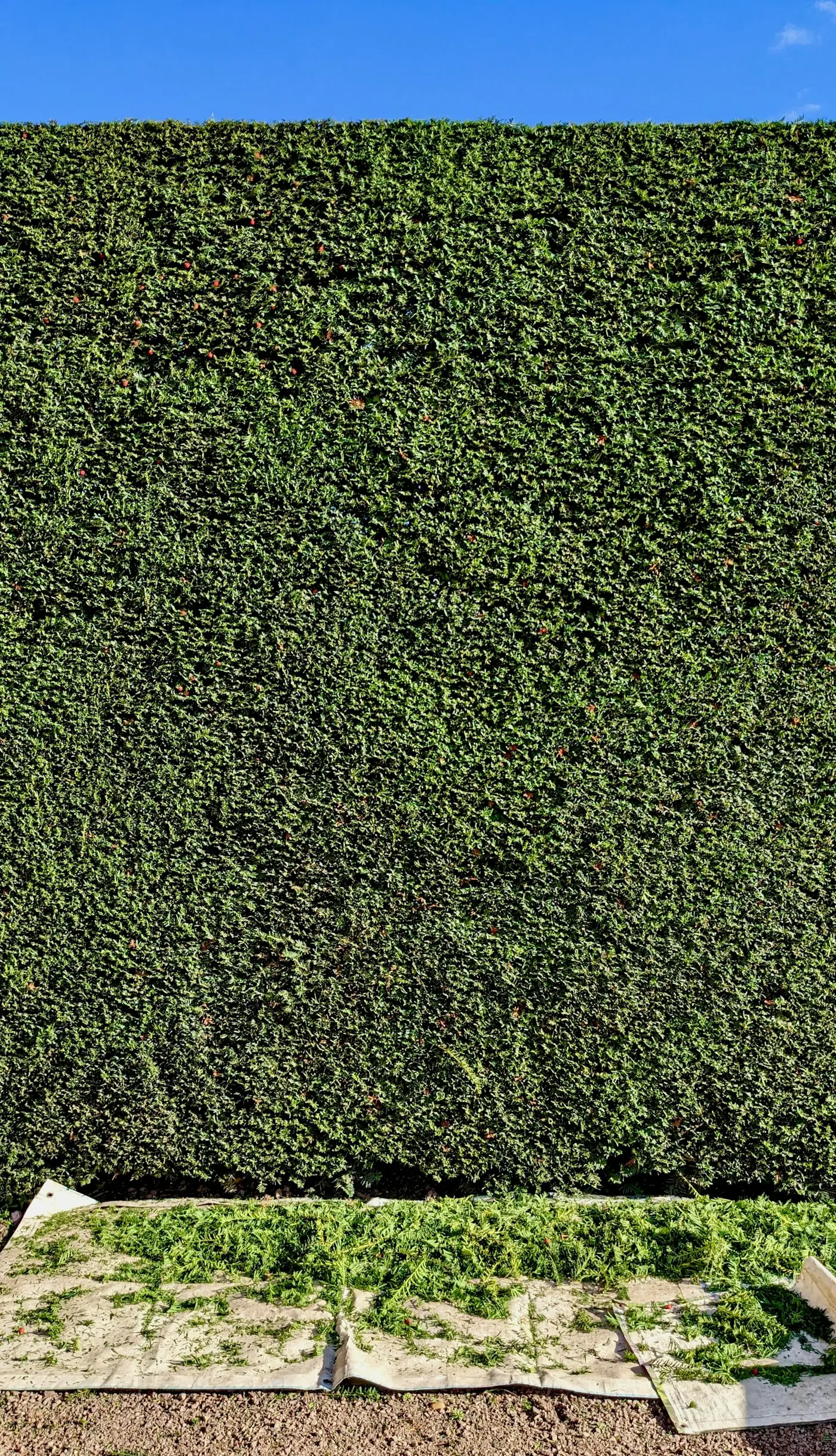
Native mixed hedging - hawthorn, blackthorn, hazel, holly and field maple - costs £8-15 per metre installed when planted as bare-root whips between November and March. Instant hedging using root-balled established plants runs £40-120 per metre installed. Between those two options lies a range of container-grown stock that gives you more planting flexibility but at a higher price. Which you choose depends on how quickly you need a screen, what you can spend, and the time of year you are starting.
The quick answer: hedge planting costs in Yorkshire 2026
Native mixed hedgerow, bare-root single row (Nov-Mar): £8-15 per metre installed. Bare-root double row stagger: £15-25 per metre. Container-grown single row (year-round): £20-35 per metre. Established instant hedge, root-balled (year-round): £60-150+ per metre. Costs include plants and labour; site preparation and rabbit protection are usually extra. Multiple rows are more expensive but create a denser hedge more quickly.
Why plant a hedge rather than a fence in Yorkshire?
A good fence costs £60-120 per metre installed and needs replacing or repairing every 10-20 years. A well-chosen hedge planted in the right spot needs a single cut per year, costs a fraction of that figure over its lifetime, and will still be standing in 80-100 years when the fence has been replaced four times. Beyond longevity, there are practical advantages that matter specifically in Yorkshire.
Wind filtration is the big one. Yorkshire is an exposed county. The Pennine corridor funnels west winds across the county from the Irish Sea. Coastal and moorland gardens face raw exposure on multiple sides. A solid fence stops wind - and then creates turbulence on the leeward side where it deflects over the top. A hedge filters wind, reducing its speed gradually through the foliage, which creates a much more effective and stable shelter zone extending several times the hedge height on the lee side. For kitchen gardens, fruit areas, or any planting that suffers from wind scorch, a hedge outperforms a fence as a windbreak in almost every situation.
Wildlife value is significant and increasingly something Yorkshire homeowners care about. A native mixed hedge provides nesting habitat for at least 30 species of birds, food and shelter for hedgehogs, habitat for insects and pollinators, and berry and nut production that supports wildlife through winter. A fence supports nothing. This is not just a nice-to-have: Yorkshire has seen significant hedgerow loss over the past century and replanting hedges in domestic gardens genuinely contributes to reversing it.
Planning permission is not required for most hedges. A hedge under 2 metres does not need any consent. Even above 2 metres, a hedge is not subject to the same permitted development restrictions as a fence (which is limited to 2 metres without consent). The main legal consideration is the High Hedges Act 2003, which allows neighbours to complain to the local council about hedges that block light, but this only applies if a hedge is already causing a problem - it is not a restriction on planting.
Species guide: what grows well in Yorkshire
The most important factor in species selection for Yorkshire is soil type. A hawthorn planted in West Yorkshire clay will thrive. A beech planted in the same clay is a gamble. A hawthorn on the Yorkshire Wolds chalk will also thrive. A hazel on exposed Pennine moorland will manage; a silver birch will do better. Soil and exposure determine species choice first. Aesthetics are secondary.
Hawthorn (Crataegus monogyna)
Hawthorn is the workhorse of Yorkshire hedging. It grows in every part of the county, tolerates clay with no complaint, handles Pennine exposure that would kill more sensitive species, and establishes quickly from bare-root stock. Growth rate of 40-60cm per year once established, reaching 3-5 metres if allowed. White blossom in May (a genuine garden event), deep red berries from September that feed fieldfares and redwings through autumn and winter. Dense enough when managed to be stock-proof. For most Yorkshire gardens, a pure hawthorn hedge or a hawthorn-dominant mix is the most reliable choice. If you know nothing about your soil and you want a hedge that will work, plant hawthorn.
Blackthorn (Prunus spinosa)
Almost as tough as hawthorn and equally suited to Yorkshire conditions. Slightly slower growing and naturally shorter at 2-3 metres. White flowers appear in March, before the leaves - a beautiful effect in early spring. Berries (sloes) are silver-blue in autumn, famously used for sloe gin. The thorns are more vicious than hawthorn, making blackthorn genuinely impenetrable when established. Useful at the base of a mixed hedge where stock-proofing or intruder resistance matters. Does not thrive in deep shade. Good companion to hawthorn in a mixed native hedge.
Hazel (Corylus avellana)
Hazel is a softer, less spiny option that works well as a garden boundary hedge rather than a stock-proof barrier. Catkins in January are one of the first signs of the year. Hazelnuts in autumn attract squirrels and dormice. Grows to 4-5 metres if not cut, and responds well to hard management including coppicing. Excellent on clay, good on loam, less happy on thin alkaline soils. Not suitable for very exposed Pennine positions without shelter. For a wildlife-friendly, informal boundary within a sheltered garden, hazel is a strong choice. In a mixed hedge with hawthorn and blackthorn, it adds texture and variety.
Holly (Ilex aquifolium)
Holly is the only major native hedge species that is fully evergreen and dense year-round. That makes it the best choice for a permanent, all-season screen or security boundary. Slow growing - allow twice the time you would for hawthorn before you have a working hedge. Tolerates heavy shade better than any other common hedge plant, which is why you see old holly hedges thriving in light-limited spots where other species have given up. Berries only on female plants; for reliable berry production plant one male to every 5-6 female plants. Most hedging holly is sold as mixed or female, which is fine for appearance but worth confirming with the nursery. Holly is less happy in waterlogged clay than hawthorn, so if your ground sits wet in winter, add drainage or choose a different species for those sections.
Field maple (Acer campestre)
Britain's only native maple, and an underused hedge species. Good on clay, excellent autumn colour (gold and butter yellow), grows to 4-5 metres. Tolerates regular clipping well and produces a neat, formal hedge if managed tightly. Less valuable for wildlife than hawthorn but far better than most exotic hedge species. Works well as a component in a mixed native hedge or as a single-species formal hedge on medium to heavy soils.
Beech (Fagus sylvatica)
Beech is famous for its winter performance: the dead copper leaves hold on the branches through winter, giving a degree of privacy even when fully dormant. For this reason it is popular as a formal garden hedge where year-round screening matters. However, beech is significantly more demanding about soil than hawthorn or blackthorn. It demands free-draining conditions: chalk, limestone, light loam. It does not perform well on heavy clay, particularly clay that sits wet in winter. Waterlogged clay will kill beech or stunt it severely. For Yorkshire Wolds and Dales gardens on chalk and limestone, beech is an excellent choice. For West Yorkshire or South Yorkshire clay gardens, it is not. Check your drainage before committing to beech. On suitable soils it grows at 30-60cm per year and makes one of the finest garden hedges in the country.
Leylandii (x Cuprocyparis leylandii)
Leylandii grows fast - very fast. Left uncut it reaches 20-30 metres. As a garden hedge it is manageable only if you are committed to cutting it 2-3 times per year from day one, and keeping it at the height you want rather than letting it establish height and then trying to reduce it. The main practical issue is that leylandii cannot be cut back into old wood - unlike hawthorn or beech, it will not regenerate from a hard cut into brown stems. You cannot reduce an overgrown leylandii hedge the way you can a native hedge; once it gets out of hand, your options are trim it at height forever or replace it. The legal context: the High Hedges Act 2003 was passed largely because of leylandii disputes between neighbours. If a leylandii hedge you plant blocks light to a neighbour's property, your local council has the power to require you to reduce it. Plant it with realistic intentions about long-term maintenance, or choose a slower-growing species that is easier to manage.
Soil matching for Yorkshire conditions
Alkaline soils (Dales limestone, Yorkshire Wolds chalk): beech, hawthorn, blackthorn all thrive. Avoid acid-lovers (rhododendrons, azaleas, pieris) unless in raised beds with ericaceous compost. Heavy clay (West Yorkshire, South Yorkshire, Vale of York): hawthorn, blackthorn, hazel, and field maple all tolerate well. Beech struggles on waterlogged clay. Exposed Pennine positions: hawthorn and blackthorn first, hazel if there is some shelter. Coastal: escallonia and griselinia for exposure; hawthorn inland from the coast.
Timing: when to plant
Bare-root hedging plants are available from November through to late February or early March, and this is the best and cheapest time to plant. Bare-root plants are lifted from nursery fields when dormant, sold without any pot or soil, and planted directly into prepared ground. They cost significantly less than container-grown equivalents and establish equally well or better in most conditions because they go in without any root circling or pot-bound growth patterns.
The best time to plant bare-root stock in Yorkshire is October to early December, before the ground hardens. Plants go in before the worst winter frosts, settle over winter, and are ready to push growth as soon as temperatures rise in March. Planting in January or February is also fine, but if the ground is frozen solid you may have to wait for a mild spell. Planting just before Christmas is consistently good in Yorkshire: the soil is moist, usually still workable, and the plants have several months of dormancy ahead to settle before they need to perform.
Container-grown plants can go in year-round but need regular watering in their first summer. They cost more than bare-root stock - typically 3-5 times as much per plant - but give you flexibility if you missed the bare-root window. For small gaps in an existing hedge or replacement of dead sections, container-grown plants in spring are entirely practical.
How to plant: spacing, rows and establishment
Spacing
For a single-row native hedge: plant at 30-45cm spacing. Tighter spacing (30cm) gives faster cover but costs more in plants. Wider spacing (45cm) is fine for hawthorn and blackthorn which branch enthusiastically. For a double-row staggered hedge - two rows offset from each other like a brick bond pattern - use 45cm within-row spacing and 40cm between rows. The double row fills in faster and creates a much more solid barrier, particularly useful for stock-proofing or if privacy is the primary aim.
Staking
Bare-root whips under 90cm generally do not need staking; they are small enough that root anchorage develops quickly. Larger transplants (over 90cm) benefit from a stake and tie for the first year to prevent wind rock while roots establish. Container-grown instant hedge plants at 1.5-2 metres always need staking until they root in fully - usually 12-18 months.
Rabbit and deer protection
This is the most overlooked aspect of hedge planting in rural Yorkshire. A row of newly planted hawthorn or hazel whips without protection is breakfast for rabbits. Individual spiral guards (60cm height for rabbits, 120cm for hares or deer) on each plant add cost but prevent complete establishment failure in any garden with wildlife pressure. In urban gardens with genuinely enclosed boundaries this may be unnecessary, but if there is any chance of access by rabbits - and in most Yorkshire villages and rural properties there is - protect the plants from the start rather than replanting after losses.
Hedge planting cost table: Yorkshire 2026
| Option | Cost per metre (installed) | Best for |
|---|---|---|
| Bare-root, single row, native mix | £8-15/m | Most cost-effective; plant Nov-Mar; typical garden boundary |
| Bare-root, double row stagger | £15-25/m | Faster screen; more stock-proof; exposed or security boundaries |
| Container-grown, single row | £20-35/m | Year-round planting; where bare-root window was missed |
| Established instant hedge, root-balled | £60-150+/m | Immediate screen needed; larger property; no patience for establishment |
Costs include plants and gardener labour for planting. Site preparation (clearing existing vegetation, cultivating soil) is typically priced separately and depends on the condition of the ground. Rabbit guards, stakes and ties are usually extra at around £1-2 per plant. If you are supplying your own plants and just want a gardener to do the planting, labour alone typically runs £4-8 per metre for a single row depending on ground conditions.
First year and second year management
A newly planted hedge needs water in its first summer if conditions are dry. Bare-root plants are the most drought-sensitive in their first year because they have no pre-established root system to draw from. Aim to water deeply once a week in dry spells from June to August in year one, rather than frequent light watering which encourages shallow roots. A mulch layer 7-10cm deep along the hedge line, kept 10cm clear of the plant stems, dramatically reduces moisture loss and suppresses competing weeds.
The most important management intervention in year two is a hard cut-back. It goes against instinct to cut back a hedge you want to grow quickly, but reducing the plants by roughly one-third of their height in February of the second year forces the plants to branch and bush out from the base rather than growing tall but thin. A hedge that is not cut back in years two and three develops a characteristic problem: thick stems at the top, bare and gappy at the base. That base gap, once established, is very difficult to close. Cutting back hard in years two and three prevents it from developing.
For ongoing maintenance of an established hedge - cutting schedules, what to do if a hedge becomes gappy or overgrown, and what to ask a professional hedge trimmer - see the hedge trimming cost guide and the guide to hedge trimming services in Yorkshire. Both cover the trimming side that follows on from a successful planting.
Planning and legal considerations
Do I need planning permission?
No. Hedges under 2 metres do not require any planning permission or permitted development consent. Even above 2 metres, hedges are treated differently from walls and fences in planning law. You can plant a hedge of any height without planning consent, though you should be aware that very tall hedges may be subject to High Hedges Act complaints from neighbours if they block light or views.
The High Hedges Act 2003
Part 8 of the Anti-social Behaviour Act 2003 gives local councils in England and Wales the power to resolve complaints about hedges that are over 2 metres tall and are blocking light to a neighbouring property. The procedure involves the complainant applying to the local council (which charges a fee), the council assessing the complaint, and if upheld, issuing a remedial notice requiring the hedge owner to reduce it. The Act applies to hedges of two or more evergreen or semi-evergreen trees or shrubs - so it catches leylandii rows but also mixed hedges that include significant evergreen elements. The practical implication: if you plant a fast-growing evergreen hedge near a neighbour's property, maintain it at a reasonable height from the start.
Boundary position and the right to trim
You can plant a hedge on your own land right up to the boundary line. Your neighbour has the legal right to cut back any branches or roots that encroach over or under the boundary line, but only back to the boundary - not further. The cuttings remain your property and must be offered back to you. The practical approach for any hedge adjacent to a shared boundary is to plant 30-40cm inside your own boundary line. This leaves room for the hedge to thicken without immediately overhanging the neighbour's side, and prevents any ambiguity about whose hedge it is. A hedge planted on the boundary line technically belongs to both parties, which can create complications if either party wants to remove or significantly alter it later.
Frequently asked questions
When is the cheapest time to plant a hedge in Yorkshire?
November to February, using bare-root whips. Bare-root plants cost a fraction of container-grown equivalents and establish just as well or better. A native mixed hedge planted as bare-root stock in November runs £8-15 per metre installed, compared to £20-35 for container-grown planted in spring. The earlier in the bare-root window you plant, the longer the plants have to settle before growth starts. Aim to have bare-root hedging in the ground before Christmas if you can.
How quickly will it fill in?
Hawthorn and blackthorn planted as 60-90cm bare-root whips will form a recognisable hedge boundary within 3-4 years and a solid screen by year 5-7. Cut back hard in year two to encourage bushy growth from the base. Holly is the slowest common option - allow 10-15 years from small plants for a dense holly hedge. Instant hedge plants (root-balled, established) give an immediate screen but cost significantly more per metre.
What about leylandii disputes with neighbours?
The High Hedges Act 2003 gives neighbours recourse if a hedge over 2 metres is blocking their light. Most leylandii disputes arise because the hedge was never properly managed and grew to 5+ metres. If you plant leylandii, commit to cutting it at least twice a year and maintaining it at a height that does not block your neighbour's light. At 2-3 metres it is a manageable and effective hedge. Above 5 metres and uncut it becomes a serious source of dispute that the Act exists to resolve.
Can I plant right on the boundary?
Yes, legally, but planting 30-40cm inside your boundary is the more practical approach. It avoids the hedge immediately overhanging your neighbour's land, prevents ambiguity about ownership if both parties share the boundary, and gives the hedge room to thicken without conflict. Your neighbour has the right to trim any growth that crosses their side of the boundary line, which can leave a hedge looking lopsided if planted right on the line.
Related articles
- Hedge Trimming Costs in Yorkshire
- Hedge Trimming Near Me in Yorkshire
- Garden Fencing in Yorkshire
- Hedge Trimming Across Yorkshire
- Borders and Planting in Yorkshire
How quickly will a newly planted hedge fill in?
For a native mixed hedgerow planted as bare-root whips (60-90cm plants at 30-45cm spacing), expect a hedge that is clearly forming a boundary after 3-4 years, a solid screen at 5-7 years, and a mature, dense hedge at 10 years. Growth rates vary by species: hawthorn and blackthorn are among the faster growers, reaching 60-90cm per year once established in their second and third seasons. Holly is the slowest of the common hedge species - allow 10-15 years for a dense holly hedge from small plants. If you need an immediate screen, container-grown instant hedge plants (at significantly higher cost) can provide privacy from year one.
Can I plant a hedge right on the boundary with my neighbour?
Yes, you can plant a hedge on or close to your boundary - there is no legal minimum setback distance for hedges in England. However, you must maintain any parts of the hedge that overhang your neighbour's property, or you must allow your neighbour the right to trim back any overhanging growth to the boundary line. If you plant directly on the boundary line, some branches and roots will inevitably cross into your neighbour's land. The practical advice is to plant 30-45cm inside your boundary on any side that adjoins another property, which prevents the hedge becoming a permanent source of dispute as it matures and spreads.
Hedge planting and trimming across Yorkshire.
Whether you are planting new or maintaining established hedges, a local Yorkshire gardener can handle the job at competitive rates.
Start the estimateGardeners in your area
We cover the whole of Yorkshire. Click through to your town for local pricing and availability: