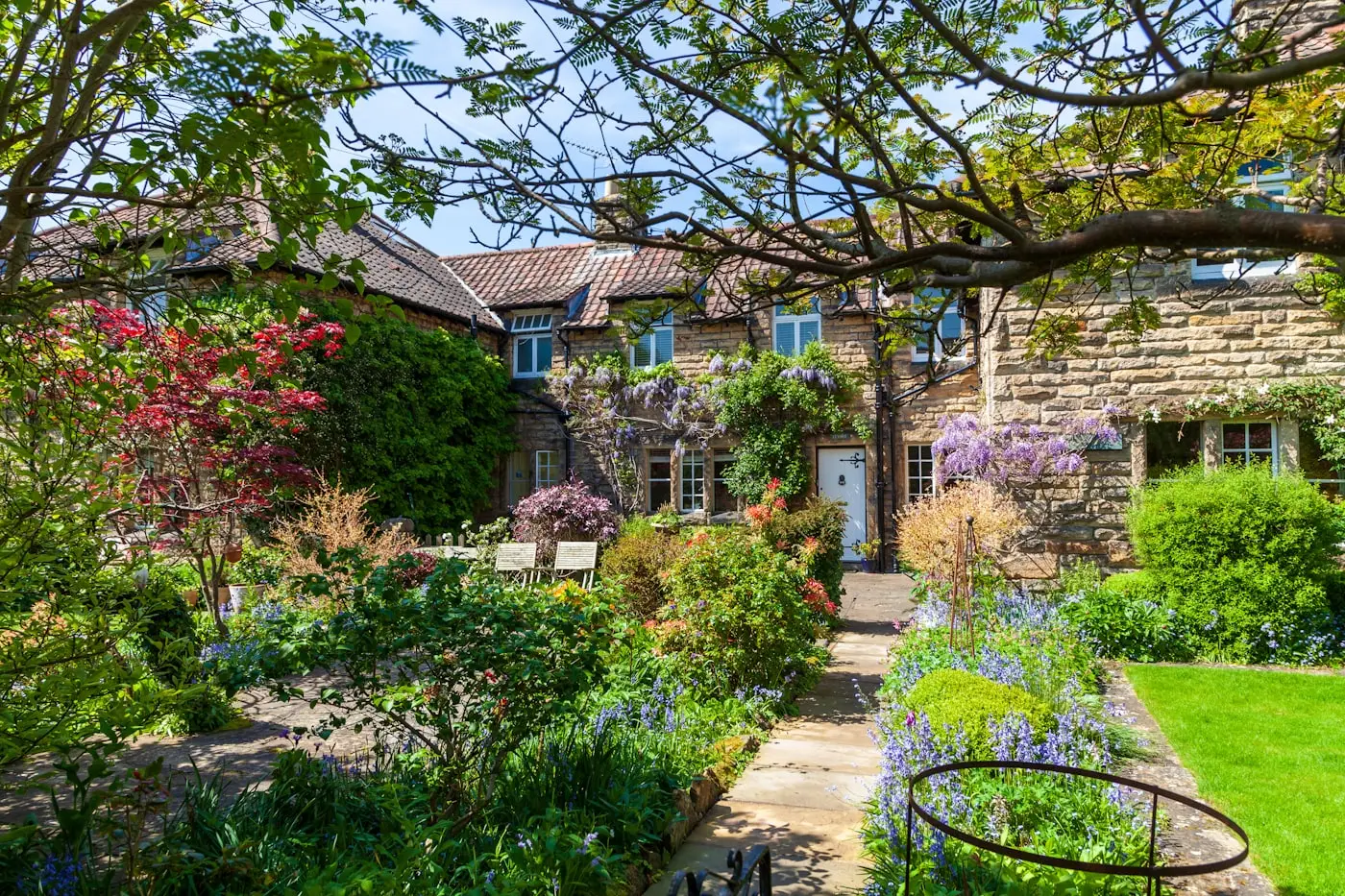
What garden design looks like in Hebden Bridge
Hebden Bridge is one of the most distinctive towns in Yorkshire. The Calder Valley carves a deep groove through Millstone Grit moorland, and the town climbs steeply on both sides in a layered stack of stone millworkers' cottages. Gardens here are shaped entirely by the valley form: steep slopes, high rainfall, acidic gritstone soil, and a culture that has consistently embraced creative and unconventional approaches to everything including gardening.
The practical reality of a Hebden Bridge garden is that it is probably on a slope. It may have been affected by flooding if it is in the valley bottom (the Calder flooded significantly in 2015 and 2020). The soil is almost certainly acidic Millstone Grit that will grow rhododendrons and heathers beautifully but needs thought for more conventional garden plants. And the rainfall of 1,000-1,200mm per year means drainage management is as important as plant selection.
The gardening culture in HX7 also reflects the town's character. Wildlife gardens, no-dig beds, permaculture principles, bold naturalistic planting and unconventional garden design are all more common here than in most Yorkshire towns. A designer who works in Hebden Bridge needs to be genuinely comfortable with briefs that go beyond the conventional cottage garden or formal townhouse design.
Terraced gardens on steep valley slopes
The defining design challenge in Hebden Bridge is the slope. Most older properties on the valley sides were built without any attempt to create level outdoor space: the garden is simply the slope behind the house, bounded by gritstone walls and accessed by steep steps. Creating a usable garden from this involves terracing: cutting level platforms into the slope, retained by stone or timber walls, with steps connecting the levels.
A garden designer working on a steep Calder Valley site will start with a proper survey of the gradient and soil depth before specifying retaining structures. Gritstone retaining walls are the traditional material and look completely natural in the valley character. Railway sleepers are a practical and cost-effective alternative, especially for informal terraces. Gabion baskets filled with local stone are increasingly used for larger retaining structures where the engineering load is significant.
Access is a real constraint on steep Hebden Bridge gardens. Getting materials to the site, including topsoil, stone, and plants, often involves wheelbarrow runs up steep paths or garden steps. This affects cost: a project that would be straightforward on a flat suburban plot can take significantly longer when every load of materials needs to be hand-carried up a slope. A realistic designer will account for this in the estimate rather than surpring you with it later.
Flood-resilient garden design
Properties in the valley bottom near the River Calder and Hebden Water face periodic flood risk. The 2015 and 2020 flood events affected a significant number of Hebden Bridge properties, and flood-resilient garden design has become an important discipline in this postcode. The principles are practical: raise what can be raised, use permeable surfaces that allow water through rather than directing it onto neighbours' properties, choose plants that survive temporary inundation, and avoid structural elements that will be damaged or carry debris in a flood event.
Raised beds on brick or concrete plinths, with no-dig growing inside them, protect the productive garden from flood contamination. Permeable gravel or resin-bound gravel surfaces manage surface water more effectively than paving. Plant choices that tolerate waterlogging (Gunnera, Iris pseudacorus, willows, moisture-tolerant grasses) can turn a recurring problem into a design feature near water. A designer who understands Calder Valley flood dynamics will create a garden that recovers quickly from a flood event rather than one that needs rebuilding every time the river rises.
No-dig and wildlife-focused garden design
Hebden Bridge has a disproportionately strong no-dig and permaculture gardening culture, and many homeowners here want design support for gardens that produce food and support wildlife rather than purely decorative schemes. No-dig bed design (permanent raised beds, deep mulch, no rotovation) is a legitimate discipline that a good productive garden designer can plan properly. Wildlife garden design (hedgehog-friendly structures, bat boxes, pond features, native planting for pollinators) is another specialism that some designers in this area have developed.
These briefs are not easier than conventional design work: a well-planned no-dig growing garden has its own logic around bed width, path surfaces, crop rotation, composting provision and harvest access that needs to be designed as carefully as a formal kitchen garden. A good brief is specific about what you want to grow and how much time you have for maintenance.
Cost ranges for Hebden Bridge garden design
Steep valley-side gardens in Hebden Bridge often cost more than equivalent flat-garden projects because of access and retaining structure costs. These are the typical ranges for HX7:
| Service |
Cost range |
| Planting plan only |
£300-800 |
| Planting plan + implementation |
£600-1,500 |
| Terrace design and construction |
£3,000-15,000+ |
| No-dig garden installation |
£500-2,500 |
| Flood-resilient garden redesign |
£2,000-8,000 |
| Full garden makeover (50-100 sqm) |
£5,000-20,000+ |
Steep-site access adds cost. Be realistic about this in the initial brief. For more detail on what drives the overall cost, see what a garden makeover costs.
Start your free Hebden Bridge garden estimate
Tell us what you want and we put your enquiry in front of local designers who quote directly. No call centre fees on your side.
Get a design estimate
The full local guide
Plants that suit acid gritstone soil in the Calder Valley
The acidic Millstone Grit soil in Hebden Bridge is genuinely unusual in a Yorkshire context. In most North Yorkshire gardens, rhododendrons and camellias need ericaceous compost in raised beds. In HX7, you can plant them in open ground and they thrive. This opens up a planting palette that is rarely available elsewhere in the county.
Rhododendrons and azaleas are the headline plants: the native moorland species, Rhododendron ponticum, shows what is possible at this elevation, and the hybrid garden rhododendrons are spectacular in flower. Camellias are reliable in sheltered valley positions (they need protection from morning sun after a frost to prevent petal scorch). Pieris, enkianthus, and kalmia are all at home in the acid conditions. Heathers, both summer-flowering Calluna and winter-flowering Erica, are native to the surrounding moorland and perform naturally.
Ferns are particularly well-suited to the high-rainfall, partially-shaded valley conditions: Dryopteris (male fern), Polystichum setiferum (soft shield fern), and Osmunda regalis (royal fern) all establish easily and look completely natural against gritstone walls. Hydrangeas perform well in the moist, slightly acidic conditions: H. macrophylla flowers blue rather than pink in the acid soil, and H. arborescens 'Annabelle' is reliably hardy and lush in the high rainfall.
For a more traditional cottage garden aesthetic, hardy geraniums (the native Geranium robertianum, herb robert, colonises naturally), foxgloves, aquilegias, and the native wildflowers of acid grassland (harebells, betony, tormentil) all suit the conditions. Blueberries are productive in the acid soil and look attractive as an ornamental-productive hybrid plant.
Common garden design projects in Hebden Bridge
Terrace creation on neglected valley-side gardens is the most significant category. Many older properties have steep rear gardens that were never properly developed beyond a coal store and a washing line. Terracing creates genuinely usable outdoor space and dramatically increases the garden's value to the household. A well-executed terrace project on a steep Hebden Bridge garden transforms a liability into an asset.
Flood recovery redesigns for valley-bottom properties have become increasingly common. After flood events, gardens that were built on conventional principles (lawns, flower beds, timber structures close to ground level) need rethinking for resilience. A redesign brief might specifically request: everything that stays must be flood-tolerant, permeable surfaces throughout, no timber structures within the flood-risk zone, planting that is easily replaceable if damaged.
Creative cottage garden redesigns on millworkers' terraces with small rear gardens are a third major category. These are often tight spaces (30-50 sqm) on north or east-facing slopes, with challenging access and irregular shapes. Making them feel generous and productive within those constraints is good design work, and the creative culture of Hebden Bridge means clients here are often more adventurous in brief than anywhere else in West Yorkshire.
Process for a Hebden Bridge garden designer
- Initial brief. Tell us the slope, access constraints, and any flood history for your plot. Steep and flood-affected sites need designers who have specific experience with these conditions, not just general garden designers.
- Site visit and structural assessment. On steep sites, the designer assesses the gradient, existing retaining structures (gritstone walls, steps), soil depth, and drainage before any design work begins. Access for materials is assessed at the same time.
- Proposal and design. For terraced gardens, the design includes retaining structure specification, drainage plan, step positions, and planting plan as integrated elements. These cannot be designed separately on a steep site.
- Phasing and coordination. Structural work (retaining walls, steps, drainage) goes first. Hard surfaces second. Planting last, ideally in autumn for best establishment through the high-rainfall winter.
- Installation and establishment. On acid soil, establishment is generally good for the right plant choices. Avoid lime-loving plants in open ground: they will struggle regardless of how well they are planted. The designer advises on soil pH testing before planting if there is any uncertainty.
A planting plan can be produced within one to two weeks of the site visit. A full terrace-and-planting project typically takes six to sixteen weeks depending on scale and access. Starting the design process in autumn or winter means structural work can happen over winter and planting can go in the following spring.
Designers in the Hebden Bridge area
We connect homeowners across HX7 with local designers who quote directly. They set their own prices and there are no call centre fees on the customer side. For steep slope and flood-resilient garden design, reaching a designer who has specific Calder Valley experience matters more than for a straightforward flat suburban garden. Tell us about the specific challenges of your site in the initial brief and we will put that on the enquiry.
Frequently asked questions
How do you design a garden on a steep slope in Hebden Bridge?
Steep valley-side gardens in Hebden Bridge almost always need terracing to create usable, stable outdoor space. The typical approach uses stone or timber retaining walls (gritstone or railway sleepers are both appropriate and widely used locally) to create a series of level terraces connected by steps. A designer will assess the gradient, soil depth, and drainage before specifying retaining structures. Access is often the first challenge: getting materials to a steep-sided garden can significantly affect cost. A good design works with the slope rather than against it, using the different levels to create interest and separate zones.
What soil do gardens have in Hebden Bridge?
Hebden Bridge gardens sit on Millstone Grit (Carboniferous sandstone). On the valley sides, the soil is thin, acidic, and free-draining, with pH typically 5.5-6.5. In the valley bottom near the River Calder, alluvial deposits give a deeper, heavier soil that is more fertile but has been flood-affected in significant events. The high rainfall (1,000-1,200mm per year) means waterlogging can be an issue on compacted valley soils, while the thin gritstone slopes can actually be droughty in a dry summer despite the overall high rainfall.
How much does garden design cost in Hebden Bridge?
A planting plan only service costs £300-800. Planting plan with implementation runs £600-1,500. Full design with project management typically costs £800-3,000+. Terraced garden design and construction on steep valley-side plots often costs more than equivalent flat-garden projects due to access, materials delivery, and the structural engineering involved in retaining walls. A full terrace-and-plant project on a steep Hebden Bridge garden can run £8,000-20,000+ depending on gradient and materials. Designers quote directly based on your specific brief and site conditions.
What plants suit acid gritstone soil in Hebden Bridge?
The acidic Millstone Grit soil supports plants that struggle elsewhere in Yorkshire. Rhododendrons and azaleas thrive in open ground here. Heathers, ferns, hydrangeas, blueberries, camellias, and pieris are all at home in the acid, high-rainfall conditions. For a more ornamental palette, hostas handle the partial shade and moisture well. Foxgloves, aquilegias, and native acid-grassland wildflowers colonise naturally on disturbed gritstone soil. A designer will specify a planting palette that makes the most of the acid conditions rather than fighting them with lime and amendments.
Areas around Hebden Bridge we also cover
We also match homeowners with designers in Holmfirth and surrounding Calderdale villages including Mytholmroyd, Sowerby Bridge, Heptonstall, Todmorden, and Luddenden Foot.
For general garden maintenance, lawn care, and year-round gardening services in Hebden Bridge, visit our local gardeners in Hebden Bridge page.