The short version: Quality solar is adequate for path marking and gentle accent lighting if you have a south-facing garden with good sun exposure - disappointing in north-facing or tree-shaded Yorkshire gardens. Mains LED from an existing outdoor socket costs 150 to 400 pounds and works reliably. A professional low-voltage 12V system is the best long-term investment at 800 to 2,500 pounds. All outdoor fittings need IP44 minimum; IP65 for anything exposed to direct rain. Check conservation area rules if you are in a listed or heritage area.
Why Garden Lighting Matters More in Yorkshire Than It Does Further South
Yorkshire sits between 53 and 54 degrees north. Sunset on the winter solstice in York is around 3:30pm. Even in late September, it is dark by 7:30pm. If you want to use your garden for anything after work through most of the year - sitting out on an April evening, having people over in September, walking the dog in the back garden in October - some form of outdoor lighting is not a luxury. It is the difference between a garden that functions and one that does not.
The return on well-planned garden lighting is also practical in a way that many garden investments are not. You cannot move a newly planted border to where it works better, but you can adjust lighting. Done right, lighting can make a modest garden look considerably larger, frame features that would otherwise disappear into the dark, and extend the usable outdoor season by two to three months at each end of the year.
But Yorkshire's climate creates specific challenges for outdoor lighting. The county averages 700 to 800mm of rainfall a year - more in the uplands. Solar lights depend on daylight hours that are limited from October to March. Salt air attacks metalwork along the East Yorkshire coast. And a significant number of Yorkshire's most attractive villages and market towns are conservation areas where external lighting on historic buildings requires careful thought before installation.
This guide works through the options honestly, with Yorkshire-specific costs and caveats. We advise on lighting as part of garden design projects; this article is the context that helps you decide what kind of system to consider before we talk.
Types of Garden Lighting: The Real Comparison
Solar Lights
Solar garden lights are the first thing most people consider, and they have become substantially better over the past five years. A quality solar fitting from a brand like Philips, Lutec, or Ring now provides genuinely useful illumination rather than the dim, blue-tinged glow of cheap supermarket solar from a decade ago. The key advantages are obvious: no wiring, no running costs, no electrician needed, and installation is as simple as pushing a spike into the ground.
The limitations are also real, and in Yorkshire they matter more than they do in, say, Kent. Solar lights need a certain amount of direct sunlight to charge effectively. A good solar fitting needs around six hours of reasonable sunlight to provide a full evening of illumination. In winter in Yorkshire, that is simply not available - even south-facing gardens in Sheffield or York get limited charge from October to February. In north-facing gardens, gardens with significant tree canopy, or any garden in the northern Dales or Pennines where sun angles are low, solar is a poor choice for anything beyond token illumination.
The other issue is quality. The price range for solar garden lights spans from under 5 pounds per fitting (essentially useless) to 80 to 120 pounds for a high-quality single fixture. In between, there is an enormous amount of mid-market product that looks reasonable in the box but fails after one or two Yorkshire winters because the waterproofing is inadequate, the battery degrades faster than expected, or the solar panel mists up and loses efficiency. Budget: 50 to 300 pounds for a decent basic path-and-accent system; 30 to 80 pounds per fixture for quality individual fittings.
Yorkshire note: North-facing gardens, gardens with heavy tree cover, and gardens in northern upland areas are not well suited to solar lighting as the primary system. Solar works best as a supplement - path markers in a south-facing run, accent lights in a sunny border - rather than the main light source. If your garden faces north or gets substantial shade, plan around mains or low-voltage instead.
Mains-Powered LED
Mains-powered LED fittings deliver the most consistent, high-quality outdoor lighting you can install. Properly specified outdoor LED fittings in an IP65 rating produce predictable output, dim well (with the right dimmer), run cool, and last years longer than halogen alternatives. Running costs are minimal: a typical 5 to 8 watt outdoor LED fitting running four hours per night costs pennies per week.
The constraint is wiring. Extending from an existing outdoor socket - the double-socket on an outside wall that many properties already have - is something a competent DIYer can do for a short cable run with weatherproof fittings and plug-in connectors. A cable buried shallowly across a path to a set of border spotlights costs very little and can be done on a weekend. The moment you need to extend to areas of the garden not served by an existing outdoor socket, or you want a new circuit run from the consumer unit (fuse box), you need a qualified electrician. This is non-negotiable: outdoor electrical work connected to a new circuit must be Part P compliant and notified to building control.
Cost for a simple extension from an existing outdoor socket with three to five fittings: 150 to 400 pounds. Cost for a new outdoor circuit from the consumer unit (electrician only, no fittings): typically 300 to 600 pounds depending on cable run length and circuit complexity. If you combine a new circuit with a full fitting installation, budget 800 to 1,800 pounds for a medium garden with eight to twelve fittings.
Battery and USB-Rechargeable Lights
The middle ground that often gets overlooked. Battery-powered and USB-rechargeable outdoor lights have improved significantly and now offer a genuinely useful option for seasonal or event-based lighting - summer evenings, outdoor dining setups, Christmas, or any occasion where you want atmospheric lighting without a permanent installation.
The better USB-rechargeable outdoor spotlights and festoon lights provide output comparable to mains equivalents, charge in four to six hours, and run for six to twelve hours per charge depending on brightness setting. The obvious limitation is that they need regular recharging rather than self-maintaining like solar or mains. For a patio that you use through summer evenings, this means recharging every few days during peak use. For occasional use, they are perfect.
Cost: 20 to 80 pounds per fitting for quality rechargeable spotlights; 30 to 120 pounds for a good-quality festoon string. A reasonable summer-entertaining lighting setup on a patio using rechargeable equipment: 100 to 350 pounds.
Low-Voltage 12V Professional Systems
This is the system of choice for professional garden lighting designers, and for good reason. A transformer steps the mains voltage down to 12 volts DC, which is low enough to be safe to handle and to bury cable shallowly in the garden without the conduit requirements of mains cabling. The cable can be run through planting, buried under lawn (at a shallower depth than mains cable), and connected to a wide range of professional-grade fittings that are not available in the retail market.
The quality gap between a professional 12V system and a retail solar or mains setup is significant. Professional 12V fittings are designed for outdoor use properly - the housings are machined aluminium or marine-grade brass, the seals are genuine IP65 or IP67, and the light output is consistent and controllable. The landscape architect or gardener installing the system specifies exactly which fittings go where and how the cable runs, integrated with planting plans and garden features in a way that a DIY installation rarely achieves.
Cost: 800 to 2,500 pounds for a professionally designed and installed 12V system in a medium Yorkshire garden with eight to fifteen fittings, cable trenching, a timer or smart controller, and quality fittings. Larger gardens or systems with more complex cable routes run higher. This is not a cheap option, but it is the option that looks professionally done because it is professionally done.
Types of Fittings: What Goes Where
Understanding the difference between fitting types helps enormously when planning a garden lighting scheme. The same budget spent badly produces a collection of lights that fights itself; spent well, it produces a coherent scheme where each fitting has a clear purpose.
Path and Navigation Lights
Small bollard lights or recessed deck lights that provide enough illumination to walk safely at night. These are functional, not decorative. The goal is to mark edges, steps, and changes in surface level - not to flood an area with light. Low-profile bollard lights at 30 to 50 centimetres suit planted borders; flush deck lights suit timber decking and patios. Avoid making path lights too bright: a gentle glow at ankle height is enough and looks better than a row of bright floodlights.
Spike Spotlights
The most versatile fitting in a garden lighting scheme. A spike spotlight pushed into the soil at the base of a tree, large shrub, or garden wall, aimed upward, creates drama from a completely invisible fitting. The fitting is hidden in the planting; the effect is a lit feature that appears to be lit by nothing. These are the fittings that make a well-planted garden genuinely beautiful at night. Cost per fitting from quality suppliers: 30 to 80 pounds for 12V or mains versions.
Wall-Mounted Lanterns
Traditional in style and well-suited to Yorkshire's heritage stone architecture. A good quality external lantern in a heritage finish - antique brass, matt black, verdigris - looks proportionate on a stone farmhouse, a Victorian terrace, or a converted barn in a way that modern stainless steel does not. These are typically mains-powered and need an existing or new exterior circuit. Replacing an existing external light fitting is straightforward; adding a new one requires an electrician. Cost: 60 to 300 pounds for a quality fitting; installation (if needed) is additional.
Festoon and String Lights
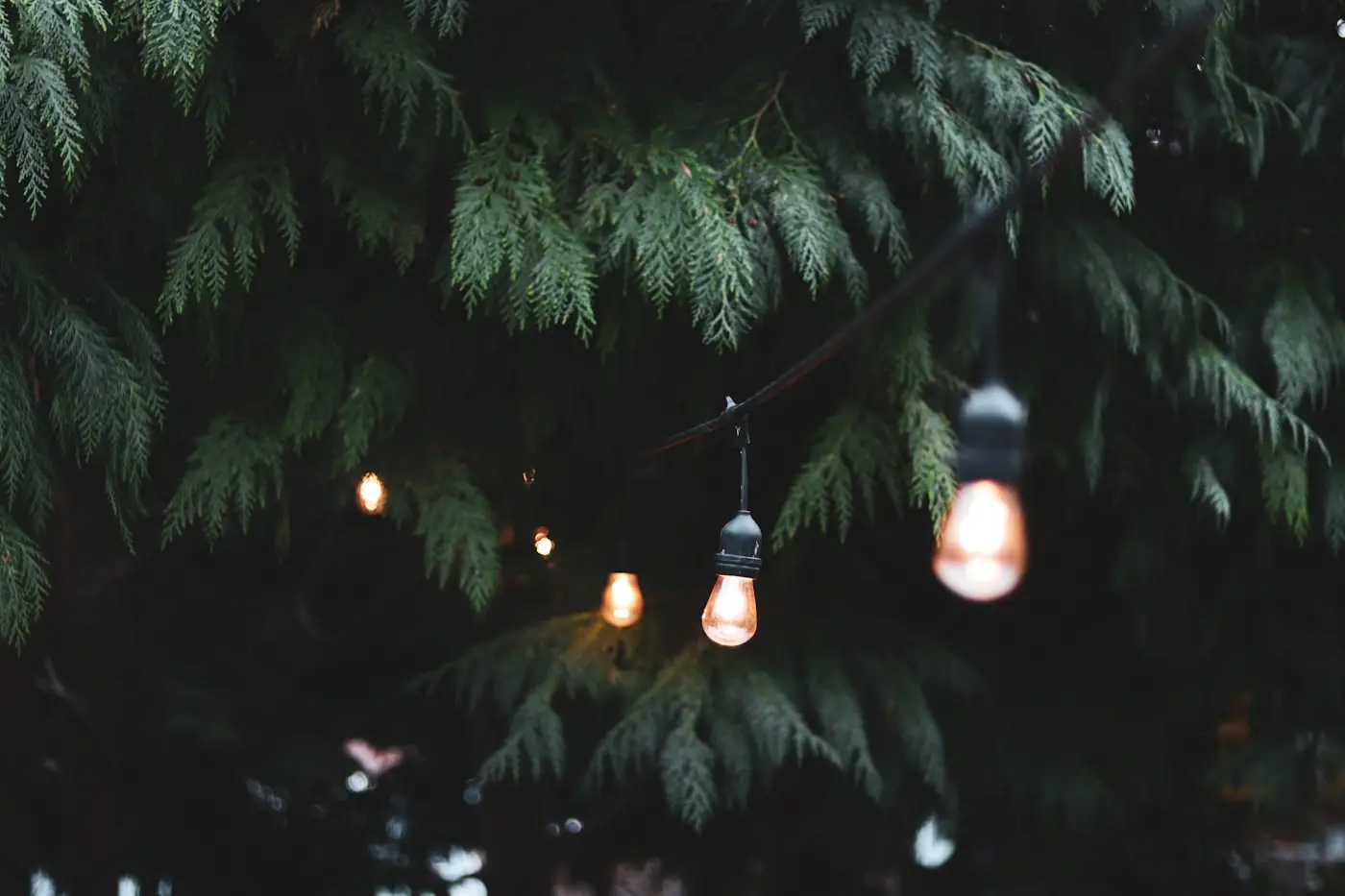
Enormously popular and, done well, genuinely atmospheric. A festoon string slung between two posts over a patio, along a pergola, or draped through mature shrubs creates an outdoor room feel that is hard to replicate with any other fitting type. The key is using quality bulbs - the larger-diameter filament-style bulbs in warm white (2700K to 3000K colour temperature) are far more attractive than cool white or the small-cap LED strings. Quality outdoor festoon strings are rated IP44 or better and last through Yorkshire winters without the string degrading. Cost: 30 to 120 pounds for quality outdoor festoon strings of 10 to 25 metres.
Uplighters for Trees
The most dramatic single lighting effect available in a garden. A wide-angle uplighter buried or spiked at the base of a mature tree and aimed up through the canopy transforms the tree into a feature from a distance of 50 metres. This works particularly well in Yorkshire gardens with mature oaks, beeches, or ornamental cherries. The effect is best achieved with a properly waterproofed in-ground recessed fitting (IP67) to avoid a visible above-ground fitting spoiling the daytime appearance. Cost: 80 to 200 pounds per fitting for quality in-ground uplighters; installation requires cable trenching.
Cost Guide for Yorkshire Garden Lighting (2026)
| System type | Typical cost | Best for | Limitations |
|---|---|---|---|
| Solar DIY | 50 to 300 pounds | South-facing path marking, gentle accent in sunny borders | Poor in shaded or north-facing gardens; variable in winter |
| Mains from existing socket (DIY) | 150 to 400 pounds | Patios, decking, areas close to the house | Limited cable reach; longer runs need an electrician |
| Battery/rechargeable | 100 to 350 pounds | Seasonal and event use; flexible placement | Needs regular recharging; not suited to automatic year-round use |
| Mains with new circuit (electrician) | 800 to 1,800 pounds | Medium garden, 6 to 12 fittings, permanent installation | Part P compliance required; needs qualified electrician |
| Professional 12V low-voltage system | 800 to 2,500 pounds | Best results, professional quality, all garden sizes | Highest upfront cost; needs professional installation |
| Full mains from consumer unit (large garden) | 1,500 to 4,000+ pounds | Extensive schemes, multiple zones, smart controls | Requires qualified electrician; building control notification |
Yorkshire-Specific Considerations
Conservation Areas
Yorkshire has more conservation areas than any other county in England, and a significant proportion of the county's most desirable residential locations sit within them. Helmsley, Masham, Middleham, Richmond, Knaresborough, Skipton town centre, large parts of York, and many smaller villages in the Dales and North York Moors all have conservation area status. Parts of Harrogate, Ilkley, and Saltaire are also designated.
Conservation area designation does not ban external lighting. What it does is require that any external alteration that materially affects the appearance of a building may need consent. Standard permitted development rules do not fully apply in conservation areas in the way they do elsewhere. If you are in a conservation area and want to install new external lights on the building structure - wall-mounted lanterns, soffit downlights, lights integrated into architectural features - check with your local planning authority first.
Free-standing garden lights that are not fixed to the building structure (spike spotlights, path lights, festoon strings on separate posts) are generally not affected by conservation area rules because they do not alter the building. When in doubt, the planning department of North Yorkshire Council, York City Council, Bradford, Leeds, or Sheffield can advise; most offer pre-application advice without charge for straightforward queries.
East Yorkshire Coastal Exposure
Gardens in Scarborough, Filey, Bridlington, Whitby, Robin Hood's Bay, and along the Holderness coast face a specific problem that inland Yorkshire gardens do not: salt air. Salt-laden air accelerates corrosion in metalwork at a rate that is surprising until you have seen it. A decent-quality zinc alloy or uncoated mild steel fitting that would last ten years inland can show significant rust and coating failure within two to three years within a kilometre of the coast.
For coastal Yorkshire gardens, specify marine-grade or coastal-rated fittings where possible. Marine-grade stainless steel, powder-coated aluminium with a quality marine finish, or solid brass (which develops a patina rather than corroding) are the appropriate choices. Avoid zinc alloy (often labelled as "die-cast metal"), chrome plating over mild steel, or any fitting without a specific coastal rating from the manufacturer.
IP65 is the minimum for any exposed fitting regardless of coastal proximity; in coastal locations, prioritise the quality of the physical construction as much as the IP rating.
Rain and Moss
Yorkshire's rainfall is not extreme by UK standards - the Dales and Pennines get 1,200 to 2,000mm per year, but the lowlands are closer to 650 to 800mm, which is not dramatically different from much of England. What differs is the consistency: sustained grey, damp conditions from October to April mean that any outdoor surface, including solar panels, accumulates moss, algae, and lichen more aggressively than it does in drier regions.
Solar panels on garden lights need regular cleaning in a Yorkshire garden - aim for once a month in the damp season. Moss colonising a solar panel in October and not being removed until March can halve the charging efficiency for half the year. A simple wipe with a damp cloth takes thirty seconds and makes a real difference to performance.
For path lights and recessed fittings, check that the lens cover is not becoming obscured by moss or algae annually. For spike spotlights in planted borders, check that the fitting angle has not shifted as the soil settles over winter - a spotlight that was aimed perfectly at a tree in April may be aimed at the ground by November.
What We Do and Do Not Do
We are gardeners and garden designers, not electricians. We can advise on lighting placement, specify fittings that integrate with a planting scheme, run 12V low-voltage cable through planted areas and borders, and install solar and battery systems ourselves. For mains-connected work - new circuits from the consumer unit, any work requiring Part P compliance - we work alongside a qualified electrician rather than doing it ourselves.
Most well-planned garden lighting projects involve both disciplines. The gardener specifies what the garden needs and where; the electrician delivers the power safely. If you are thinking about lighting as part of a broader garden project - a garden makeover, a new patio installation, or a full garden redesign - lighting is most cost-effectively integrated into the project from the start rather than added afterwards.
Talk to us about incorporating lighting into your garden design
We work with qualified electricians on mains systems and can specify and install 12V low-voltage systems ourselves.
Start the conversation →Frequently Asked Questions
Do I need planning permission for garden lights in Yorkshire?
For most residential gardens, no. Standard garden lighting is permitted development. However, if you live in a conservation area and want to install lights on a listed building's structure - wall-mounted lanterns fixed to listed stonework, for example - check with your local planning authority before installing. Free-standing lights in the garden not attached to the building are generally unaffected by conservation area rules. When in doubt, a quick call to the planning department is always the right first step.
What is the most cost-effective garden lighting option?
For a straightforward path and accent lighting setup, quality solar lights (50 to 300 pounds) have the lowest upfront cost with no installation fees. However, in north-facing gardens, under tree cover, or in the limited winter daylight of a Yorkshire garden, solar performance is often disappointing. For reliable, consistent lighting, a mains setup from an existing outdoor socket with a few LED fittings gives better results for 150 to 400 pounds. A professional 12V low-voltage system (800 to 2,500 pounds) is the best long-term investment for the quality of result.
How do I light a garden without mains electricity?
Quality solar lights work acceptably in south-facing positions with good daylight exposure. They are unreliable in north-facing gardens, under tree canopy, or through Yorkshire's shorter winter days. Battery and USB-rechargeable lights are a practical middle ground: good quality output, no wiring needed, flexible placement. They need recharging regularly (every one to three weeks depending on use) and work best for seasonal use - summer evenings and outdoor entertaining - rather than automatic year-round operation.
Can I install garden lights in a conservation area in Yorkshire?
Yes, but check before installing lights on a listed building's structure. Free-standing lights in the garden not attached to the building are generally fine. If you want wall-mounted fittings on a listed building or in a sensitive conservation area context, call your local planning authority for a pre-application opinion before committing to anything. Most planning departments can advise without charge for a basic query. The rules apply to the building structure, not to lights standing independently in the garden.
How long do outdoor LED lights last?
Quality outdoor LED fittings from established brands are typically rated for 25,000 to 50,000 hours, equating to 10 to 20 years at typical garden use. In practice, the housing and waterproofing degrades before the LED chip in outdoor conditions, particularly in Yorkshire's wet climate. A well-specified IP65 fitting from a quality brand will typically last 8 to 15 years outdoors. Cheap fittings in large packs often fail within one to three years because the waterproofing is insufficient for genuine outdoor exposure.
What IP rating do outdoor lights need to be in Yorkshire?
IP44 is the minimum for any fitting protected from direct rain (under an eave, recessed into a sheltered ceiling). IP65 is the appropriate minimum for any fitting exposed to direct rainfall - spike spotlights, path lights, open wall-mounted lanterns, and anything in an open garden. For East Yorkshire coastal gardens around Scarborough, Whitby, and Bridlington, IP65 plus marine-grade metalwork is strongly recommended; salt air attacks low-grade metals within two to three years of coastal exposure.