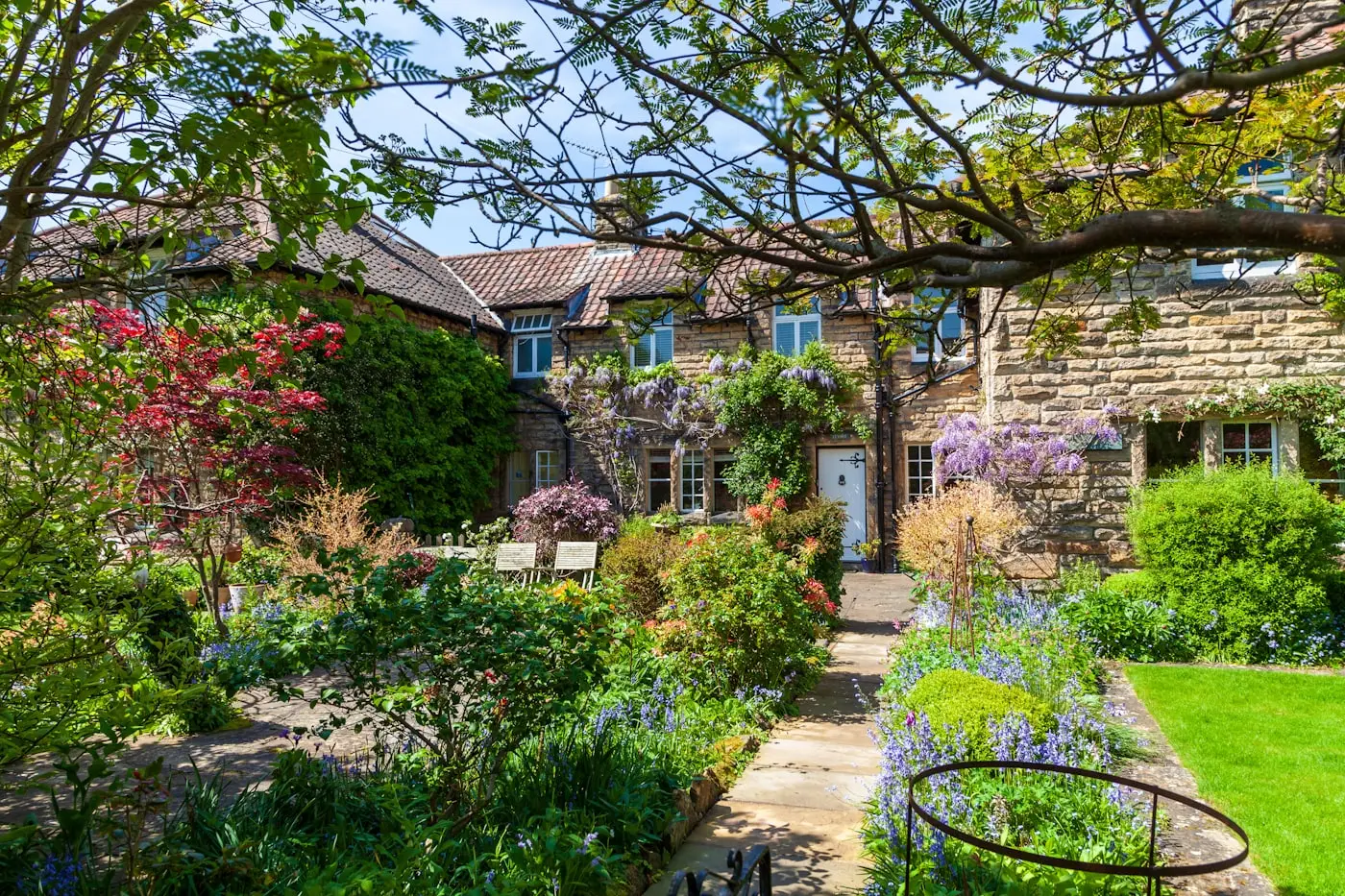
Garden designers working across Yorkshire bring ideas rooted in local landscape and climate, and practices based in Harrogate, York, and Leeds regularly take on projects ranging from courtyard redesigns to large rural plots.
Yorkshire gardens aren't Surrey gardens. You can't copy a Chelsea show garden and expect it to thrive here. Our soil is heavier, our frost dates are later, our rainfall is higher, and our wind is stronger. This guide explains what works in Yorkshire, broken down by soil zone, with plant palettes and style ideas tailored to the county.
Yorkshire climate primer
Before choosing plants or styles, understand what you're working with:
- Latitude: 53-54°N. Similar to Hamburg or Moscow. Short winter days, late spring, long summer evenings.
- Frost dates: Last frost mid-April in the Vale of York, late April on the Pennine fringe, early May in the upper Dales. First autumn frost mid-October lowland, late September hills.
- Growing season: 180-220 days depending on elevation. Shorter than southern England, longer than Scotland.
- Prevailing wind: South-westerlies off the Irish Sea. Coastal gets salt; Pennine fringe gets persistent wind; vale sheltered.
- Rainfall: 600-800mm/year vale lowlands, 1,000-1,400mm/year Pennine fringe and upper Dales. More than southern England, less than Lake District.
What this means: spring arrives 2-4 weeks later than southern England. Tender plants get frosted in May if you plant too early. Heavy clay dominates and drains poorly in our wet winters. Wind shred is real on exposed sites. Choose plants that handle these conditions, not what looked good in a Surrey magazine.
Yorkshire soil zones and what to plant
Vale of York clay (York, Selby, Northallerton, Thirsk lowlands)
Heavy moisture-retentive clay, fertile but prone to winter waterlogging. Compacts under foot traffic. Summer drought cracks if not mulched. North-facing lawns get persistent moss.
What works: moisture-tolerant plants that don't mind wet feet in winter.
- Astilbes: feathery plumes, love clay, shade-tolerant, July-August flower.
- Hostas: architectural foliage, slug-prone but magnificent on clay, shade to part-shade.
- Persicaria: poker-like flowers, vigorous, fills space, Aug-Oct.
- Ligularia: bold leaves, orange spikes, damp borders, July-Aug.
- Moisture-tolerant grasses: Deschampsia, Molinia, Calamagrostis — all thrive on clay.
- Shrub roses: Rosa rugosa, David Austin varieties — clay suits them if drainage isn't sitting-water bad.
- Hydrangeas: macrophylla and paniculata both love clay moisture.
First intervention: drainage. French drains, raised beds, or 10cm organic matter dug in before planting. Don't plant drought-lovers (lavender, cistus, rosemary) on unimproved vale clay — they'll rot over winter. See our York garden design page and Selby for local examples.
Wolds and Dales-margin chalk/limestone (Pocklington, Driffield, Malton, Bedale, Ripon western fringes)
Free-draining alkaline soil, low organic matter, dries fast in summer. Chalk or magnesian limestone influence. Lavender and rosemary country.
What works: drought-tolerant plants that like alkaline pH.
- Salvias: 'Caradonna', 'Mainacht', nemorosa types — blue spikes, June-Sept, perfect for chalk.
- Sedums: 'Autumn Joy', spectabile — fleshy leaves, pink autumn flowers, bombproof on chalk.
- Ornamental grasses: Stipa, Pennisetum, Miscanthus — all thrive on free-draining alkaline.
- Catmint (Nepeta): billowing blue clouds, May-Sept, self-seeds, bees love it.
- Hardy geraniums: 'Rozanne', 'Johnsons Blue' — long flowering, chalk-tolerant, fill gaps.
- Lavender and rosemary: classic chalk plants, full sun, well-drained, prune after flowering.
- Cistus (rock rose): Mediterranean shrub, thrives on chalk, June flowers, needs shelter from hard frost.
Key challenge: moisture retention in summer. Add compost annually as mulch. Avoid acid-lovers (rhododendrons, azaleas, camellias, pieris) — they'll chlorose and die on alkaline soil.
Pennine fringe peat/acidic (Keighley, Skipton heights, Holmfirth, Hebden Bridge, Haworth moors)
Acidic peaty soils above 200m elevation, high rainfall (1,000-1,400mm/year), frost risk extending to late April. Short growing season. Exposed to westerly wind.
What works: acid-loving plants that handle wind and late frost.
- Rhododendrons and azaleas: thrive on acid peat, shelter from wind essential, April-June flower.
- Heathers (Calluna, Erica): ground cover, year-round interest, perfect for peaty moorland-edge gardens.
- Pieris: red new growth, white spring flowers, evergreen structure, acid-only.
- Camellias: early spring flowers (March-April), shelter from morning sun after frost (frosted buds brown if sun hits them fast).
- Ferns: Dryopteris, Polystichum — shade-tolerant, love moisture, architectural.
- Astilbes and hostas: work here too if sheltered — high rainfall suits them.
Key challenge: wind. Stake everything. Build shelter belts (holly, rowan, hawthorn hedging) before planting tender shrubs. Avoid Mediterranean plants entirely — they won't survive wet acid winters.
East Yorkshire coastal (Scarborough, Whitby, Bridlington, Filey, Hornsea)
Salt exposure from North Sea wind, free-draining sandy or chalky soils, mild winters but persistent wind. Frost less severe than inland but wind shred worse.
What works: salt-tolerant wind-resistant plants.
- Sea holly (Eryngium): metallic blue spiky flowers, July-Sept, thrives in salt wind.
- Tamarisk: feathery pink shrub, coastal-specific, wind-resistant, June-Aug flower.
- Rosa rugosa: tough coastal rose, repeat-flowers, salt-tolerant, red hips, vigorous.
- Valerian (Centranthus): pink or white flower spikes, self-seeds on walls, loves coastal conditions.
- Salt-tolerant grasses: Ammophila (marram), Festuca, Leymus — all handle coastal exposure.
- Thrift (Armeria): cushion-forming pink flowers, coastal native, April-June.
Key challenge: wind and salt. Windbreaks essential (timber fencing, tamarisk hedging). Avoid large-leaved tender plants — wind shreds them. See our Scarborough and Bridlington garden design pages for coastal-specific advice.
Coal Measures clay (Barnsley, Wakefield, Castleford, Pontefract, Rotherham)
Very heavy clay, compacts under foot traffic, north-facing lawns get persistent moss. Similar to Vale of York clay but often heavier and more compacted on ex-industrial sites.
What works: same as Vale of York clay (astilbes, hostas, shrub roses, hydrangeas, moisture-tolerant grasses). Drainage improvements are mandatory before planting anything remotely drought-preferring.
Key intervention: spring lawn scarification and aeration. Moss thrives on compacted waterlogged clay. Don't just keep mowing over it — scarify hard in March, aerate with hollow-tine fork, top-dress with sand/compost mix. Fixes 80% of Coal Measures lawn problems.
Garden style ideas that work in Yorkshire
Cottage garden
Where it lands: most suburban Yorkshire plots, rural villages, anywhere with informal character.
What it is: relaxed mixed planting, self-seeders encouraged, roses interplanted with perennials, paths edged with catmint and lady's mantle, no hard geometry.
Plant palette: roses (shrub and climbing), hardy geraniums, alchemilla, foxgloves, aquilegias, delphiniums, peonies, catmint, lavender (on free-draining soil only), sweet peas, honeysuckle.
Suits: period terrace and semi-detached houses, rural cottages, anyone who wants abundant flowers without strict maintenance. Works on most Yorkshire soils if you match plants to drainage (moisture-lovers on clay, drought-tolerant on chalk).
Contemporary
Where it lands: new-build estates, modern extensions, urban courtyards, anyone who wants clean lines and low-maintenance structure.
What it is: architectural planting, grasses and evergreens, limited palette (3-5 plant types repeated), hard landscaping dominant (decking, gravel, raised beds), garden lighting integrated. For a full Yorkshire guide to this style, see contemporary garden ideas in Yorkshire.
Plant palette: ornamental grasses (Miscanthus, Calamagrostis, Stipa), clipped evergreens (box balls, yew cubes), multi-stem birches, ferns in shade, sedums for late-season interest.
Suits: new-builds in Leeds, Wakefield, and Hull estates, modern urban plots, anyone prioritising year-round structure over flower abundance. For a quieter, more meditative take on minimalist design, the Japanese garden ideas guide for Yorkshire covers how to adapt the style to our climate.
Wildlife-friendly
Where it lands: rural edges, suburban plots backing onto countryside, anywhere with hedgehog/bird/pollinator focus.
What it is: native hedging (hawthorn, blackthorn, hazel), wildflower meadow or long-grass areas, pond for amphibians, log piles for insects, berry-bearing shrubs for birds, no pesticides.
Plant palette: native hedging, wildflower mixes (Yorkshire Meadows or Emorsgate EM1), nectar plants (catmint, lavender, sedums, verbena bonariensis), berry shrubs (rowan, hawthorn, cotoneaster, pyracantha).
Suits: rural plots, families wanting to attract wildlife, low-intervention gardeners, anyone with space for a pond and wildflower patch.
Kitchen garden
Where it lands: any plot with 6+ hours sun, especially rural or large suburban gardens.
What it is: raised beds (solves Yorkshire clay drainage), crop rotation layout, companion planting, herbs near the kitchen door, fruit cage or wall-trained fruit.
What grows well: potatoes, brassicas, onions, leeks, runner beans (Yorkshire staple), rhubarb (thrives on clay), soft fruit (raspberries, gooseberries, blackcurrants — all love our rainfall). Avoid courgettes and tomatoes unless you have a greenhouse or very sheltered south-facing spot — our summers aren't reliable enough for consistent outdoor cropping.
Suits: anyone who wants to grow food, families, allotment-style gardeners. Raised beds (15-20cm height) solve clay drainage and warm up faster in spring.
Formal stone-house garden
Where it lands: period stone houses in Dales villages (Grassington, Pateley Bridge, Settle), Wolds villages (Pocklington, Stamford Bridge), Harrogate/Ilkley Victorian properties.
What it is: symmetry, clipped hedging (yew, beech, hornbeam), Yorkshire-stone paving and walls, structural evergreens, restrained plant palette, formal rose beds.
Plant palette: yew and box for hedging and topiary, standard roses in formal beds, lavender edging (on free-draining sites), clipped holly, pleached limes or hornbeam for boundaries, underplanting with hardy geraniums and alchemilla for softness.
Suits: period properties where the garden needs to match the house's architectural formality. Higher maintenance (hedging needs annual clipping) but delivers year-round structure.
Mistakes Yorkshire homeowners make
Planting drought-lovers on heavy clay
Lavender, cistus, rosemary, Mediterranean herbs all rot on waterlogged clay over winter. Either improve drainage drastically (raised beds with 50% grit added, French drains) or choose moisture-tolerant plants instead.
Not staking on exposed sites
Pennine fringe and coastal Yorkshire get persistent wind. Delphiniums, tall grasses, dahlias, hollyhocks all need staking or they'll topple and shred. Use bamboo canes and twine in April before they grow tall, not in June after they've already flopped.
Planting tender bedding too early
Garden centres sell bedding plants in March. Yorkshire frost dates are mid-April lowland, late April hills, early May upper Dales. If you plant tender stuff (petunias, begonias, busy lizzies) in March, a late frost will kill them. Wait until after your local last-frost date.
Ignoring moss on clay lawns
North-facing lawns on Coal Measures or Vale of York clay get moss because the soil is compacted and waterlogged. Moss killer doesn't fix the problem — it kills the moss, lawn stays thin, moss returns. Fix: scarify hard in March (rip the moss out), aerate with hollow-tine fork or machine, top-dress with 50:50 sand and compost. That actually solves it.
Under-improving clay before planting
Adding a 2cm layer of compost on top of clay does almost nothing. You need 5-10cm of organic matter (compost, well-rotted manure, leaf mould) dug into the top 20-30cm, or raised beds built on top. Yorkshire clay is workable if you improve it properly; it's a nightmare if you don't.
Where to see real Yorkshire gardens
RHS Harlow Carr (Harrogate)
68 acres showing what thrives in Yorkshire conditions. Acid borders, alkaline borders, woodland, kitchen garden, streamside planting, winter garden. Go in every season to see what's performing. Probably the single most useful garden for Yorkshire homeowners to visit before designing their own.
Helmsley Walled Garden
5-acre walled kitchen and ornamental garden. Demonstrates intensive raised-bed vegetable growing, espaliered fruit, cutting borders, glasshouse use. Shows how much you can produce in a Yorkshire growing season with proper planning.
Castle Howard
1,000-acre estate with formal and woodland gardens. Ray Wood shows rhododendrons and acid-loving plants in a Yorkshire woodland setting. The formal terraces show period stonework and how to match planting to grand architecture.
Studley Royal Water Garden (Ripon)
18th-century water garden and deer park, UNESCO World Heritage Site. Formal geometry, lime avenues, water features. Shows how formal design lands in a Yorkshire landscape. Useful if you're designing for a period property and want to understand historical context.
Yorkshire Sculpture Park (Wakefield)
500-acre parkland with contemporary sculpture and naturalistic planting. Shows grasses, wildflower meadows, and low-maintenance perennial planting at scale. Good for ideas if you want contemporary feel with wildlife-friendly approach.
Design rule
Visit at least one of these gardens before you start designing your own. You'll see what actually works in Yorkshire soil and climate, not what works in a magazine photo shoot in Surrey. One afternoon at Harlow Carr saves you two years of expensive plant failures.
Frequently asked questions
What plants grow best in Yorkshire gardens?
It depends on your soil. Vale of York clay suits moisture-lovers like astilbes, hostas, ligularia, and shrub roses. Wolds chalk suits drought-tolerant plants like salvias, sedums, lavender, hardy geraniums. Pennine peat suits acid-lovers like rhododendrons, azaleas, heathers. Coastal areas need salt-tolerant plants like sea holly, tamarisk, Rosa rugosa. Most Yorkshire gardens are heavy clay and benefit from drainage improvements before planting.
What garden style works in Yorkshire?
Cottage garden, contemporary, wildlife-friendly, kitchen garden, and formal stone-house styles all work here. Cottage suits most suburban plots. Contemporary works well on new-builds. Wildlife-friendly thrives in rural edges. Formal stone-house suits period properties in the Dales and Wolds villages. The key is matching the style to your house character and soil type.
When should I plant in Yorkshire?
Autumn planting (September to November) is best for most perennials, shrubs, and trees - roots establish over winter, ready for spring growth. Spring planting (March to May) works for tender plants and when autumn weather is poor. Avoid planting in baked-dry July or frozen January. Frost dates vary by elevation: mid-April in the Vale of York, late April on the Pennine fringe, early May in the upper Dales.
Do I need to improve Yorkshire soil before planting?
Almost always on heavy clay (most of Yorkshire). Clay compacts under foot traffic, drains poorly in winter, and bakes hard in summer. Add organic matter (compost, well-rotted manure, leaf mould) at 5-10cm depth, and consider drainage improvements (French drains, raised beds) on persistently wet sites. Wolds chalk and coastal sand drain freely but need organic matter for moisture retention.
What are common Yorkshire garden mistakes?
Planting drought-lovers (lavender, cistus, Mediterranean herbs) on heavy clay without improving drainage - they rot over winter. Not staking plants on exposed Pennine or coastal sites - wind shred and topple them. Planting tender bedding too early at elevation - late frosts (April-May) kill them. Ignoring moss on north-facing clay lawns - scarify and aerate in spring, don't just mow over it.
Where can I see good Yorkshire gardens for inspiration?
RHS Harlow Carr (Harrogate) shows what thrives in Yorkshire conditions across all seasons. Helmsley Walled Garden demonstrates kitchen garden and formal borders. Castle Howard offers grand landscape and woodland planting. Studley Royal Water Garden (Ripon) shows 18th-century formal design. Yorkshire Sculpture Park gardens blend contemporary art with naturalistic planting. All are open to the public and worth visiting before designing your own garden.
Can I grow Mediterranean plants in Yorkshire?
On free-draining Wolds chalk, magnesian limestone, or improved sandy soil, yes. Lavender, rosemary, cistus, salvias, and hardy geraniums thrive on alkaline free-draining sites. On heavy Vale of York or Coal Measures clay, they'll struggle unless you build raised beds with 50% grit added or install serious drainage. Don't plant Mediterranean plants in waterlogged winter clay - they'll rot.
Get your enquiry in front of a Yorkshire designer
Tell us about your garden and we put your enquiry in front of local designers who understand Yorkshire soil and climate.
Start the assessment