Garden Lighting Installation in Yorkshire
Yorkshire's winters are long. By late October the sun sets before five o'clock, and by December you have less than seven hours of daylight in Hull and barely more in Harrogate. A well-designed garden lighting scheme does not just make your garden look good - it makes it usable for four or five months of the year that would otherwise be wasted. We connect you with local garden lighting installers across all 240+ towns in our Yorkshire network.
Get a free quote- Free quotes, no obligation
- Local gardeners
- 240+ Yorkshire towns covered
- No call centres
Solar, low-voltage or mains: which system suits Yorkshire gardens?
This is the most important decision in garden lighting and the one most homeowners get wrong by defaulting to the cheapest option first. Understanding the trade-offs saves money in the long run because you do not end up replacing a solar system in year two when you discover it does not do what you wanted through winter.
Solar garden lighting
Solar spike lights from garden centres and DIY stores are everywhere, and they work reasonably well in summer. The problem in Yorkshire is the winter performance, which is the time when garden lighting actually matters most. A solar light is entirely dependent on the amount of sunlight the panel receives to charge its battery. Yorkshire in November and December means short days, frequent overcast skies, and solar panels angled away from a low sun that spends most of the day behind cloud. A fixture that gives a bright six-hour display in July may give a dim two-hour flicker in December.
Solar is a viable option if you want summer-only path lighting, if your garden has no convenient mains supply, or if you want to try garden lighting before committing to a wired system. For year-round reliable performance, particularly in the West Riding mill towns and the higher Pennine gardens that see the least winter sun, solar underdelivers consistently.
A reasonable solar starter kit with six to eight stainless spike lights costs £50-200. Higher-end solar fixtures with larger panels and lithium battery packs (£30-80 per fitting) perform better in winter but still lag behind wired systems. If you are buying solar, choose fixtures with a panel rated at least 2W and a battery capacity of at least 2000mAh per fitting to get acceptable winter performance.
Low-voltage LED systems (12V)
A low-voltage LED garden lighting system uses a transformer plugged into an existing outdoor socket (or wired to a fused spur) to step mains voltage down to 12V DC. The cable running around the garden carries low-voltage current, which is significantly safer to work with than mains voltage and does not require armoured cable or conduit for most runs.
These systems are the most popular professionally installed option for Yorkshire gardens in the medium price bracket. The transformer is typically mounted in an inconspicuous location - inside a weatherproof box on the wall, inside a shed, or behind a trellis - and low-voltage cable runs out from it in one or more circuits. Modern transformers have built-in timer and dusk-to-dawn sensor controls, so the system turns on and off automatically without any manual intervention.
A professionally installed low-voltage system with transformer, cable, and six to ten quality LED fittings typically costs £300-800 for a straightforward install on a standard Yorkshire patio garden. The performance is consistent year-round, weatherproof, and entirely independent of daylight hours or solar charging.
The cable used in low-voltage systems is typically 1.5mm twin-core outdoor garden cable. This can be buried directly in soil at 300mm depth or run along the surface and covered with conduit in more exposed areas. For runs that cross under paving, conduit laid at installation time makes future changes easy - retrofitting cable under an established patio is more disruptive and adds cost.
Mains-powered systems (230V)
Mains-powered garden lighting circuits run at full 230V from a dedicated fused spur or consumer unit circuit with RCD protection. They require armoured cable (SWA - steel wire armoured) buried at the correct depth and sheathed in conduit where it passes through walls or under paving.
Mains systems are the right choice when you need high-output lighting (floodlights, powerful uplighters for large trees), very long cable runs (over 30 metres), or when you want no transformer or outdoor socket involved. They must be installed by a Part P-registered electrician who can certify the installation under Building Regulations.
A full mains-powered garden lighting installation with armoured cable, RCD protection, a mix of path lights and uplighters on a medium-sized Yorkshire patio or rear garden costs £500-2500. The higher end of that range reflects multiple circuits, smart timer and remote controls, and a higher number of premium IP65-rated fittings. Larger schemes on bigger properties in the Harrogate and Wetherby areas, where gardens can extend to half an acre and multiple distinct zones want individual control, can reach £3000-5000 for a comprehensive professional installation.
Garden lighting types: path lights, uplighters, feature lighting and more
A well-designed garden lighting scheme uses a mix of fitting types to create depth, guide movement, and highlight the best features of the garden. Understanding what each type does helps you brief an installer on what you actually want from the finished result.
Path lights and bollard lights
Path lights are the most functional garden lighting type. Mounted on a short spike or short post (typically 300-600mm height), they wash downward light across a path, step, or lawn edge. The primary purpose is safe movement around the garden at night, particularly important for patio access from kitchen doors and for navigating steps. In Yorkshire's wet winters, paths and paving can be slippery, and good path lighting significantly reduces the risk of accidents on damp paving.
Modern LED path lights use 1-3W per fitting and run cool to the touch. A warm-white colour temperature (2700-3000K) works better in Yorkshire gardens than a harsh cool-white, giving a welcoming tone that suits both contemporary and traditional garden styles. A typical path lighting run of four to six fittings costs £40-120 for the fixtures, plus installation labour.
Uplighters
Uplighters are buried in the ground or surface-mounted to project light upward, typically used to highlight specimen trees, garden walls, architectural features, or large planting. They create focal points that are visible from inside the house as well as in the garden itself, which is a significant quality-of-life benefit in Yorkshire winters where you are more likely to be looking out at the garden from indoors than sitting in it.
A buried uplighter under a mature specimen tree - a Japanese maple, a Scots pine, or a magnolia in a Harrogate garden - transforms the garden view from the kitchen or living room window on a dark evening. The light catches the canopy structure and trunk detail in a way that reads beautifully from inside the house.
Uplighters need to be IP67-rated (fully waterproof) as they sit at or below ground level and regularly collect water. Budget spike uplighters start at £15-30 each; quality buried recessed uplighters from established manufacturers cost £60-200 per fitting. For trees and significant planting, investing in quality fittings pays back over many years of reliable performance.
Deck and step lights
Recessed deck lights are fitted flush into decking boards to illuminate the surface from within the deck itself, creating a dramatic low-level effect that reads well from inside and from the garden. Step lights are similar - recessed into the riser of a step to light the tread surface from below.
Both types require planning at installation time. Retrofitting deck lights into existing decking means drilling through boards and dealing with whatever is underneath. For new decking projects, specifying lighting positions before laying the boards makes the installation clean and straightforward. See our decking installation service page for more detail on decking with integrated lighting.
Wall lights and post lights
Exterior wall lights mounted on the house or outbuilding wall provide a traditional garden lighting solution that is easy to install and maintain. A simple pair of wall lanterns either side of a rear door or patio door costs £40-200 for quality fittings and a couple of hours of an electrician's time to connect. Post lights on a 1.2m post are a good option for larger gardens where you need illumination in areas away from walls.
String lights and festoon lighting
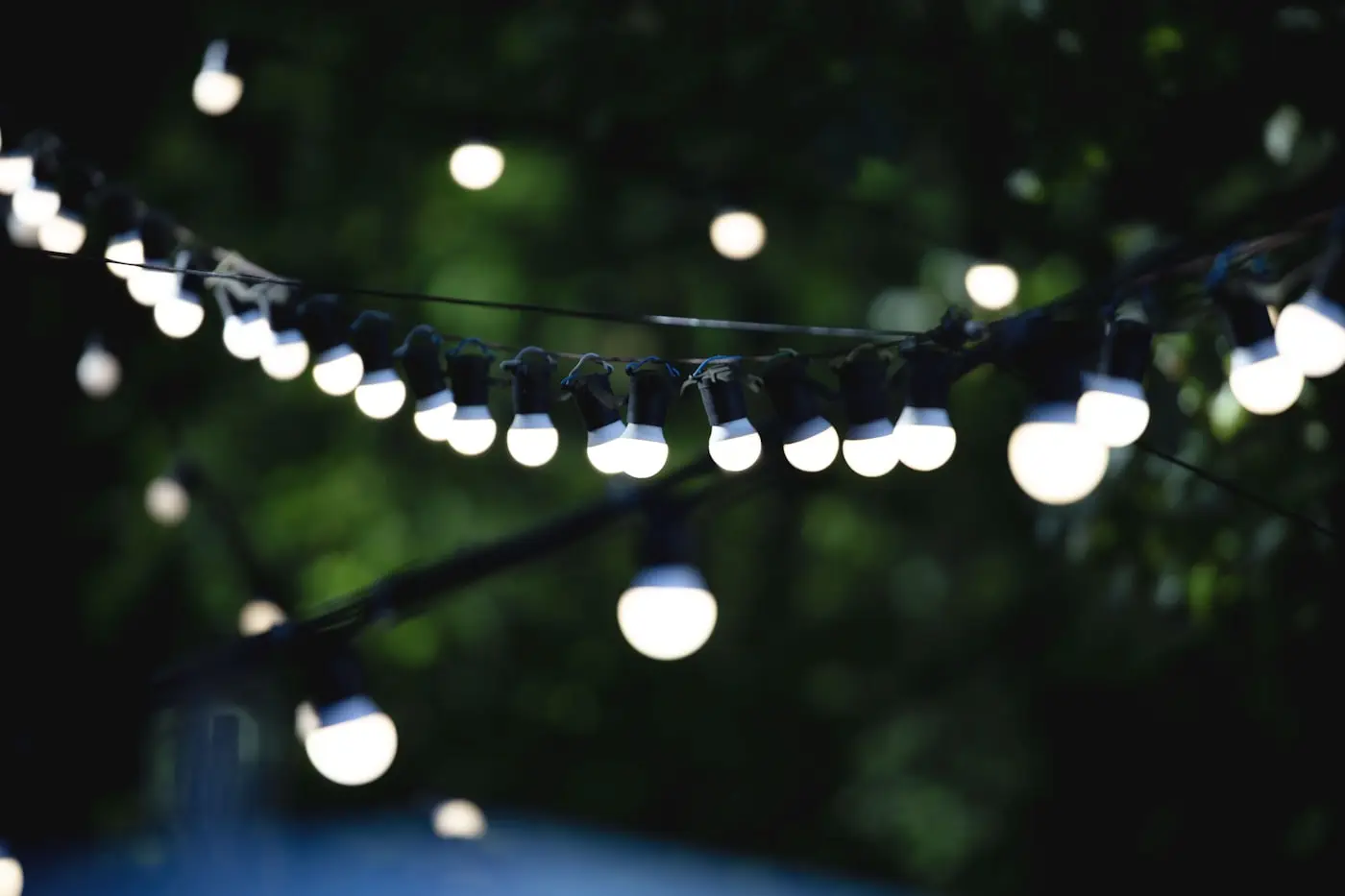
Festoon strings (bulb strings on rubber cable) have become a significant category for patio areas, pergolas, and garden structures. They give a warm social light that is suited to entertaining areas rather than functional pathway lighting. A good outdoor-rated festoon string costs £30-80 for a 10-15m length. They can be plugged into an outdoor socket or wired to a weatherproof outdoor socket by an electrician. For a covered outdoor dining area, festoon strings over the table are a simple and effective first step before committing to a full integrated scheme.
Smart and sensor controls
Timer and dusk-to-dawn sensor controls are standard on most modern transformer units and many individual mains fittings. A timer turns the lights on and off at preset times; a dusk-to-dawn sensor uses a photocell to automatically detect when ambient light drops below a threshold and switches the lights on, then off again at dawn or after a set period. In Yorkshire this means your lights activate earlier in winter (before four o'clock on a December afternoon) and later in summer without any manual adjustment.
Smart lighting systems integrate with home automation platforms (Hue, Lutron, Amazon Alexa, Google Home) and allow remote control from a smartphone. This is useful for holiday-let properties and second homes where you want to be able to activate and adjust lighting remotely. Smart systems add cost to the installation but provide genuinely useful functionality for the Yorkshire climate where you need lights on early and often.
Garden lighting costs in Yorkshire
Garden lighting costs vary significantly depending on system type, number of fittings, cable routing complexity, and fitting quality. The figures below are indicative ranges for professional installations in Yorkshire; DIY solar options sit outside this range at the lower end.
What affects your quote
Cable routing complexity: Running cable under an existing established patio is the single biggest cost variable. Lifting slabs, cutting channels or threading through conduit all add labour. New builds with conduit pre-run can be lit for considerably less than identical schemes on existing gardens.
Number of circuits and zones: A single transformer driving one circuit is simpler than a multi-zone system with separate timers for front garden, rear patio, and lawn uplighters. Each zone adds cost but provides more control.
Fitting quality: IP65-rated LED path lights from a trade supplier cost £15-40 each and last 10-15 years. Equivalent quality in premium brands (Hunza, Davey, Integral) costs £60-200 per fitting but gives significantly better light quality and reliability. For a long-term installation, fitting quality is worth investing in.
Smart controls: Adding Bluetooth or WiFi-enabled transformer controls or smart switches adds £50-300 to the system cost but provides remote operation and scheduling flexibility.
Running costs
LED garden lighting is cheap to run. A typical 10-fitting LED garden scheme drawing 30W total, running six hours per night, uses 0.18kWh per night. At current electricity rates that is approximately 5p per night, or around £18 per year for year-round operation. Compare this to a halogen garden lighting scheme of the same number of fittings, which would use 400-600W and cost £60-90 per year to run. LED payback over halogen is rapid.
The full guide
Why garden lighting matters more in Yorkshire than further south
Yorkshire's latitude and geography make it one of the parts of England where garden lighting has the greatest practical impact on how much use you get from outdoor spaces across the year.
Daylight hours: Hull vs Harrogate
Hull, on the east coast at 53.7 degrees north, has a sunrise of around 8:19am and sunset at 3:48pm on the winter solstice - just seven and a half hours of daylight. Harrogate, further inland at a similar latitude, is similar. Compare this to London, which has about eight hours and twenty minutes on the same date. The difference is meaningful but it is the cumulative effect across the whole October-to-March period that matters most for garden usability.
By late October, many Yorkshire residents are leaving for work in the dark and returning in the dark. Any time spent in the garden - feeding the cat, checking on raised beds, walking through a patio to a home office in the garden, or simply looking out from the kitchen window - happens in darkness. A lit garden transforms this experience significantly.
Extending the patio season
The standard Yorkshire patio season without lighting is roughly May to September - five months. Add quality patio lighting and a covered outdoor area and you can realistically extend that to March through November. On mild evenings in October and early November, a well-lit covered patio with a gas heater is a usable outdoor dining space. Without lighting it is effectively invisible and unused by six o'clock.
The Harrogate and Wetherby markets see the most investment in extended-season outdoor living, typically combining a quality patio, a pergola or canopy, an outdoor heater and a professionally installed mains lighting system as a single project. See our patio laying service page for the groundwork element. The average spend on this type of combined project in the Yorkshire market runs to £5000-15000 across all elements; good garden lighting is typically the most cost-effective element of extending outdoor season.
Pennine hills vs Vale of York
Gardens in the Pennine areas - Hebden Bridge, Holmfirth, Slaithwaite, Marsden, Todmorden - are in the lowest-light zones of Yorkshire. The hills block low winter sun and cloud cover is higher than on the plain. Solar lighting particularly underperforms here compared to the more open Vale of York. Gardens at altitude in the Pennines need wired systems to get reliable winter performance.
The Vale of York and East Riding are slightly better for solar in winter, but even here the advantage is marginal compared to the south of England. For any garden where winter lighting matters, wired systems are the reliable choice across the whole of Yorkshire.
Security and deterrence
Motion-activated security floodlights are one of the most common garden lighting installations across Yorkshire and are often fitted as a standalone job separate from any aesthetic lighting scheme. A single LED PIR floodlight on the rear of the house (150-400W equivalent output but only 20-30W actual consumption) costs £30-80 for the fitting and one to two hours of electrician's time. Most Yorkshire homes have a back gate or yard access that benefits from security lighting, particularly in the terraced housing of Leeds, Bradford, Hull, and the West Riding mill towns where back alleys and rear ginnels are a feature.
How garden lighting is installed: cable, conduit and RCD protection
Understanding the practical side of installation helps you make good decisions at the planning stage and avoid retrofitting problems later.
Planning the cable routes before you start
The single most important thing to get right before any garden lighting is installed is the cable route. Changes after paving is laid, decking is down, or borders are planted become expensive excavation jobs. Spend time thinking about where you want fittings now and where you might want them in five years, then route cable to those positions whether or not you install fittings on day one. A length of conduit laid under the patio during construction costs almost nothing and saves a significant amount of disruption later.
Running cable under lawn
In lawn areas, cable is typically buried using a narrow flat spade to open a 150-200mm deep slit, cable is fed in, and the slit is closed and tamped back. The grass recovers within two to three weeks. For mains armoured cable, burial depth should be at least 500mm under cultivated areas and 450mm under lawns to comply with BS 7671. Low-voltage cable can be shallower but should still be buried enough to prevent damage from garden forks and aerating spikes.
Mark cable routes on a garden plan once installation is complete. This sounds obvious but is frequently skipped, and finding an unmarked cable with a garden fork two years later is a common Yorkshire garden mishap.
Running cable under paving
Under new paving, run cable in plastic conduit laid across the base before slabs are placed. Leave conduit ends accessible - a junction box or marked endpoint at each end. Under existing paving, the options are: lift slabs to run conduit underneath (the proper approach), drill through the bedding mortar at a low angle (messier), or run surface cable in steel conduit along the edge of the patio and down into the soil at the border. The right approach depends on the paving type, how much disruption is acceptable, and how permanent you want the installation to be.
RCD protection requirements
This is not optional and is worth understanding clearly. Any outdoor socket or fixed wiring in a garden must be RCD-protected under BS 7671 (the UK wiring regulations). An RCD at 30mA rating cuts the power in less than 40 milliseconds if it detects a fault current, which is the difference between a safe disconnection and a fatal electric shock in a wet environment. Yorkshire's climate - rain, frost, damp - makes this particularly important as moisture is the most common cause of ground-fault conditions in garden electrics.
If you already have an outdoor socket on the rear of your house, check whether it is RCD-protected. Older properties, particularly Victorian and Edwardian terraces common in Leeds, Bradford, Halifax, Huddersfield, and Hull, may have outdoor sockets fitted by previous owners without RCD protection. An electrician can check this and add a socket with built-in RCD or retro-protect the circuit at the consumer unit for a modest cost before you connect any garden lighting to it.
IP ratings for Yorkshire weather
IP (ingress protection) ratings define how well a fitting resists dust and water. The relevant standard for Yorkshire gardens: IP44 is the minimum acceptable for an outdoor fitting under cover (a wall light under an eave). IP65 (dust-tight, protected against water jets) is the standard for most exposed garden fittings including path lights and wall-mounted lanterns. IP67 (dust-tight, protected against immersion to 1m for 30 minutes) is required for ground-level and buried fittings such as uplighters and buried deck spotlights. Do not install IP44-rated fittings in exposed positions in Yorkshire's climate - they will fail within one or two winters.
Designing a garden lighting scheme that works
Good garden lighting design is about restraint and layering, not maximum wattage. The most common mistake in DIY garden lighting is buying too many fittings and ending up with an evenly lit garden that has no depth or focal points - it looks like a car park rather than a garden.
The three-layer approach
A professional garden lighting scheme works in three layers. Task lighting handles functional needs: path lights for safe movement, step lights for level changes, security lighting at entry points. Accent lighting highlights specific features: uplighters on a specimen tree, a wall washer on a stone wall, a spotlight on a garden sculpture or water feature. Ambient lighting creates the overall mood: festoon strings over a dining area, a soft glow from post lights at the far end of the garden. Each layer serves a different purpose and all three together create the layered, dynamic effect you see in professionally designed schemes.
Using light to create depth
A garden lit only at close range looks flat. Placing a light at the far end of the garden - an uplighter under a tree, a bollard light at a boundary - draws the eye outward and makes the space feel larger. This is particularly effective in the smaller terrace gardens common across West Yorkshire, where a single well-placed light at the far end can transform the visual depth of an eight-metre garden.
Colour temperature for Yorkshire gardens
Warm white (2700-3000K) is the right choice for most Yorkshire gardens. It gives a golden, welcoming tone that works well with stone walls, brick, timber decking and traditional planting schemes. Cool white (4000-5000K, often marketed as "daylight") gives a harsh, blue-toned light that can look institutional and cold in a garden setting, particularly in winter. Some contemporary garden designs use cool white deliberately for a modern effect, but the warm end of the spectrum suits the majority of Yorkshire's period and traditional properties far better.
Designing for the view from inside
In Yorkshire, the garden is often viewed from inside the house for six months of the year. A good lighting design should look as good from the kitchen window as it does when you are standing in the garden. Uplighters that catch the canopy of a tree, wall washers that illuminate the far boundary, and a softly lit path curving away from the back door all read well from inside the house. This inside-out design perspective often changes which features get lit and which do not.
Common questions about garden lighting in Yorkshire
How much does garden lighting cost in Yorkshire?
DIY solar starter kits cost £50-200 and require no installation. A professionally installed low-voltage LED system with transformer, cable and six to ten LED fittings typically costs £300-800. A full mains-powered system with RCD protection, armoured cable and multiple fittings ranges from £500-2500 depending on scale. Large premium installations on bigger Yorkshire properties can run to £3000-5000. For perspective: fitting quality and cable routing complexity have more effect on the final price than the number of lights.
Do I need an electrician for garden lighting?
You need a Part P-registered electrician for any mains-voltage (230V) outdoor wiring - connecting to the consumer unit, running SWA armoured cable, installing outdoor sockets and fused spurs. Low-voltage (12V) transformer systems can be installed by a garden lighting specialist without an electrical qualification because the cable running around the garden is at safe low voltage. Solar spike lights require no professional involvement. If in doubt, use a qualified electrician for anything connected to the mains.
Will garden lighting work through Yorkshire winters?
Mains and low-voltage LED systems perform identically regardless of season - a cold, dark December night in Yorkshire makes no difference to a hardwired system. Solar systems perform significantly worse in Yorkshire winters than in summer. If winter performance matters to you (and in Yorkshire it should - half the year has short days and limited daylight), a wired system delivers consistent results that solar cannot match at this latitude.
Can I add garden lighting to an existing patio?
Yes, but the cable routing is more disruptive than on a new installation. For transformer-based low-voltage systems, cable can usually be run along the edge of a patio and buried in the adjacent border, or threaded under slabs at a raised join. For mains cable, lifting one or two slabs to run conduit is typically the cleanest approach. A garden lighting specialist will assess the specific patio before quoting and advise on the most practical route. Expect to pay a modest premium over a new-build installation because of the extra routing work.
Do I need planning permission for garden lights in Yorkshire?
In most cases, no. Garden lights are generally considered permitted development and do not require planning permission for standard domestic installations. However, if your property is a listed building or within a conservation area, you may need consent before installing permanent external lighting. York, Harrogate, Beverley, Richmond and many other Yorkshire towns have extensive conservation areas - check with your local planning authority if you are unsure. Light pollution rules also apply: lights should be directed downward or at the intended feature and not cause nuisance to neighbours.
What is the difference between low-voltage and mains-powered garden lighting?
Low-voltage systems (typically 12V) use a transformer plugged into an outdoor socket to step down from mains voltage. The cable running around the garden is low-voltage, which is safer to install and easier to modify. Mains-powered systems run at 230V directly from a fused spur or consumer unit, require armoured cable and RCD protection, and must be installed by a Part P-registered electrician. Low-voltage suits most garden lighting schemes; mains power is needed for high-output floodlights, longer cable runs over 30 metres, or where you want no transformer box visible.
How is garden lighting cable run under paving or lawn?
For lawn runs, cable is typically buried 150-300mm deep using a flat spade to open a narrow slit, then closed and tamped back down. Under paving, armoured cable passes through a conduit laid when the paving was originally installed, or is threaded through existing joints if that was planned for. Retrofitting cable under an established patio usually means lifting one or two slabs to route conduit underneath. A good installer assesses the route before quoting because the cable-running method significantly affects the labour cost.
How do I choose between solar and mains-powered garden lights?
Solar is lower cost to install and requires no electrical work, but performance in Yorkshire's shorter winter days and cloudier climate is notably weaker than in southern England. A solar light that performs well from May to September may give only 2-3 hours of dim light on a December night in Yorkshire. Mains or low-voltage systems deliver consistent, bright light year-round regardless of the weather. If you want reliable winter lighting - which is much of the value in Yorkshire given the long dark evenings - a hardwired system gives significantly better results.
What RCD protection is required for outdoor garden lighting?
Any mains-powered outdoor socket or circuit must be protected by a 30mA RCD (residual current device) under BS 7671 wiring regulations. This applies to garden lighting circuits fed from the consumer unit and to outdoor sockets used to power transformer-based systems. An RCD cuts the power in around 30 milliseconds if a fault is detected, preventing electric shock. If your outdoor circuit does not have RCD protection, an electrician should add it before any garden lighting is connected to it. This is a safety requirement, not optional.
What types of garden lighting work best for Yorkshire winters?
Yorkshire's winters are long, dark and often wet. Warm-white LED fittings (2700-3000 Kelvin colour temperature) work better than cool white in winter conditions because they give a welcoming, amber-toned light rather than a stark white that can feel bleak on a grey November evening. IP65-rated or above fittings handle Yorkshire rainfall reliably. For the darkest months, path lighting guides movement safely, uplighters on specimen trees or walls create focal points, and deck or step lights extend the usable patio season into October and November.
How do I choose a reliable garden lighting installer in Yorkshire?
For any mains-powered work, check that the installer is registered under Part P of the Building Regulations - they should be able to issue a Building Regulations compliance certificate on completion. For low-voltage LED systems, any competent electrician or experienced garden lighting specialist can handle the installation. Ask for photos of previous Yorkshire installations, check that they specify IP65 or higher fittings, and ask how they run cable under existing features before committing. A quote that does not mention cable routing or transformer position has probably not thought through the full installation.
Garden lighting alongside other Yorkshire garden projects
Garden lighting works best as part of a considered garden scheme rather than as an afterthought. If you are planning a new patio or decking, specify lighting positions before the groundwork starts - retrofitting later is always more disruptive and expensive. Our patio laying service and decking installation service both include guidance on pre-running conduit for future or concurrent lighting installations.
For ongoing garden care around a lit scheme - keeping borders clear of the cable routes, maintaining planting that features in the lighting design, and seasonal tidy-ups that account for the fittings - our garden maintenance service covers the full ongoing programme. For broader garden design including the lighting scheme as part of a wider project, our garden design service brings together all the elements.
Further reading: our Yorkshire garden lighting guide covers specific product recommendations and installation case studies across the county. For outdoor entertaining areas where lighting is one element of a wider project, our decking installation guide for Yorkshire covers timber choice, design and the integration of lighting into deck builds.
Garden lighting installation covering 240+ towns across Yorkshire
Our network of garden lighting installers covers the full county. Find your local installer below, or find your nearest gardener in Yorkshire to see all available services in your area.
- York
- Harrogate
- Beverley
- Hull
- Cottingham
- Scarborough
- Wetherby
- Boston Spa
- Driffield
- Malton
- Norton
- Helmsley
- Pickering
- Kirkbymoorside
- Easingwold
- Thirsk
- Ripon
- Knaresborough
- Tadcaster
- Selby
- Pocklington
- Northallerton
- Leeds
- Bradford
- Sheffield
- Halifax
- Wakefield
- Huddersfield
- Doncaster
- Rotherham
- Barnsley
- Haxby
- Strensall
- Huntington
- Copmanthorpe
- Bishopthorpe
- Stamford Bridge
- Filey
- Bridlington
- Goole
- Ilkley
- Dunnington
- Boroughbridge
- Skipton
- Whitby
- Stokesley
- Market Weighton
- Stockton-on-the-Forest
- Keighley
- Otley
- Bedale
- Hornsea
- Castleford
- Dewsbury
- Garforth
- Guiseley
- Horsforth
- Morley
- Pontefract
- Ackworth
- Batley
- Bingley
- Cleckheaton
- Holmfirth
- Horbury
- Ossett
- Pudsey
- Hebden Bridge
- Mirfield
- Sowerby Bridge
- Brighouse
- Elland
- Featherstone
- Normanton
- Hemsworth
- Maltby
- Mexborough
- Wath-upon-Dearne
- Rawmarsh
- Swinton
- Royston
- Darton
- Hoyland
- Wombwell
- Penistone
- Thorne
- Bawtry
- Kippax
- Rothwell
- Knottingley
- Richmond
- Leyburn
- Masham
- Settle
- Guisborough
- Loftus
- Saltburn-by-the-Sea
- Pateley Bridge
- Grassington
- Long Preston
- Hebden
- Shipley
- Hessle
- Brough
- Swanland
- Withernsea
- Heckmondwike
- Birstall
- Liversedge
- Yeadon
- Catterick Garrison
- Acomb
- Poppleton
- Rawcliffe
- Sherburn-in-Elmet
- Howden
- Mytholmroyd
- Marsden
- Meltham
- Conisbrough
- Tickhill
- Adwick-le-Street
- Thurnscoe
- South Elmsall
- Denby Dale
- Farsley
- Crofton
- Armthorpe
- Sprotbrough
- Todmorden
- Willerby
- Hedon
- Hawes
- Addingham
- Burley-in-Wharfedale
- North Cave
- Barlby
- Haworth
- Baildon
- Bolton-upon-Dearne
- Goldthorpe
- Cudworth
- Honley
- Queensbury
- Upton
- Kirkburton
- Skelmanthorpe
- Thornton
- Silsden
- Slaithwaite
- Linthwaite
- Golcar
- Greetland
- Middleham
- Reeth
- Emley
- Flockton
- Spofforth
- Stocksbridge
Get a garden lighting quote today
Tell us what you have in mind - patio, path, uplighters, or a full scheme - and we put your enquiry in front of a local installer who can quote for your specific garden.
Get a free quote