Poppleton occupies an unusual position among York's satellite villages: close enough to the city to function as a commuter suburb, but with a distinct character that sets it apart from the larger estate suburbs. Upper and Nether Poppleton together form a community of executive detached homes, older village properties, and some more modern infill development - all sitting on heavy York clay that is shared with the city gardens to the east. The York-Harrogate railway line runs through the village, making it a natural landing point for professional households who want a proper village with good transport links. What that means in practice for gardening is straightforward: larger-than-average gardens, households with disposable income and limited free time on weekends, and a strong preference for a gardener they can trust to manage the garden without supervision.
Poppleton's gardens: larger plots, more complex maintenance
The executive detached housing that characterises much of Upper and Nether Poppleton comes with rear gardens that are meaningfully larger than the semi plots in nearby Acomb or Rawcliffe. A typical Poppleton detached property will have a rear garden of 60-100 feet, often with formal lawn areas, a planted border or two, and a boundary treatment - whether that is hedging, fencing, or a mix. Some of the larger properties on Station Road and the approaches to Upper Poppleton have gardens that run considerably further, with mature trees, kitchen gardens, and ornamental planting that needs genuine horticultural knowledge to maintain rather than just routine mowing and edging.
The formal hedging at Poppleton properties is also more complex than the standard privet boundary that dominates the surrounding suburbs. Yew, beech, and box hedging are common in the larger gardens, and these need to be cut to shape with a precision that is different from simply keeping a privet boundary from spreading. If you have formal hedging at your Poppleton property, ask specifically about the gardener's experience with shaped hedges before booking - it is a skill that not all general maintenance gardeners have developed. See the hedge trimming service page for what to expect, and the hedge trimming cost guide for pricing context.
The York clay underneath Poppleton gardens
The soil across Poppleton is the same heavy alluvial clay that defines York city's gardens and runs through most of the northwest suburbs. This is a clay that holds water through winter and well into spring - it is not unusual for a Poppleton lawn to still be soft and waterlogged in early April after a wet March - and compacts under foot traffic in a way that creates progressive lawn problems over time. Bare patches in high-traffic areas, moss in shaded or low-lying zones, and a general thickening of weed grasses through compacted turf are all symptoms of the same underlying soil condition.
The good news is that this is very well understood by any York-area gardener with experience of YO26 clay. The standard treatment cycle - hollow-tine aeration in September, followed by overseeding with a moisture-tolerant grass mix and top-dressing with sharp sand to improve drainage - is highly effective on Poppleton lawns when done consistently over two or three seasons. The Yorkshire clay soil garden guide covers the mechanics of what is happening in your soil and why this treatment cycle works. For the overseeding side specifically, the Yorkshire lawn overseeding guide covers timing and technique. The broader Yorkshire lawn care guide sets the whole seasonal programme in context.
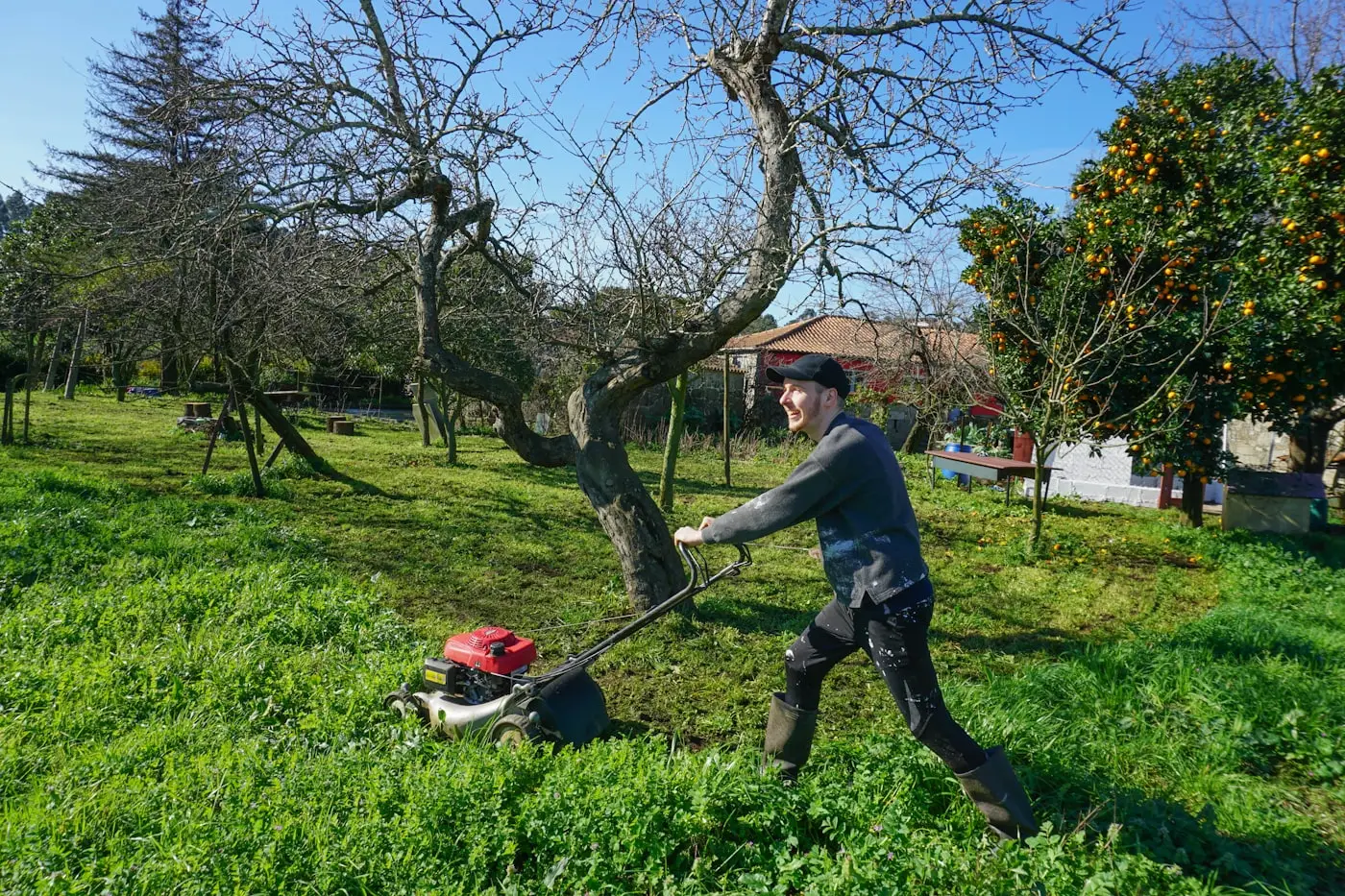
One practical implication of the Poppleton clay is that the first lawn cut of the year should not be rushed. A clay lawn that has been wet through winter and is still carrying surface moisture in late March is vulnerable to compaction if mowed - the tyre or roller of a lawnmower on soft clay will compress the surface and worsen the drainage problem for the rest of the season. A good gardener will wait for the ground to firm before the first cut, even if it means the lawn looks a little shaggy into April. If a gardener proposes to start mowing in early March on heavy ground, that is worth querying.
Fortnightly rhythm and the Poppleton commuter household
Fortnightly garden maintenance settles naturally into the Poppleton growing season because the household pattern - two working adults, away during the week, weekend time at a premium - makes it the obvious arrangement. A good fortnightly contract removes the garden entirely from the weekend to-do list: the gardener comes on a fixed day, the lawn is kept, the borders are weeded, and the garden looks the way it should without any input from you. If you want this to work properly, the key is finding a gardener before the season rather than partway through it - February enquiries secure April starts; April enquiries often get May or June starts at best.
What gets booked in Poppleton gardens
Fortnightly garden maintenance from April through October is the standard arrangement for most Poppleton households. For a larger executive garden - rear plot of 70-100 feet with lawn, borders, and hedging - a fortnightly visit will typically cover lawn mowing with a cylinder or rotary mower, border edging with a half-moon, weeding of planted beds, path and patio sweeping, and basic deadheading of summer planting. This is a two-hour job on most larger plots, and some will run longer if there is formal hedging included in the regular visit scope.
Hedge trimming is booked more intensively in Poppleton than in surrounding villages because the formal hedging here is more substantial and more demanding. Box hedging requires cutting to precise shapes two or three times through the growing season to look well. Yew is slower-growing but needs to be cut cleanly to the shape; it does not recover from being cut into old wood the way privet does. Beech hedging needs timing to ensure the old leaves are retained through winter - cutting too late in the season removes the mechanism that holds last year's growth. These are details that matter to the result, and they are details a gardener with experience of formal hedging will know. The lawn mowing service guide and lawn edging service page cover the maintenance basics.
Spring and autumn one-off work - tidies, border clearances, planting - also come up regularly at Poppleton properties. Spring tidies here tend to be more complex than in the surrounding areas because the gardens are larger and the planting is more established. A full spring tidy at a larger Poppleton property might cover cutting back a dozen or more established perennials, clearing borders that have filled with winter weeds, mulching beds, edging the lawn after winter, and getting everything back into shape for the season. Budget four to six hours for a full reset at a substantial property. The spring garden tidy guide for Yorkshire covers what is typically included.
What it costs to hire a gardener in Poppleton
Poppleton sits in the York-area rate band for standard maintenance, with an upward pull from the larger garden sizes and the more complex scope that executive properties require. The UK gardener cost guide gives the national context; Poppleton-specific rates for 2026 are set out below.
| Rate type | Poppleton YO26, 2026 | Notes |
|---|---|---|
| Hourly rate (maintenance) | £25-£40/hr | Regular contracts at the lower end; one-off visits at the higher end |
| Day rate (7-8 hrs) | £160-£220 | Full working day; larger gardens or complex restoration projects |
| Fortnightly maintenance (medium garden) | £35-£60 per visit | Standard semi or smaller detached garden on a regular contract |
| Fortnightly maintenance (large executive garden) | £55-£65 per visit | Larger plots with formal hedging, borders, and lawn; 2-hour+ visits |
| Spring tidy (one-off, large property) | £150-£350 | Full seasonal reset including border clearance, mulching, lawn edging |
| Formal hedge trimming (yew, beech, box) | £80-£200 per session | Shaped formal hedges; pricing depends on length, height, and complexity |
| Lawn aeration and overseeding | £90-£240 | Hollow-tine aeration plus seed and top-dressing; larger lawns at the top |
For the full rate context across Yorkshire, the gardener hourly rate guide covers how Poppleton's pricing sits relative to the wider region and nationally.
How to find a gardener in Poppleton
Word of mouth is the most effective route in a village of Poppleton's size. The community is compact enough that recommendations travel quickly - if you know a neighbour whose garden is consistently well-maintained, asking directly who does it will get you a name and an honest assessment of what the gardener is like to work with. The Poppleton community Facebook group and the village newsletter are also good channels, both for recommendations and for hearing about gardeners who are becoming available as their regular rounds change.
York-area gardeners cover Poppleton naturally as part of their YO26 routes - the village is not far enough from the city to be an inconvenient add-on. Some gardeners also base themselves in the Poppleton area and cover the village as their primary patch alongside nearby Acomb and the western York suburbs. A introduction service that connects you to a single vetted YO26 gardener with experience of Poppleton's larger gardens and clay soil conditions is a more reliable route than a national lead aggregator, which will forward your enquiry to multiple contractors without any local knowledge filtering. The Poppleton town page and the York gardeners guide have further local context.
When making first contact, confirm public liability insurance, check for a Waste Carrier's Licence if clearance work is involved, and ask specifically about experience with larger gardens and formal hedging. For Poppleton properties, experience with clay soil management - knowing when to hold back on the first cut, understanding the aeration cycle, recognising the signs of compaction - is a baseline qualification. Ask whether they have worked YO26 clay gardens before, and specifically whether they have experience of formal hedging if your property has it.
Frequently Asked Questions
What garden jobs are typical for Poppleton properties?
Fortnightly lawn and border maintenance on larger executive detached gardens is the core work. Formal hedge trimming for yew, beech, and box hedges. Spring and autumn seasonal tidies on established planted borders. Annual lawn renovation - aeration and overseeding - on clay lawns that compact over time. The garden maintenance service page covers the standard scope.
What do gardeners charge in Poppleton?
Standard maintenance runs £25-£40 per hour. Fortnightly visits for medium gardens run £35-£60; for larger executive gardens with formal hedging and border management, fortnightly visits can reach £65 per visit. Spring tidies at larger properties run £150-£350. For the full rate picture, see the UK gardener cost guide.
Is it easy to find a gardener in Poppleton?
Yes - York-area gardeners cover Poppleton as part of their YO26 rounds, and word of mouth in the village works very effectively. The Poppleton Facebook group and village newsletter are reliable channels. Book in February for an April start - the best gardeners fill fortnightly slots before the season begins.
When should I book a gardener in Poppleton?
February or early March for regular maintenance from April. Spring tidies: book in March for April. Hedge trimming: from June, after nesting season. Lawn aeration and overseeding: book in August for September. See the Yorkshire lawn care guide for seasonal detail.
Related reading
- Gardeners in York - the main York city guide
- How much does a gardener cost in the UK? (2026)
- Clay soil gardens in Yorkshire - what you are dealing with
- Lawn overseeding in Yorkshire - timing and technique
- Hedge trimming cost guide
- Poppleton town page
- Garden maintenance across Yorkshire
Gardeners in other nearby areas
We cover Poppleton and the surrounding northwest York corridor:
Get a quote for your Poppleton garden.
60-second assessment. If a local YO26 gardener takes your enquiry, they call you with a price for your garden and job.
Start the assessment