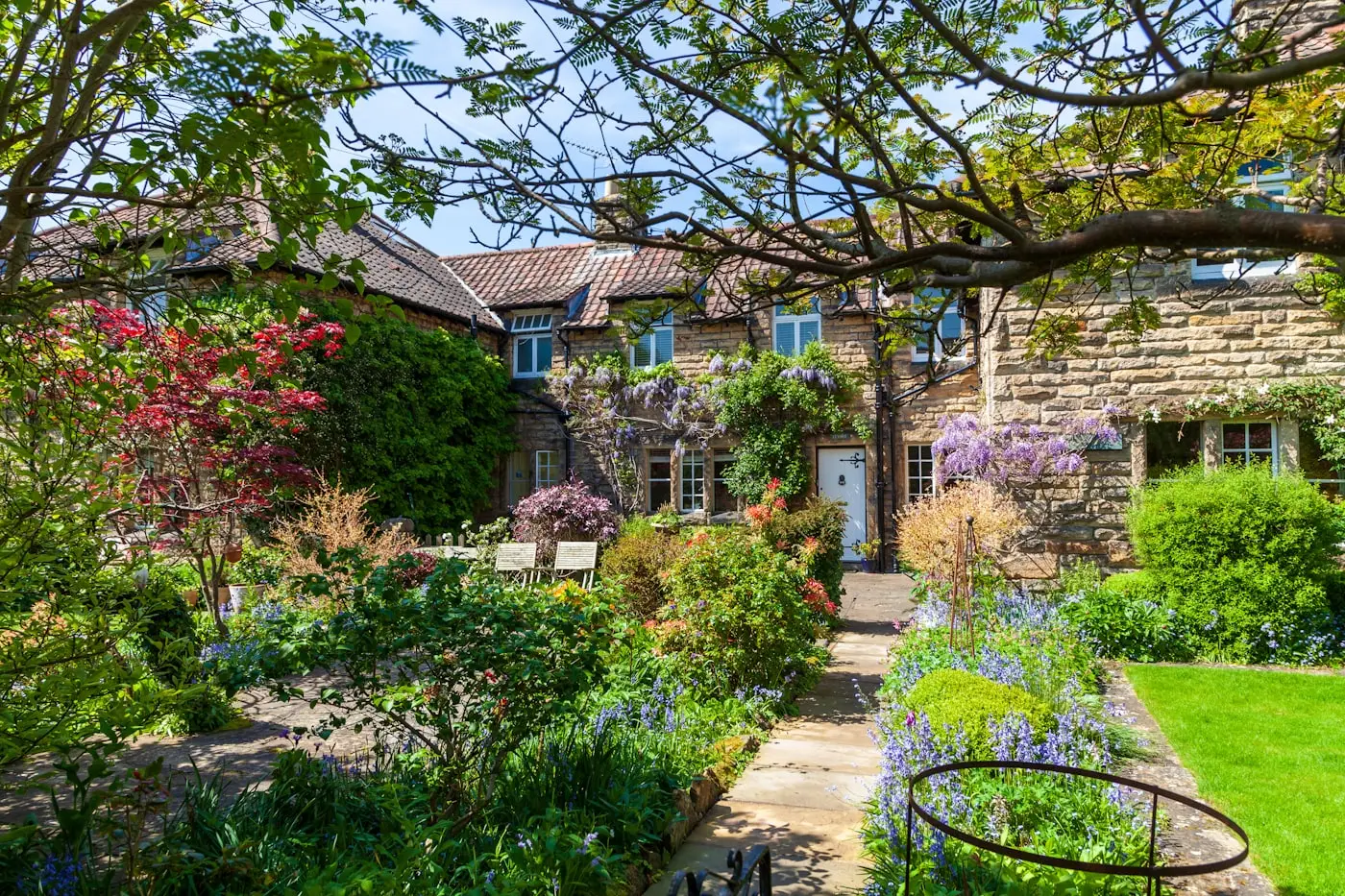
Harrogate takes its gardens seriously. The town grew into a Victorian spa resort precisely because it was beautiful, and that aesthetic sensibility never quite left. Walk through the Duchy estate, past the Edwardian semis on Kent Road, or through the large detached plots in Pannal and Killinghall, and you will find gardens that are genuinely tended - formal hedges clipped to a line, perennial borders with year-round structure, kitchen gardens still producing in November. If you are planning a garden redesign here, you are working in a town that knows the difference between a good garden and a mediocre one. That is both an opportunity and a reason to get the design right before any contractor picks up a spade.
Harrogate's Garden Heritage and What It Influences
Three places shape what Harrogate homeowners want from their gardens: The Stray (200 acres of protected open grassland running through the town), Valley Gardens (the formal spa garden with its extensive borders and structured planting), and RHS Harlow Carr on the edge of town. Harlow Carr in particular is relevant - it is an RHS trial ground for plants that perform in the north of England, which means its plant selection reflects what genuinely thrives in this climate rather than what looks good in a Surrey catalogue. If a plant features prominently at Harlow Carr, you can have reasonable confidence it will perform in a Harrogate garden.
The housing stock creates very different design briefs across the town. Victorian and Edwardian terraces in the streets around the town centre - Beech Grove, Bower Road, Alexandra Road - typically have modest rear gardens of 40 to 80 square metres, often with limited light from neighbouring houses and a north-facing aspect at the back. Larger Edwardian and interwar detached houses in the Duchy estate and around Duchy Road have generous gardens with established trees. The large detached properties on the rural fringes - Pannal, Burn Bridge, Killinghall, Rossett Green, Follifoot - often have plots of 400 square metres or more, sometimes with paddocks, significant mature trees, and views over the Crimple Valley or the wider Nidderdale landscape.
Each requires a different approach. A small terrace garden benefits from a tight brief: one or two focal points, structural planting that provides interest through winter, low-maintenance hard landscaping that does not leave the owner with a weekend maintenance burden. A large rural plot needs a stronger design framework - clear sight lines, planting that connects to the surrounding landscape, and enough structure to carry the garden through the months when it is not at its colourful best.
The Quick Answer: What Does Garden Design Cost in Harrogate?
| Scope | Typical Cost | What's Included |
|---|---|---|
| Concept drawings only | £400-£900 | Site visit, measured survey, initial concept sketches. Not a complete design. Useful as a starting point before committing to a full project. |
| Full design (plan only, no build) | £800-£2,500 | Measured survey, scaled planting plan, hard landscaping layout, materials specification, plant list. You implement using your own contractors. |
| Small garden redesign (under 80 sqm) | £5,000-£10,000 | Design plus build. Typical terrace or small detached rear garden. Includes new patio or path, border replanting, fencing or screening. Hard landscaping dominates the budget. |
| Medium garden redesign (80-200 sqm) | £10,000-£18,000 | Design plus build. Typical 3-4 bed detached. New patio, paths, lawned area, planted borders, structure planting (hedges, trees), possibly raised beds or kitchen garden. |
| Large garden (200 sqm+, rural fringe) | £18,000-£25,000+ | Pannal, Burn Bridge, Killinghall area properties. Full design and build including significant hard landscaping, extensive planting, irrigation, lighting, possibly terracing or level changes. |
| Planting-only refresh (existing structure) | £2,000-£6,000 | New planting scheme for existing beds, no structural changes. Border design, plant sourcing, implementation. Good option if your layout works but the planting is tired. |
These are combined design-and-build costs. The designer's fee within those figures is usually 10 to 15% of the total - so on a £14,000 project, expect the design fee to be £1,200 to £2,000, with the remainder going to hard landscaping materials and labour, plants, and waste removal. For more on how designer fees are structured, see our Yorkshire garden designer cost guide.
What a Harrogate Garden Design Project Involves
Stage 1: Initial site visit and brief
A good designer will spend at least an hour on the initial visit. They will measure the garden, check the aspect (which way it faces and how much sun it gets at different times of day), look at the soil type and drainage, identify what is worth keeping and what needs to go, and most importantly talk to you about how you actually use the garden. Lifestyle brief matters: a family with young children has very different requirements from a couple who want a formal garden they can look at from the kitchen window but do not want to spend every weekend maintaining.
Stage 2: Concept design
The concept stage is where the designer turns the brief and the site information into a spatial idea. This is usually presented as a hand-drawn or digitally produced overview sketch showing the layout - where the patio goes, how paths connect spaces, where planting beds sit in relation to the house, where focal points are placed. At this stage you are making broad decisions about layout and style, not plant species.
Stage 3: Detailed design and planting plan
Once the concept is agreed, the designer produces a detailed plan: scaled drawings of hard landscaping, a planting plan showing every plant by species and position, a plant list with quantities, and a materials specification. This is the document you hand to a contractor to quote from. On more complex projects it may also include detail drawings for features like raised beds, water features, or retaining walls.
Stage 4: Implementation
You can either use the designer's own build team (design-and-build), or go out to tender with the plans and get quotes from local landscapers. Using a separate landscaper gives you independent pricing but removes the single-point-of-responsibility you get from design-and-build. Either approach works; the decision often comes down to whether you want the designer to be involved during the build for oversight and sign-off.
Stage 5: Planting and establishment
Hard landscaping is typically installed first. Planting follows - and in Harrogate, timing matters. If you are planning significant planting, autumn (October to November) and early spring (March to April) are the best windows. Summer planting is possible but requires more watering support. The late frosts that can run into May in Harrogate and the surrounding area (Pannal is particularly susceptible) mean that tender plants should go in after mid-May at the earliest.
Harrogate's Soil and What It Means for Your Garden
Harrogate sits on and around the Magnesian Limestone and Millstone Grit geology, which means soil conditions vary across the town. Much of the central and western area has limestone-influenced alkaline soil - typically a pH of 7 to 8, free-draining, and with good calcium content. This is genuinely good growing soil for a wide range of ornamental plants, but it rules out acid-lovers completely unless you create raised beds with imported ericaceous compost.
What thrives on alkaline Harrogate soil: Cistus (sun rose - superb in a sunny sheltered spot), rosemary, lavender, salvias (both shrubby and herbaceous), alliums, Geranium (virtually all species), Nepeta (catmint), Veronicastrum, most ornamental grasses, Verbena bonariensis, Echinops, Eryngium, and the full range of Mediterranean herbs. Formal structure plants - Taxus (yew), Buxus (box), and hornbeam - all perform well, though box blight has become a serious risk across the area over the past decade.
Box blight in Harrogate: what designers are recommending
Buxus sempervirens (common box) has historically been the go-to formal hedging plant for Harrogate's period gardens. Box blight (caused by Cylindrocladium and Volutella fungi) has now spread widely across North Yorkshire. Many local designers are now specifying Ilex crenata (Japanese holly), Pittosporum tenuifolium cultivars, or clipped Euonymus japonicus as alternatives. Ilex crenata in particular looks very similar to box at a distance and performs well on Harrogate's alkaline soils. If a designer is still automatically specifying Buxus for a formal scheme, ask them why and what their mitigation strategy is.
The outlying rural areas have their own soil character. Burn Bridge and Pannal have pockets of heavier clay mixed with the limestone; Kirkby Overblow and the Crimple Valley have more varied soils. If you are on the rural fringe, a soil test at the start of the project is worth the £30 to £50 it costs - it tells you the pH and gives you a nutrient profile that shapes the entire planting design.
Late frosts are also a design consideration specific to Harrogate and the surrounding area. Valley Gardens in the town centre records last air frosts on average around 8 May - later than most national guides suggest. At Pannal, Burn Bridge, and the higher-lying rural edges, frosts into mid-May are not unusual. This means tender perennials (dahlias, cannas, salvias from warmer climates) should either be treated as annuals or given protected overwintering. A designer who knows the local microclimate will factor this into their plant selection.
Garden Styles Common in Harrogate
Formal and structured
The most popular design direction in Harrogate's period properties. Formal geometry - clipped hedges, topiary, parterre-style planting, symmetrical beds, axial paths - suits the Victorian and Edwardian architecture well and satisfies the local aesthetic preference for a well-ordered garden. This style has the highest design complexity (everything has to be precisely placed) and the highest ongoing maintenance requirement (formal hedging needs clipping, topiary takes time). Budget at the upper end of the scale for design-and-build on a formal scheme.
Cottage and naturalistic
Harrogate's garden culture has always had a strong cottage-garden thread - it is visible in the plantings around Harlow Carr and in countless domestic gardens across the town. Cottage planting on alkaline soil lends itself to Geranium, Alchemilla, Nepeta, Salvia, Astrantia, Digitalis, and structural plants like Philadelphus and Viburnum. This style is more forgiving of imprecision in implementation and typically cheaper to build, though a good cottage garden still requires a clear design structure beneath the apparent informality.
Contemporary and low-maintenance
Increasingly popular across Harrogate's newer properties and in gardens where the owners want interest without the maintenance overhead of a traditional border. Typically combines hard landscaping with a relatively small number of structural plants chosen for year-round interest and minimal intervention - ornamental grasses, Salvia nemorosa, Allium, Echinacea, and reliable ground-cover. Paving and gravel often replace lawn areas where lawn is more work than it is worth.
Kitchen and productive garden
Harrogate's affluent demographic has a strong interest in productive gardens - well-built raised beds, soft fruit, espaliered fruit trees against walls, cutting flowers. A well-designed kitchen garden on a property with a large Harrogate plot is a significant project in itself: raised bed construction, paths, tool storage, composting area, irrigation if the site warrants it. Budgets for a serious kitchen garden installation run from £3,000 for a simple two-bed setup to £12,000 or more for a full walled kitchen garden on a large property.
Designer vs Gardener: What Each Brings
This is a question worth thinking through before you spend money on either. A garden designer creates a plan - a spatial and horticultural framework for your garden. A gardener implements and maintains it. They are different skills, and the best outcome for most clients is using both in their appropriate roles.
Where a designer adds value that a gardener typically cannot: spatial design (how spaces relate to each other, sight lines, proportions), access to design software and measured drawings, experience specifying hard landscaping materials, and formal training in horticultural knowledge. Where an experienced gardener may be sufficient: if your garden structure is basically sound and you need a refreshed planting scheme rather than a redesign, a skilled gardener with strong planting knowledge can produce a good planting plan for a fraction of the design fee.
For a large or complex Harrogate garden - a significant period property, a rural plot with level changes, a formal scheme with architectural precision requirements - use a designer. For a suburban border refresh on a plot that already has a sensible layout, an experienced local gardener may be all you need. Our guide to designer vs landscaper vs gardener covers the decision in more detail.
Ready to start your Harrogate garden design?
Tell us what you are planning and we put your enquiry in front of local designers and gardeners who cover Harrogate and the surrounding area.
Start the assessmentFrequently Asked Questions
How much does garden design cost in Harrogate?
For a typical Harrogate garden design project, expect to pay £5,000 to £12,000 for a medium-sized garden combining hard landscaping and planting. Larger detached properties in Pannal, Burn Bridge, and the Rossett area with 300 to 600 square metre plots run from £12,000 to £25,000 or more, depending on the scope of hard landscaping. The designer's fee alone is usually £800 to £3,000 depending on complexity. These figures are for design and build combined; design-only fees without implementation are £500 to £2,500.
What grows well in Harrogate's soil?
Much of Harrogate sits over limestone or limestone-influenced soils, which tend to be alkaline and free-draining. Plants that do well include Cistus, rosemary, lavender, salvias, alliums, Geranium (most species), Nepeta, Veronicastrum, and most herbs. Rhododendrons and camellias, which need acid soil, will struggle unless you use raised beds with imported ericaceous compost. Box hedging has historically been popular in formal Harrogate gardens, but box blight is now a serious risk; many designers are switching to Ilex crenata, Pittosporum, or clipped Euonymus as alternatives.
How do I find a good garden designer in Harrogate?
Look for designers registered with the Society of Garden Designers (SGD) or those with RHS qualifications and verifiable local experience. Ask to see at least three completed local projects, not just mood boards. Check whether they have worked on limestone-based sites in the area before - it makes a meaningful difference to plant selection. Yorkshire Lawn and Garden can put your enquiry in front of local designers who cover the Harrogate area.
Do I need planning permission for landscaping in Harrogate?
Most domestic garden landscaping does not require planning permission. Exceptions include: building a wall or fence over 1 metre adjacent to a highway or 2 metres elsewhere; substantial outbuildings; hard surfaces on front gardens over 5 square metres using non-permeable materials; and any works affecting a listed building or its curtilage. Harrogate town centre has several conservation areas; check with Harrogate Borough Council if you are unsure. Your designer should flag any potential planning issues at the initial consultation.
How long does a garden design project take in Harrogate?
From initial site visit to a completed garden, allow 3 to 9 months depending on scope. The design phase typically takes 4 to 10 weeks. Hard landscaping takes 1 to 4 weeks for a typical garden. Planting is usually best done in autumn or early spring to give plants the best establishment chance. If you want your garden finished for summer, start the design process no later than January or February. See our full garden design timeline guide for a month-by-month breakdown.
What is the difference between a garden designer and a landscaper in Harrogate?
A garden designer creates the plan - the layout, plant selection, materials specification, and design concept. A landscaper is the contractor who builds it. Some firms combine both roles (design-and-build), which simplifies the project but means one firm controls both the design and the build quote. If you use a designer separately from a landscaper, you get independent oversight - the designer can check the build is done to specification. For complex or higher-budget projects, that independence is worth having.