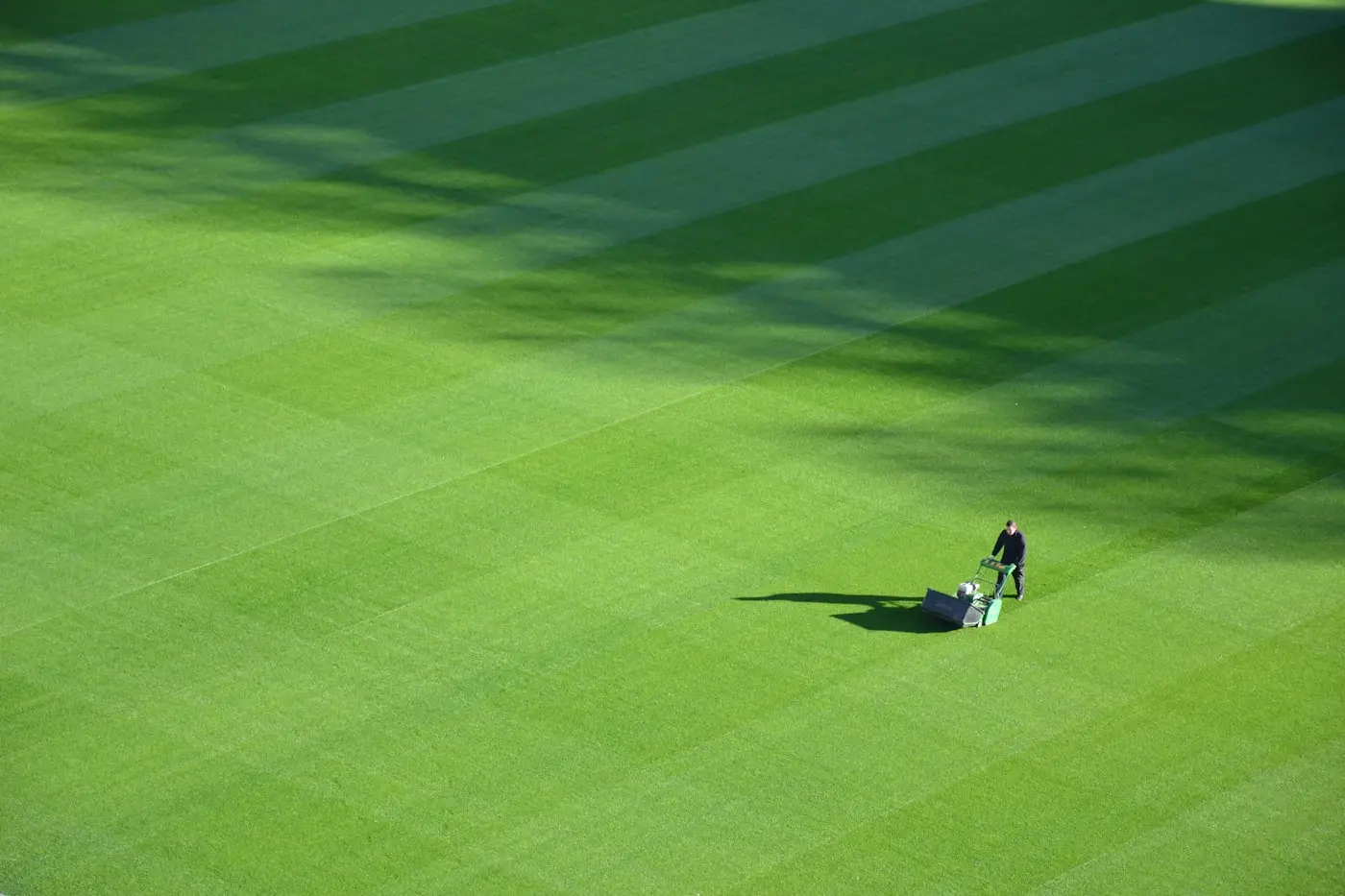
If you're looking for lawn scarification in Sheffield, Leeds, or York, local lawn care professionals can time the treatment to your grass type and ensure overseeding follows immediately for the best recovery.
If your lawn feels spongy underfoot when the ground should be firm, or if the grass has looked increasingly thin and mossy over the past two or three seasons despite regular mowing, the problem is almost certainly thatch. Thatch is the layer of dead grass stems, moss fragments, and organic debris that accumulates between the base of the grass and the soil surface. A little is normal. A lot - anything over 15mm - acts as a physical barrier that prevents water from reaching the roots, blocks new grass from establishing, and creates the moist, airless conditions that moss thrives in.
Scarification is the process of removing that layer. It is one of the most disruptive things you can do to a lawn, and it is also one of the most beneficial - provided the timing is right and it is followed up correctly. This guide explains what it involves, why Yorkshire clay gardens need it more than most, what it costs, and what to do in the weeks after the machine has gone over.
What Scarification Actually Does
A scarifier is a machine with steel blades or wire tines mounted on a rotating drum. It is dragged across the lawn surface and the blades cut vertically through the thatch, slicing it up and lifting it to the surface where it can be raked off. The effect is dramatic and, for anyone who has not seen it before, alarming. After a proper scarification, the lawn looks like something went badly wrong. It is brown, torn open, and bare in patches. People sometimes call their gardener in a panic at this point.
This is exactly what should have happened. The visual damage is temporary. The benefit - removing the layer that was choking the grass - is permanent, provided the aftercare is done correctly. Within three to four weeks of overseeding into the scarified surface, new grass fills the bare areas. By the following spring, a properly treated Yorkshire lawn looks noticeably better than it did before: greener, denser, and with significantly less moss than the previous year.
How to test if your lawn needs scarifying
Push your finger into the lawn surface. If it sinks easily without reaching firm soil, you have significant thatch. Pull a handful of grass upwards - if it comes away with a felted brown layer attached to the base, that is the thatch mat. A layer over 10-15mm means scarification is needed. If the layer is predominantly grey-brown and dry, the thatch has gone beyond dormant grass matter into compacted dead material that is actively blocking drainage.
Why Yorkshire Clay Soil Makes Scarification More Important
Thatch builds up on every lawn. On Yorkshire clay - the dominant soil type across Bradford, Leeds, Wakefield, Doncaster, Rotherham, Barnsley, and much of the Pennine fringe - it builds up faster and causes more damage than on lighter, better-drained soils.
The reason is drainage. Clay soils drain slowly. After rain, moisture sits at the surface longer than it does on sandy or loam soils. That persistent surface moisture is exactly what moss and the microorganisms that accelerate thatch decomposition - or fail to decompose it - are adapted to. The result is a lawn that accumulates thatch faster, supports moss more readily, and suffers more from the drainage blockage that thick thatch creates.
On well-drained sandy soil, some gardeners can go two or even three years between scarifications and maintain a reasonable lawn. On Yorkshire clay, the annual scarification recommendation is not optional maintenance - it is the minimum needed to keep a lawn from deteriorating into a moss-dominated thatch mat over three to four seasons.
There is also a physical compaction element. Clay soil compacts under foot traffic and the weight of a mower. Compaction reduces the air pockets in the soil that grass roots need to grow into. Compacted clay + thick thatch = conditions where grass cannot compete with moss. Scarification removes the thatch, but for a genuinely lasting improvement it needs to be combined with aeration, which addresses the compaction directly. See the garden drainage guide for a full explanation of what compaction does to Yorkshire clay gardens.
When to Scarify in Yorkshire
The timing of scarification matters considerably more than most people realise. The rule is simple: the lawn needs to be growing actively enough to recover from the shock, but not so vigorously that it is under other stresses.
September to early October - the best window
This is the window that professionals prioritise, and with good reason. Soil temperature in early September in Yorkshire is typically still 12-15 degrees Celsius at depth - warm enough for overseeding to germinate successfully. Grass growth is slowing naturally as day length shortens. The westerly weather patterns that bring reliable moisture to Yorkshire through autumn reduce the irrigation burden on newly overseeded areas. And the lawn has three to four months of cooler growing conditions ahead of it to establish new grass before the hard frosts of December and January.
The practical constraint is that September slots fill quickly. If you want your lawn scarified in September, the time to book is August. A gardener who covers West Yorkshire will typically have September fully committed by early-to-mid August each year, particularly after any summer that has produced significant moss growth.
April to May - the spring option
Spring scarification is possible and is better than not scarifying at all. The main limitation is that overseeding in spring is significantly less reliable than overseeding in autumn. Yorkshire clay soils warm slowly - in Bradford and Wakefield, the soil may not reach a reliable germination temperature until late April or even early May. Seed sown into cold clay fails to germinate promptly, sits vulnerable to birds and surface drying, and competes with the first flush of weed growth that comes with rising spring temperatures.
Spring scarification also coincides with the period of most rapid grass growth, which means the disruption of scarification is followed immediately by the vigour of spring growth. This is actually helpful for recovery, but it means the lawn is pushing resources in two directions at once. Autumn scarification followed by the slower, steadier growth of late October and November is gentler on the plant and gives better outcomes.
If you do spring scarification, keep it light - set the blades shallower than you would in autumn - and overseed immediately. Water daily for the first two weeks. Expect results to take longer to show than they would with autumn treatment.
What to avoid
Do not scarify in summer. The combination of heat stress, moisture stress, and the physical shock of scarification damages clay-soil lawns significantly in July and August. The thatch removal exposes the clay surface, which bakes and cracks, making overseeding almost impossible without intensive daily irrigation. Wait for September.
Do not scarify on a lawn that has been treated with a moss killer or lawn sand in the previous four weeks unless the dead moss has fully dried out and browned. Scarifying into wet, freshly killed moss just moves it around without lifting it cleanly. Let it die fully first.
The Full Autumn Renovation Programme
Scarification in isolation helps, but the full autumn programme is where the real transformation happens. A Yorkshire lawn that has been deteriorating for several years will not be fixed by one service alone. It needs the full sequence.
- Pre-mow. Cut the lawn shorter than usual - 25-30mm rather than the typical 40-50mm. This allows the scarifier blades to reach the thatch layer without fighting through long grass. Do this 2-3 days before scarification so the clippings can be removed.
- Scarify. Run the scarifier across the lawn, typically in two directions (north-south then east-west) on a heavy thatch lawn, or one direction on a lighter pass. The amount of material lifted is usually surprising - a 50m² lawn with significant thatch will produce a pile of material equivalent to several wheelbarrow loads.
- Rake and remove thatch. Every bit of lifted thatch needs to come off the surface. Leaving it there means it re-mats. Use a lawn rake or leaf blower to collect it into heaps, then remove by barrow to a compost heap or green waste bags. Do not underestimate the time this takes - on a badly thatched lawn it can be as long as the scarification itself.
- Hollow-tine aeration. While the surface is open, run a hollow-tine aerator across the entire lawn. Hollow tines remove plugs of soil, which temporarily looks untidy but creates channels for water and nutrients to penetrate the clay subsoil. Leave the soil plugs on the surface - they will break down and incorporate into the top-dressing applied next.
- Overseed. Spread grass seed over the entire lawn at the manufacturer's recommended rate. On Yorkshire clay, choose a shade-tolerant, hard-wearing mix that specifies suitability for clay soils. Spread by hand or with a seed spreader, then lightly rake into the surface to improve soil contact.
- Top-dress. Apply a top-dressing of grit-compost mix (typically 70% sharp sand, 30% compost) at 1-3kg per m², worked into the aeration holes with a soft broom. This improves the surface drainage of the clay over time and gives the new seed a better growing medium.
- Water thoroughly. Soak the whole lawn. Keep moist for the next 3-4 weeks while the seed germinates and establishes. In Yorkshire's autumn climate, natural rainfall usually handles most of this, but check after any dry spell and water if the surface has dried out to depth.
What the Lawn Looks Like After: Setting Expectations
This is the part people are not always prepared for. Immediately after scarification, the lawn looks terrible. It is brown, the surface is torn and textured like a rough brown carpet, and in places where the thatch was thick there are bare soil patches. This is exactly right. The grass has not been killed - the thatch mat that was on top of it has been removed.
Two to three weeks after overseeding, you will see a faint green haze as new grass germinates. By four weeks it is visible as actual new grass growth. By six weeks the bare patches are filling. By the following spring, provided the lawn has not been walked on excessively during establishment, it looks significantly better than it did before - denser, greener, and with a fraction of the previous year's moss.
Do not cut the lawn for the first four to six weeks after overseeding, or until the new grass is at least 50mm high. When you do cut, set the mower high (40-50mm) for the first two or three cuts.
The lawn will look like a disaster for three weeks. This is completely normal. Resist the urge to call anyone. Come back in six weeks.
Scarification Alone vs the Full Programme
Scarification without overseeding removes the thatch but leaves bare soil. Bare soil in a Yorkshire garden will not stay bare - it will fill with whatever germinates first, and in most Yorkshire clay gardens that means moss, annual meadow grass (Poa annua), or couch grass. To get grass into the bare areas, you need to seed them immediately while the soil surface is loose and prepared. Skipping the overseeding step wastes most of the benefit of scarification.
Scarification without aeration on Yorkshire clay is better than nothing but leaves the compaction problem unaddressed. The thatch is gone, but if the soil underneath is still compacted and drains slowly, moss will be back within two seasons. The combination of scarification and hollow-tine aeration is what produces lasting results on West Yorkshire clay.
For further reading on clay soil management in Yorkshire gardens, see the clay soil gardening Yorkshire guide. For autumn garden jobs beyond the lawn, see the autumn garden care guide.
Scarification Costs in Yorkshire (2026)
| Service | Lawn size | Typical cost | Notes |
|---|---|---|---|
| Scarification only | 30m² | £60-120 | Machine pass and basic thatch removal; no overseeding |
| Scarification only | 50m² | £80-160 | Professional petrol machine; includes thatch removal |
| Scarification + aeration | 50m² | £120-220 | Both passes, thatch and plug removal |
| Full autumn programme | 50m² | £200-400 | Scarify, aerate, overseed, top-dress, water in |
| Full autumn programme | 100m² | £350-600 | Larger garden; preparation and material costs scale |
| DIY electric scarifier hire | Any | £40-80/day | Domestic electric machines; adequate for light thatch |
| DIY petrol scarifier hire | Any | £60-100/day | More effective on heavy thatch; worth the extra for clay lawns |
The full autumn programme is significantly better value than the individual components bought separately, because the preparation work (pre-mow, surface readiness, thatch removal) is shared across all the tasks. A gardener doing all four stages in one visit charges less than four separate visits. For broader gardener pricing in Yorkshire, see the gardener cost UK guide.
DIY vs Hiring a Gardener
Scarification is one of the more achievable DIY lawn jobs, but there are genuine reasons why hiring a professional produces better results on Yorkshire clay.
The case for DIY
Scarifier hire is widely available from tool hire companies across Yorkshire. A petrol rotary scarifier can be collected for around £60-100 per day and returned the same day. You can complete a 50m² lawn in a morning including the raking. If your thatch problem is light to moderate and your lawn is on a reasonably flat, accessible plot, DIY scarification is perfectly achievable. The overseeding and top-dressing that follow can be done at whatever pace suits you over the next few days.
The case for hiring a gardener
Professional scarifiers are heavier, more powerful machines with adjustable blade depth settings that domestic hire machines do not match. On a lawn with heavy, compacted thatch on clay soil, the difference in outcome between a professional machine and a hire machine is significant. The professional machine lifts more, cuts more cleanly, and takes less time. A gardener who does this work regularly also knows the correct blade depth for the conditions, which matters - too shallow and you miss the thatch; too deep and you damage the grass crowns.
The thatch removal after scarification is also significantly harder work than people expect. On a 50m² lawn with heavy thatch, the material piled up after scarification is substantial - several full garden bags or barrow loads. A professional includes this in their time; a DIYer is doing it themselves.
For most Yorkshire homeowners with a significant thatch problem on clay soil, hiring a gardener for the full autumn programme produces better results and saves a full weekend of physically demanding work. For mild annual maintenance on an already-healthy lawn, DIY scarification is perfectly reasonable.
See the garden maintenance service page for information on regular lawn maintenance programmes that include annual scarification as part of a managed schedule. The lawn edging service pairs well with autumn renovation, as defined edges complement a freshly renovated lawn surface.
What to Do After Scarification: Month by Month
September (immediately after)
Overseed, top-dress, water. Keep the surface moist. Keep foot traffic off. Resist mowing for four to six weeks.
October
New grass should be visible. Light leaf clearing to prevent smothering. First light cut if the new grass is at 50mm. Rake leaves promptly - leaves left on a recovering lawn cause moss to re-establish in the bare areas.
November
Reduce lawn mowing frequency as growth slows. Apply an autumn lawn fertiliser (low nitrogen, higher potassium and phosphorus) to strengthen roots through winter. Do not apply nitrogen-heavy fertilisers in autumn on Yorkshire clay - it promotes soft growth that is vulnerable to frost and fungal disease.
December to February
Leave the lawn alone. Do not walk on frozen or waterlogged clay-soil lawns - every footprint compresses the clay and undoes some of the aeration benefit from autumn. If the lawn is draining significantly better than before treatment, the hollow-tine aeration is doing its work.
The following March and April
As growth resumes, you will see whether the treatment worked. A successful autumn renovation produces noticeably denser, greener growth in spring with less moss visible than the previous year. If the moss is still significant, the pH may also need addressing with a lime application - Yorkshire's acid clay soils often need annual lime treatment alongside mechanical renovation. The lawn care Yorkshire guide covers the full seasonal programme.
For help with autumn garden jobs beyond the lawn, see the autumn garden care Yorkshire guide. If drainage problems persist despite aeration, see the garden drainage Yorkshire guide for more structural solutions.
Frequently Asked Questions
What is lawn scarification?
The mechanical removal of thatch - the layer of dead grass, moss, and organic debris that builds up between the grass blades and the soil. Done with a rotating blade machine. Removes the layer that blocks water, nutrients, and air from reaching grass roots. More important on Yorkshire clay soil than on lighter, better-drained soils.
When should I scarify my lawn in Yorkshire?
September to early October is the best window. Soil is still warm enough for overseeding to germinate; autumn moisture reduces irrigation demand; the lawn has time to recover before winter. Spring (April-May) is possible but less effective. Avoid summer. Book in August - September slots are taken quickly.
How much does lawn scarification cost in Yorkshire?
Professional scarification of a 50m² lawn: £80-160. Full autumn programme (scarify, aerate, overseed, top-dress): £200-400. DIY hire: £60-100 per day for a petrol machine. Hiring a gardener for the full programme is better value than four separate visits. See the gardener cost guide for wider context.
Does scarification damage the lawn?
Yes, temporarily. The lawn looks terrible for 2-3 weeks after treatment. This is completely normal. New grass fills the bare areas within 4-6 weeks of overseeding. By the following spring, the lawn is significantly better than it was before treatment. The temporary damage is the mechanism of improvement.
Should I aerate before or after scarifying?
After. The correct sequence: pre-mow low, scarify, rake out thatch, aerate, overseed, top-dress, water. Aerating after scarification means the hollow-tine holes go into prepared soil with the thatch layer already removed, which improves the benefit of aeration.
Can I scarify my lawn in summer?
Not recommended on Yorkshire clay. Summer heat plus scarification stress plus clay that cracks when dry is a difficult combination. Overseeding after summer scarification fails without intense daily irrigation. Wait for September. The lawn will respond far better.
How often should I scarify my lawn?
Once a year in autumn for Yorkshire clay-soil lawns. Every two years if the lawn is well-managed and thatch is light. Once the lawn is on a proper maintenance schedule, annual light scarification is far less disruptive than occasional heavy scarification on a neglected thatch problem.
What is the difference between scarifying and raking?
Hand raking collects loose surface debris. It cannot remove compacted thatch that is bonded to the soil surface. Scarification uses high-speed rotating blades to physically cut through and lift the thatch mat. No amount of hand raking replaces it for lawns with significant thatch accumulation.
What happens after scarification - what should I do next?
Remove all lifted thatch from the surface. Aerate. Overseed with a shade-tolerant clay-soil grass mix. Top-dress with a grit-compost mix. Water thoroughly. Repeat watering if the surface dries out. First cut when new grass is 50mm high. Full recovery in 6-8 weeks.
Related reading
- Lawn care in Yorkshire - full seasonal guide
- Lawn overseeding in Yorkshire
- Lawn top dressing in Yorkshire - follow-up treatment after scarification
- Lawn moss treatment in Yorkshire - killing moss before you scarify
- Autumn garden care in Yorkshire
- Gardening on clay soil in Yorkshire
- Garden drainage in Yorkshire
- How much does a gardener cost in the UK?
- Garden maintenance across Yorkshire
- Lawn edging across Yorkshire
Need a Yorkshire gardener?
Tell us what you need and we put your enquiry in front of a local gardener. No call centres, no national franchise - direct contact with someone who knows Yorkshire gardens.
Get a free assessment