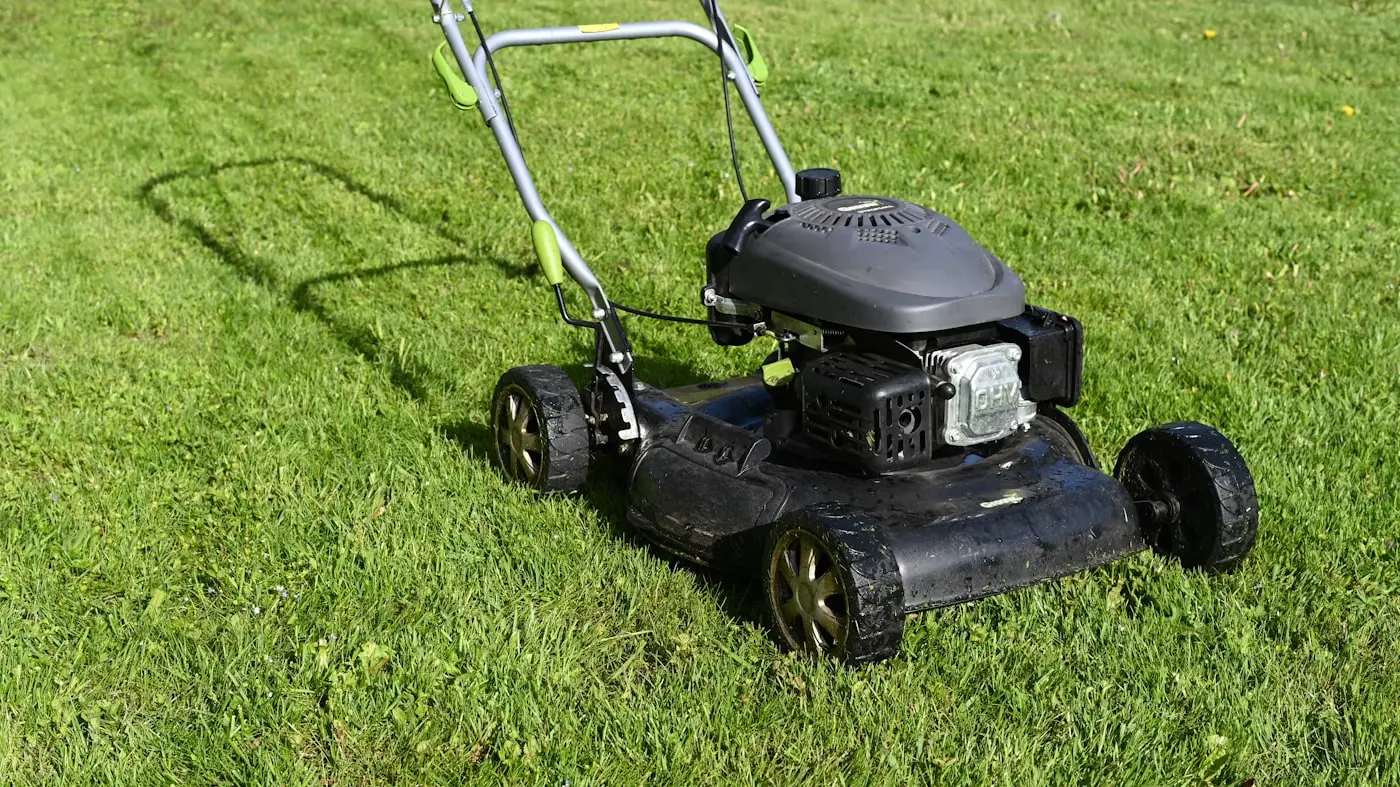
If you want professional lawn stripes in Harrogate, Wetherby, or York, a local gardener can advise on the right mower and roller combination for your grass variety and cut the first pattern for you.
Lawn stripes are not magic - they are physics. The alternating light and dark bands you see on a well-mown lawn are created by bending the grass blades in opposite directions on adjacent mowing passes. When the blades in one strip lean away from you, they reflect light differently to the blades in the next strip, which lean towards you. The contrast between these two angles creates the stripe. Understanding this simple mechanism is the starting point for creating and maintaining good stripes on a Yorkshire lawn.
How stripes are created: the role of the roller
The roller is the key piece of equipment for lawn striping. It follows directly behind the cutting deck and presses the freshly cut grass blades down in the direction of travel. On the return pass, the roller presses the adjacent strip in the opposite direction. The alternating direction of blade deflection is what creates the stripe.
Rollers are available as integrated components on cylinder mowers (the traditional choice for fine lawns) and as aftermarket attachments that fit behind most rotary mowers. Cylinder mowers - which cut grass with a rotating helical blade against a fixed bottom blade, like scissors - give the cleanest stripe and the lowest cutting height. They are the right choice for an ornamental striped lawn where the appearance is a priority. Rotary mowers with a roller attachment are a practical compromise: they stripe well on healthy, upright-growing grass, and they handle Yorkshire's longer, coarser grass better than a cylinder mower would in wet or neglected conditions.
A striping kit (a roller attached to the back of a rotary mower) costs roughly 30 to 80 pounds for a domestic model. Dedicated cylinder mowers start at around 200 pounds for a basic model and rise steeply for petrol or self-propelled versions. The investment is worthwhile if you mow regularly and want consistent stripes as a feature of the lawn throughout the season.
Grass varieties and stripe quality in Yorkshire
Not all grass types stripe equally well. The key variable is how readily the blade bends and how long it stays bent after the roller has passed over it. Fine, upright-growing grass blades deflect and hold position better than coarse, flexible blades that spring back quickly.
Fescue (Festuca species)
Fine-leaf fescues - red fescue (Festuca rubra) and chewings fescue (Festuca rubra ssp. commutata) - produce the sharpest, most defined stripes of any common grass. They are used in bowling green and ornamental turf mixes specifically because the thin blades respond so well to roller treatment. In Yorkshire's conditions, fescue thrives in the cooler, moister climate and on well-drained, slightly acidic soils. On the heavier clay of the West and South Riding, fescue needs well-prepared, well-drained soil to establish well - it is less tolerant of waterlogging than ryegrass. Harlow Carr's fine-turf areas are predominantly fescue-dominant, demonstrating that the grass variety works well in Yorkshire's northern climate.
Perennial ryegrass (Lolium perenne)
Perennial ryegrass is the workhorse of most Yorkshire lawn turf. It establishes quickly, handles wear, and grows vigorously from April to October in Yorkshire's conditions. It stripes reasonably well - not as crisply as fescue but adequately for a domestic lawn - and the stripes hold for three to five days. In the cooler weeks of April, May, and September, when ryegrass growth is steady and the blades are thicker and more upright, stripe definition is better than in the rapid-growth weeks of June. Most Yorkshire garden lawns are ryegrass-dominant, and they can stripe well with consistent technique and a good roller attachment.
Yorkshire fog and rough-stalked meadow grass
Yorkshire fog (Holcus lanatus) is a common grass in older Yorkshire lawns that were not established from specialist seed. It has wide, soft leaves that bend easily but spring back quickly, giving poor stripe definition. Rough-stalked meadow grass (Poa trivialis) is similarly soft-bladed and common in wetter Yorkshire sites. Both are difficult to stripe well. If your lawn has a high proportion of these grasses, overseeding with a ryegrass or fescue mix - ideally after scarification to open the sward - will improve both stripe quality and overall lawn appearance. See the lawn scarification service for the preparation process.
Yorkshire seasonal timing for lawn striping
The Yorkshire growing season runs from approximately late March to October, with peak growth in May, June, and August. Stripe quality and persistence vary through the season in ways that the Yorkshire gardener should understand.
| Season | Stripe quality | Notes |
|---|---|---|
| March - April | Good to excellent | Cool temperatures slow blade recovery; stripes hold well. Grass may be wet in early morning - mow in the afternoon for best definition. |
| May - June | Good | Rapid growth in May can mean stripes fade within 3-4 days. Mow every 7 days minimum to maintain appearance. First cut of the season should be higher than target height. |
| July | Variable | If dry, grass may slow growth and stripes persist longer. If wet (common in Pennine and northern Yorkshire gardens), rapid growth reduces stripe persistence. Mow when dry, not after rain. |
| August - September | Very good | Autumn growth flush produces upright, vigorous blades that respond well to rolling. Cooler temperatures slow blade recovery. Often the best striping season in Yorkshire. |
| October | Good | Reduce mowing frequency. Raise cutting height to 35-40mm for winter. Do not mow when frost is on the ground - damaged grass is slower to recover in winter. |
Mowing height, direction, and pattern
The right mowing height for a striped Yorkshire lawn is 25 to 35mm. At this height, the blades are long enough to create visible directional contrast but short enough to maintain a well-kept appearance. Cutting below 20mm risks scalping on any lawn with minor undulations - and Yorkshire's clay soil expands and contracts with moisture in ways that can create small ridges over time, even on lawns that started level. Scalped patches are an open invitation for moss and weed establishment in Yorkshire's wet conditions.
For basic parallel stripes, start by mowing a straight edge strip around the perimeter of the lawn to give yourself turning space. Then mow up and down the length of the lawn in parallel strips, turning at each end within the perimeter strip. Align each pass with the previous one using the edge of the mowing deck as a guide. The first pass across a new lawn is the most critical - if the first strip is not straight, everything else will follow the same curve. Use a taught string line as a guide for the first pass if the lawn lacks a straight reference edge.
Varying the stripe direction between mowing sessions - alternating between north-south and east-west, or switching to diagonal one season - prevents permanent compaction in fixed tracks and avoids creating directional wear patterns. It also produces more interesting visual variety and demonstrates the range of stripe effects available on the same lawn.
When not to mow for stripes in Yorkshire
Never stripe a lawn when the grass is wet. Wet blades fold under the roller without creating directional contrast - the stripe effect does not develop, and the cut surface is messier. In Yorkshire, where mornings are frequently damp from overnight rain or heavy dew, the best striping window is typically early to mid-afternoon on a dry day. Wait until the grass has dried fully after rain before mowing for stripes. The difference in result between a wet-grass cut and a dry-grass cut is significant.
Equipment options: what to buy for Yorkshire lawn striping
Cylinder mowers
A petrol cylinder mower is the premium choice for a striped lawn. The cutting action is cleaner than a rotary, the roller is integrated, and the machines are designed specifically for producing the high-quality finish associated with good lawn stripes. Good domestic petrol cylinder mowers from brands like Allett, Atco, or Hayter start at approximately 400 to 600 pounds and rise to 1,200 pounds or more for self-propelled models with larger cutting widths. For a lawn of 100 square metres or more, the self-propelled option significantly reduces the effort of regular mowing and produces more consistent stripe width.
Rotary mowers with roller attachments
Many mid-range rotary mowers accept a roller striping kit. The roller attaches behind the cutting deck and provides the directional pressure to create stripes. The quality of the stripe on a rotary with a roller is generally adequate for a domestic lawn - not the precision of a cylinder mower, but clearly visible and satisfying. Cost for a good roller-equipped rotary mower ranges from 200 to 500 pounds for a self-propelled petrol model. Aftermarket roller kits for existing mowers cost 30 to 80 pounds and fit most brands.
Standalone lawn rollers
A standalone roller - a heavy drum rolled manually across the lawn, typically water-filled for adjustable weight - can be used after mowing to enhance stripe definition. It is not a replacement for a mower roller (because you need the directional cutting action to create the initial stripe) but it can intensify an existing stripe by increasing the blade deflection. Standalone rollers are also useful for flattening small bumps and worm casts, which disrupt stripe appearance. Weight-adjustable water-fill rollers start at around 40 to 80 pounds for a domestic model.
Maintaining the striped effect through the Yorkshire season
Consistent stripes require consistent mowing. The stripe effect relies on fresh directional deflection created at every mowing session. If you skip a session or mow in a different pattern without realigning the stripe direction, the visual effect breaks down. For a striped lawn in Yorkshire, plan to mow every seven to ten days from April through September, always in the same direction (or a deliberate, consistent alternative direction). The Yorkshire grass cutting timing guide covers the full seasonal schedule.
Lawn health is the foundation of good stripes. A thin, patchy, or moss-riddled lawn will not stripe effectively regardless of technique. A lawn treatment programme - including spring feed, summer iron, and autumn aeration and scarification - produces the dense, upright sward that responds best to roller treatment. For lawns with significant moss or thatch, scarification before the main mowing season dramatically improves the base grass quality and therefore the stripe result. See the scarification service for details on the process and timing in Yorkshire.
Frequently Asked Questions
How do lawn stripes work?
A roller bends grass blades in alternating directions on adjacent mowing passes. The different angles at which each strip reflects light creates the alternating light and dark bands. The roller does not cut the grass - it simply lays the blades down in a consistent direction.
Does a roller mower work in Yorkshire's climate?
Yes. The main adjustment for Yorkshire is mowing in the afternoon when the grass has dried, rather than the morning when it is often damp. Wet blades do not respond to the roller in the same way and stripe definition suffers. Otherwise, Yorkshire's cool, moist conditions are good for grass quality and stripe persistence.
Which grass types show stripes best in Yorkshire?
Fine fescue produces the sharpest stripes. Perennial ryegrass stripes adequately and is the dominant component of most Yorkshire lawn turf. Yorkshire fog (Holcus lanatus) stripes poorly and indicates an older, less managed sward that would benefit from overseeding.
What mowing height gives the best stripes in Yorkshire?
25 to 35mm is the optimal range for a striped domestic lawn in Yorkshire. Lower than 20mm risks scalping; higher than 40mm reduces stripe visibility.
How long do lawn stripes last in Yorkshire?
Three to five days in summer; up to seven days in cooler spring and autumn conditions. Mowing every seven to ten days maintains consistent stripe appearance through the season.
Can I create diagonal or checkerboard patterns?
Yes. Diagonal stripes require mowing at 45 degrees to the garden boundary. A checkerboard requires two mowing passes at right angles to each other. Both are achievable with any roller mower on a well-prepared Yorkshire lawn.
Can I create diagonal or checkerboard stripe patterns?
Yes. Diagonal stripes are created by mowing at 45 degrees to the garden boundary rather than parallel to it. A checkerboard pattern requires two mowing sessions at right angles to each other - the second session crosses the direction of the first, creating a grid of darker and lighter squares where the opposing directional bends of the grass blades intersect. Both patterns are achievable with any mower that has a roller attachment. Checkerboard patterns look best on square or rectangular lawns with clearly defined edges; they are harder to read on irregularly shaped gardens.
Get your Yorkshire lawn striped professionally.
Our grass cutting service includes precision roller mowing and can match stripe patterns to your specification.
Get a quote