If you have moved to Keighley from anywhere in southern or eastern Yorkshire, your new garden is going to behave differently from what you are used to. The Millstone Grit that forms the bedrock of the Worth Valley and the surrounding Pennine hills produces a soil character that is sharply different from the clay plains of the south or the limestone country to the east. It is acid, thin, fast-draining, and low in nutrients. On the hilltop streets above the town centre, it can be very thin indeed - sometimes only 20-30cm of soil above the rock. On the slopes, rainfall runs off quickly and erosion is a risk on any bare ground. And the Pennine climate at the top of the Worth Valley means you are working with a growing season that starts a week or two later than in Keighley town centre, and perhaps two to three weeks later than in lower Bradford.
None of this is a reason not to have a beautiful garden in Keighley. The Millstone Grit soils are excellent for heather, moorland plants, hardy perennials, and many traditional cottage garden favourites. The hillside positions offer dramatic views and strong summer light on the exposed faces. And the steep gradient that makes maintenance harder also creates terrace and retaining wall opportunities that give Keighley gardens a character quite different from the flat suburban plots of the valley floor. But it does require a specific approach and a gardener who knows the Worth Valley conditions rather than someone who will apply the same treatment here as in a Bradford suburb at lower elevation.
What Kind of Gardens Are in Keighley?
Keighley's housing reflects its development as a Victorian and Edwardian mill town, with a substantial expansion in the postwar period and additional growth in more recent decades. The garden character varies dramatically depending on which part of the BD21 and BD22 postcodes you are in.
The Victorian and Edwardian mill-worker terraces that climb the hillsides above the Worth Valley floor are among the most characteristically Keighley gardens. Tiny back yards on slopes, often accessed through narrow gates barely wide enough for a wheelbarrow, with soil that is sometimes more grit and rubble than earth, and aspects that range from full south-facing exposure with excellent light to north-facing positions that see the sun only briefly in midsummer. These yards are genuinely challenging gardens, but they are not without potential. The steep south-facing positions in particular can be used very effectively for trained fruit, climbing roses, and hardy perennials that appreciate the reflected warmth from the stone walls. The north-facing yards call for shade-tolerant planting - ferns, hostas, astilbe, and the hardier of the woodland bulbs - rather than fighting the light conditions with plants that need full sun.
The larger properties in Utley and Riddlesden, to the north and east of the main town, have a different character. These areas carry some of the larger detached and semi-detached houses in the Keighley area, with more substantial gardens that have space for proper lawns and established borders. The soil here transitions somewhat from the harshest of the Millstone Grit conditions towards a slightly heavier, more moisture-retaining character as the ground levels off towards the lower Worth Valley and the Bradford direction. Gardens in Utley and Riddlesden are more conventional in their requirements - regular lawn maintenance, border care, hedge trimming - and respond to standard good-quality gardening practice more predictably than the hilltop terrace yards.
Worth Valley villages and the higher ground up towards Haworth and Oxenhope (the Bronte Country side of the valley) have the most extreme Millstone Grit conditions. Thin soils over grit, significant wind exposure on the exposed faces, and a growing season that is genuinely compressed compared to the valley floor. Haworth Moor is not just a literary backdrop - it represents the weather and soil conditions that gardens at this elevation actually experience. Plants that thrive at moorland elevation in the Yorkshire Pennines are a specific category: the heaths, the hardy grasses, the moorland perennials that have evolved to cope with acid soil, exposure, and a short growing season. A gardener who understands this range of conditions and can advise on plants that will genuinely perform at your specific elevation is providing far more value than one who recommends what works at lower altitude.
The Millstone Grit soil character
Millstone Grit is a coarse sandstone, and the soil it produces is acid (often pH 4.5-5.5 on the exposed hilltops), thin, fast-draining, low in nutrients, and cold compared to clay soils of equivalent elevation. It warms quickly when it does warm in spring, but it also loses heat quickly in autumn and frost-thaw cycles penetrate to the bedrock on the thinnest soils. The acid character is ideal for heather, bilberry, and moorland plants, but is too acid for fine lawn grass without lime management. A gardener who checks your soil pH before advising on grass seed selection or border planting is doing the job properly for this specific soil type.
What Gardeners Do in Keighley
The work that gets booked across BD21 and BD22 reflects the hillside character, the acid soil conditions, and the practical challenges of the Worth Valley's slopes and narrow accesses. Here is what actually comes up most often.
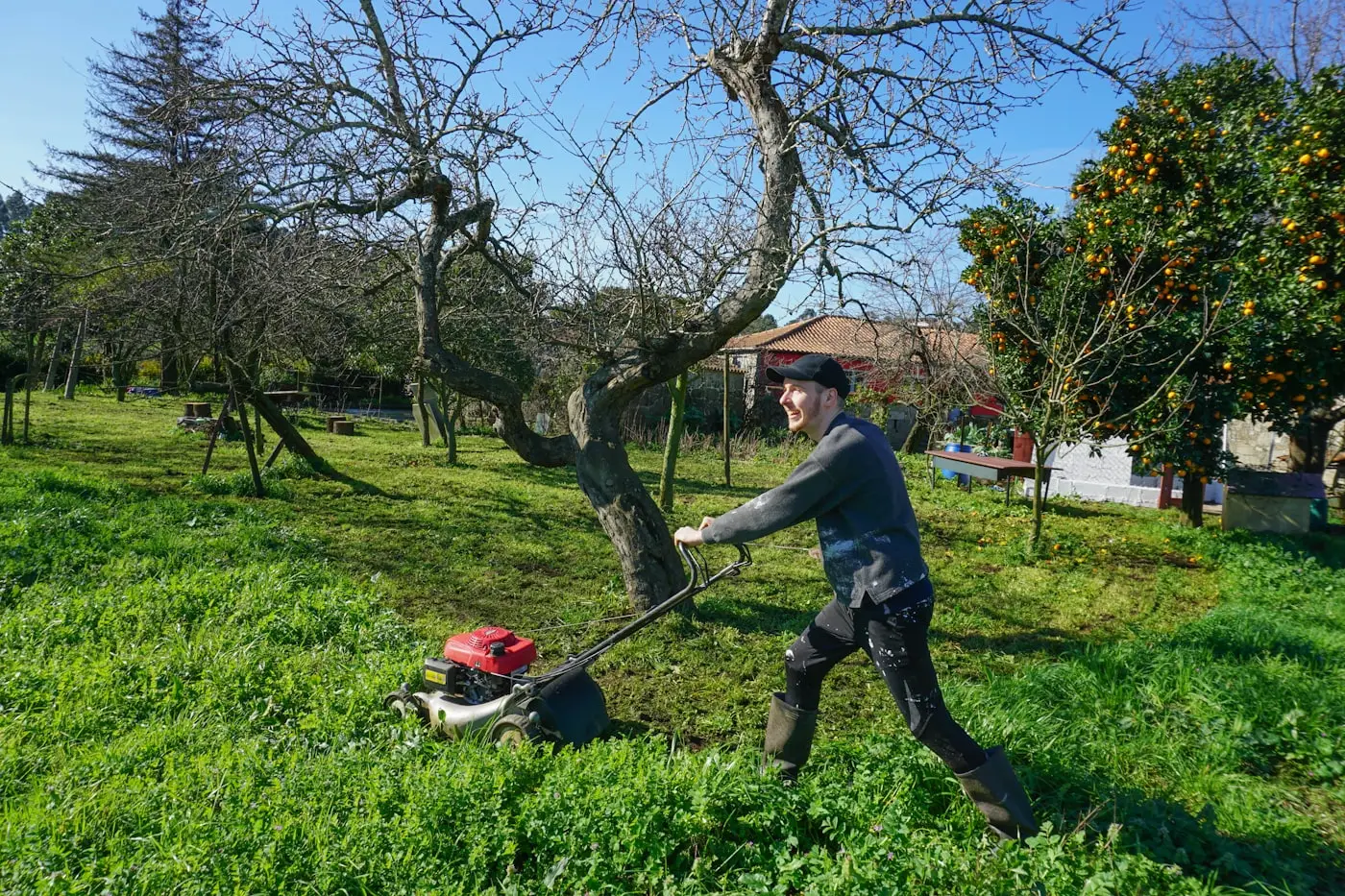
Lawn care on difficult terrain is the defining challenge for many Keighley gardens. Mowing a hillside garden safely and effectively is a skilled task - a standard walk-behind mower is not appropriate on steep slopes, and the access to many terrace back gardens means large equipment cannot be brought in at all. Self-propelled mowers with good grip, hover mowers for steeper faces, and hand tools for the areas machinery cannot reach are the equipment of choice in Keighley's challenging gardens. A gardener who quotes the same price for a steep hillside garden as a flat suburban plot is either not accounting for the extra time and effort, or has not seen the site. Always get a visit before the quote. Garden maintenance on sloped gardens is priced per the difficulty of access and terrain, not just the square footage.
Moss management on acid grit soils is a persistent requirement across most Keighley lawns that do not receive active annual treatment. The very acid character of Millstone Grit soils - sometimes pH 4.5 on the exposed hilltops - creates ideal moss conditions even where drainage is excellent. On acid soils, moss does not need poor drainage to thrive: it needs only the acid pH and adequate rainfall, both of which Keighley provides reliably. The correct management sequence for a Millstone Grit lawn that is moss-dominated is: hollow-tine aeration, scarification, lime application to raise pH towards 6.0-6.5, overseeding with appropriate acid-tolerant grass varieties, and top-dressing with grit-free (or low-grit) compost to add organic matter without changing the drainage character. Lime management needs to be done on the basis of a pH test rather than a standard prescription - the starting pH on Millstone Grit soils is often so low that a single application is not sufficient, and repeating without testing can take the pH too high. The soil management guide for Yorkshire covers the broader principles of managing acid soils.
Terrace and retaining wall construction and maintenance is a specific category of work that comes up in Keighley gardens much more than in flat-ground areas. Converting a steeply sloping garden into a series of level terraces connected by steps creates usable planting and sitting areas that a slope alone does not allow. Drystone retaining walls in the local Millstone Grit are the traditional approach and tie in authentically with the character of the terrace streets and field boundaries that define this part of the Pennine foothills. Reclaimed railway sleepers are a modern alternative that is easier to work with on restricted access sites. Garden design work that incorporates terracing and steps can transform an unusable slope into a genuinely productive and beautiful garden. Garden design for hillside plots in Keighley is a distinct discipline from flat-garden design and benefits from local knowledge of what works on this terrain.
Hedge trimming across the BD21 and BD22 postcodes involves the same privet, hawthorn, and beech boundaries common across West Yorkshire, with the addition of some more recently planted ornamental hedges on newer developments. The hillside position of many properties can make hedge trimming more physically demanding - working on a slope is tiring, and scaffolding or specialist equipment may be needed for tall hedges on steeply sloping ground. Hedge trimming pricing in Keighley should account for this; a gardener who quotes the same as for a flat-ground equivalent without visiting has not accounted for the site conditions.
Garden clearance on Keighley's hillside terrace gardens is among the most physically demanding garden work in West Yorkshire. All material has to be removed by hand through a narrow gate, often up or down steps, and sometimes involving a significant carry to the vehicle. The Millstone Grit soil, while thinner than clay, holds bramble and elder roots tenaciously in the rock fissures and can surprise you with how difficult removal actually is. Garden clearance pricing must reflect the access conditions, and a proper in-person assessment is essential before quoting.
Weed control on the acid Millstone Grit soils involves some weeds not common elsewhere in Yorkshire. Bilberry and heather self-seed readily from the moorland above on garden soil of similar acid character, and while these are attractive plants in the right context, they can be invasive in a garden border if not managed. Bracken is the weed that causes most problems - it spreads by underground rhizome, is highly persistent, and is very difficult to eradicate once established. Repeated cutting weakens it over multiple seasons, but complete removal from a garden border usually requires targeted herbicide application to the fronds when they are fully open in summer. The weed control guide for Yorkshire covers the management approaches for persistent weeds.
How Much Does a Gardener Cost in Keighley?
Keighley rates broadly follow the West Yorkshire suburban band, with a premium on hillside and difficult-access gardens reflecting the extra time and physical effort required. For full context, see the how much does a gardener cost guide and the gardener cost Yorkshire guide.
| Rate type | Keighley (BD21-22), 2026 | Notes |
|---|---|---|
| Hourly rate (maintenance) | £25-£40/hr | Flat-access gardens lower; hillside terrace gardens higher |
| Day rate (7-8 hrs) | £150-£200 | Full working day for clearance or renovation |
| Fortnightly maintenance visit | £40-£75 per visit | Hillside and difficult-access gardens at higher end |
| Lawn renovation (aeration, scarification, overseed, lime) | £120-£280 | Lime application often needed on Millstone Grit acid soils |
| Hedge trimming (standard domestic) | £45-£95 per visit | Hillside access or tall hedges at higher end |
| Garden clearance (medium plot) | £200-£400 | Difficult terrace access or bracken/bramble: £400-£700 |
| Terrace/retaining wall (drystone) | £300-£800 per metre run | Material and installation; drystone traditional to the area |
The hillside premium on maintenance and clearance work in Keighley is real and justified. A garden that takes twice as long to mow because of slope, access, and equipment limitations costs twice as much to maintain, regardless of its square footage. Getting a site visit before agreeing a maintenance schedule is important in Keighley in a way it is not always necessary in flat-ground areas.
Finding a Reliable Gardener in Keighley
Keighley has a reasonable number of gardeners covering BD21 and BD22, but the hillside garden experience is specific - not every gardener who can manage a flat suburban plot is equipped, physically and in terms of experience, for the terrace yards and hillside gardens that characterise much of the town. The right gardener for a flat Riddlesden property may not be the right gardener for a steep Keighley hilltop terrace.
Personal recommendation from someone in a similar position - on a similar slope, with similar access conditions - is the most reliable starting point. If you are in a terrace street and your neighbour's back yard looks well-maintained, finding out who they use is worth the conversation. A local introduction service that specifically covers BD21 and BD22 and understands the hillside garden context is the next best option for those without a direct contact.
Before committing, the standard questions apply, plus some specific to Keighley:
- Can you show me your public liability insurance certificate?
- Do you hold a Waste Carrier's Licence?
- Have you worked with Millstone Grit acid soils and hillside gardens in the BD21 and BD22 area?
- What equipment do you use on steep-slope gardens - do you have a self-propelled mower, a hover mower, or both?
- For a terrace yard with narrow gate access, do you visit before quoting, and is the access factor built into your pricing?
- Do you have experience with the shorter growing season at higher elevations in the Worth Valley?
A gardener who answers the equipment and access questions specifically and confidently, rather than generically, has almost certainly done this kind of work before. One who is vague about what they will use on a steep slope has probably not, and that is worth knowing before they start.
Seasonal Guide for Keighley Gardens
The Worth Valley growing season is genuinely shorter than lower West Yorkshire, and gardening advice that is calibrated for the Vale of York or the lower Aire Valley will be systematically too early in its timing for Keighley gardens at higher elevation. The adjustments are real and practical.
Spring (March to May)
March in Keighley is a planning month, not a working month for most gardens. The Millstone Grit soils warm slowly after winter, and the Pennine wind exposure means the effective start of useful spring weather is later here than forecasts for the Bradford area might suggest. Border tidying from late March is possible in sheltered valley-floor positions; hilltop terrace gardens may not be ready for productive work until mid-April.
April is when spring work begins in earnest on most Keighley gardens. The first cut of the season is typically late April on established lawns at valley-floor level, and early May on the hilltop gardens. Structural pruning that was deferred from autumn happens in early April before growth starts. Hardy perennial planting can happen through April in sheltered positions; exposed hillside gardens should wait until late April or early May.
May is the main spring month for most Keighley garden work. Grass growth is well established by mid-May, fortnightly grass cutting begins, and tender bedding plants can go out in late May when the last of the Pennine late frosts has passed. In exposed hilltop positions, the last frost risk can extend into the first week of June in an unfavourable year - local knowledge is more reliable than the standard RHS frost date maps for this specific microclimate.
Summer (June to August)
June and July are the best growing months in Keighley, with long daylight hours that partially compensate for the shorter growing season. Grass grows vigorously in this period and fortnightly mowing keeps pace with most lawn growth rates; hillside gardens exposed to wind dry out faster than sheltered positions and may need less frequent mowing in dry spells. Border plants that were held back by the late spring will often put on significant growth in June, catching up with the same plants at lower altitude.
The Pennine rainfall pattern means Keighley gardens rarely suffer the drought stress that affects drier eastern Yorkshire in summer. Westerly fronts bring reliable rainfall through the growing season, and the Millstone Grit's fast drainage means that even after heavy rain the soil dries out quickly - genuinely waterlogged conditions are less common in summer at this elevation than the clay valley floors below. The challenge is maintaining adequate moisture for plants in dry easterly spells, when the Pennine barrier keeps the westerly rain away and the thin, fast-draining grit soil dries quickly.
August is booking month for autumn renovation. September aeration and scarification slots fill quickly, and the shorter growing season in Keighley means the window for effective overseeding closes earlier here - by early October at the latest on exposed hilltop positions, because soil temperature drops faster at elevation than in the valley.
Autumn (September to October)
September is the critical month for lawn renovation in Keighley, and this timing is more urgent here than in lower West Yorkshire because the effective window closes earlier. Hollow-tine aeration in early September, combined with lawn scarification, lime application to adjust the pH, and overseeding with an appropriate acid-tolerant grass mix, gives new grass seedlings the best chance of establishing before soil temperature drops below the threshold for root activity. By mid-October on exposed hillside gardens, soil temperature at depth can be too low for new grass establishment. Book in August.
October is the month for bulb planting and border replanting. Hardy bulbs establish well in the fast-draining Millstone Grit soil and perform better year after year than in heavy clay. Tulips in particular appreciate the drainage. Perennial border plants that were planted in autumn will establish root systems through the mild periods before winter sets in, ready for strong spring growth.
Winter (November to February)
Keighley winters are real winters at the higher elevations. The hilltop terrace gardens can experience significantly more frost, snow, and wind than the valley floor, and plants that are rated as marginally hardy for West Yorkshire will not survive on exposed hilltop positions in a cold year. February is the time for garden bookings - the growing season at Keighley's elevation starts later than lower Yorkshire, but gardeners covering BD21 and BD22 fill their rounds from late winter regardless, and making contact in February gives you the best access to available capacity.
Common Garden Problems in Keighley
Acid soil and moss domination
The Millstone Grit's natural acidity means that moss in Keighley lawns is not just a drainage or shade problem - it is a pH problem that persists regardless of how well you drain and aerate the soil. Without lime management to raise the pH towards 6.0-6.5, fine lawn grass will never compete effectively with moss on the more acid hilltop soils. A dedicated moss treatment programme alongside lime application addresses the chemical side of the problem, while hollow-tine aeration and scarification deal with the physical thatch. The fix requires a soil pH test, a lime application calculated to the measured deficit rather than a standard dose, and an annual maintenance programme that includes pH monitoring over several seasons. See the lawn care Yorkshire guide for more on what effective lawn management involves in this region.
Hillside erosion
Any bare or sparsely planted ground on a Keighley hillside will erode in heavy rain. The thin Millstone Grit soils have limited capacity to absorb rapid rainfall, and on any gradient, surface water runs off rather than soaking in. The result is soil movement, gully formation, and the gradual loss of the thin topsoil layer. Keeping slopes covered with vigorous ground cover plants, close-mown grass, or retaining the slope with terracing are the practical responses. A bare slope in Keighley is never safe to leave bare for long.
Wind exposure on hilltop gardens
Exposed hilltop gardens in the Worth Valley experience regular strong westerly winds that damage soft, tall plants, break hollow stems, and desiccate foliage in winter. Plant selection for exposed Keighley positions should prioritise compact, wind-tolerant species: ornamental grasses that move rather than break in wind, low-growing heathers, compact shrubs such as escallonia and potentilla, and ground-hugging perennials that stay below the wind's worst effects. Staking of tall border plants is essential in exposed positions. A windbreak planting - a hedge or robust mixed shrub planting on the windward side - that provides shelter without blocking the view is one of the most valuable garden investments in an exposed Keighley hilltop garden.
Frequently Asked Questions
How do I find a reliable gardener in Keighley?
Personal recommendation from a neighbour with a similar hillside garden is strongest. A local introduction service covering BD21 and BD22 specifically is more useful than a national platform. Ask about hillside access experience, acid soil management, and growing-season timing at Worth Valley elevations. See the garden maintenance near me Yorkshire guide for vetting principles.
How much does a gardener in Keighley charge?
Hourly rates run £25-£40 for garden maintenance, with hillside and terrace-access gardens at the higher end. Fortnightly visits for a medium garden are £40-£75. Lawn renovation including lime application runs £120-£280. Day rates for clearance run £175-£300. See the gardener cost Yorkshire guide for broader context.
What soil do Keighley gardens have?
Millstone Grit acid soils - thin, fast-draining, naturally very acid (pH 4.5-5.5 in many hilltop positions), low in nutrients. Valley-floor gardens along the Worth are slightly heavier. The acid character is ideal for moorland plants and heathers, challenging for fine lawn grass without pH management.
Does the growing season start later in Keighley than in Bradford?
Yes, by one to two weeks at valley-floor level and two to three weeks on exposed hilltop positions. First mowing is typically late April to early May rather than mid-April. Autumn renovation should be completed by early October on hilltop gardens rather than late October. Local knowledge of the specific elevation timing matters.
How do I manage a sloped or terraced garden in Keighley?
Self-propelled mowers and hover mowers for slopes, hand tools for areas machinery cannot reach, and drystone or sleeper retaining walls to create level terraces on the steepest ground. A garden that has been terraced is more useful, more manageable, and often more visually interesting than an unbroken slope. Garden makeovers that incorporate terracing are one of the most value-adding transformations available on Keighley's hillside plots.
Can I get a garden clearance in Keighley?
Yes. Garden clearance runs £200-£400 for a standard medium garden. Terrace yards with narrow gate access, steep gradients, or established bracken and bramble can run £400-£700. In-person assessment before quoting is essential for any difficult-access property.
What are the main garden problems in Keighley?
Acid soil causing persistent moss in lawns without pH management; hillside erosion on any bare or sparsely-planted slopes; wind exposure on hilltop gardens requiring specific wind-tolerant plant selection; and a shorter growing season that requires adjusted timing for renovation, planting, and season-end work. The weed control guide for Yorkshire covers bracken management in detail.
Related reading
- How much does a gardener cost in the UK? (2026 prices)
- Gardener costs in Yorkshire
- Lawn care across Yorkshire
- Weed control in Yorkshire gardens
- Garden maintenance near me - Yorkshire
- Garden maintenance across Yorkshire
- Garden clearance across Yorkshire
- Garden makeovers across Yorkshire
Gardeners in other West Yorkshire areas
We cover West Yorkshire and beyond:
For structural landscaping or a full redesign, see our garden design Keighley page.
Get a quote for your Keighley garden.
60-second assessment. If a local gardener takes your enquiry, they call you with a price for your specific garden and job.
Start the assessment